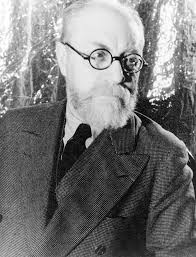
While the avant-garde was busy robbing the viewer of his composure — shaking him awake, prying him loose from the saccharine cherubs of salon painting and marching him out into unvarnished reality — the French painter Henri Matisse announced: "I simply want a tired man, looking at my painting, to taste rest and peace." Does anyone still care, frankly, about a man desperately weary of this "beautiful and furious world"? And would anyone offer him "luxury, calm, and pleasure" without lapsing into the cheap flirtations of salon art? Someone would — and would do it as, arguably, no one has managed before or since. Henri Matisse.
"He Will Simplify Painting!"
The son of a grain merchant and a milliner was marked out for the law. So he liked to draw — everyone likes something or other; a man should take up work that leads somewhere. Such was his father's view, and Henri had nothing to set against it. Chance intervened in the form of appendicitis, removed when Matisse was twenty-one. He came through the operation badly and was long in recovering. To amuse her son, his mother brought him a box of paints and a sketchbook. "When I started to paint, I felt I had entered a kind of paradise," Matisse later recalled. Even his father unexpectedly relented — someone had whispered to him that the boy might study under Bouguereau himself!
To Émile Matisse the salon painter seemed an Olympian deity, so he furnished his son with the means to move to Paris, where Henri was to prepare for the École des Beaux-Arts in the studio of William Bouguereau. Raymond Escholier, author of a monograph on Matisse, calls Bouguereau "a fat Bordelais, pink as a piglet." The antipathy between Bouguereau and Matisse was instant and mutual. To his father's great disappointment, Henri left the studio and continued his preparation at the School of Decorative Arts. Into the holy of holies, the École des Beaux-Arts, he was never admitted — but he did find his first real teacher, Gustave Moreau. Moreau sent his students to the Louvre to copy the classics and build technique, told them that "one must dream of color," and predicted that Matisse would "simplify painting."
In 1898 several momentous things happened in the artist's life at once. His teacher Gustave Moreau died — and Matisse promptly left the school. He married the beautiful Amélie Parayre and went off on a honeymoon to London. Why London? To see Turner, of course. In the Louvre Matisse had come to know the classics; now it was time to study the man who bridged classicism and Impressionism.
Impressionism — or rather Neo-Impressionism — was an important stage in the master's formation. He worked at color; he tried the technique of Pointillism. But he would not stay there long. His task was to set color absolutely free, to hand it the leading role and throw out the details. That happened in 1905, with the pivotal picture that raised a storm and marked the birth of the art of the "wild beasts": "Woman with a Hat."
It was the critic Louis Vauxcelles who called the young French painters' work "wild" (fauve), and he entered history as the coiner of "Fauvism," the name of a movement that put color and decorative force above all else. Derain and Vlaminck showed alongside Matisse at that Salon d'Automne.
Matisse's Travels
Fame came to Matisse quickly; money did not. Only his acquaintance with the Russian patrons and collectors Sergei Shchukin and Ivan Morozov lifted him out of poverty — for good.
In 1908 Shchukin, a connoisseur of fine discrimination, commissioned two panels from him to adorn his Moscow mansion. That is when the first painting by Matisse to bear the title "Dance" appeared. Shchukin invited the French painter to Russia, where the master was utterly overwhelmed by Russian icons.
Odalisques, arabesques, and the other Eastern motifs are the harvest of the winters of 1911–1913, spent in Morocco. Matisse's odalisques bear comparison with those of Ingres. In the East the artist outgrew the confines of Fauvism, though he remained loyal to its essentials forever. His paintings now became less strident, less demonstrative; depth and subtlety came in their place.
At the end of 1917 the master arrived in Nice. How many artists, in any art whatever, can paint the face of happiness without slipping into treacle? Matisse could. Nice, which he would love for the rest of his life, is immortalized in blazing color and light, in the blue of a bottomless sky, and in the endless, famous "open windows."
In Gauguin's footsteps Matisse set out for Oceania. He too hoped to find a Tahitian paradise... In vain. He spent three months there, drinking in the equatorial light ("There it is pure gold, while ours is silver...") and coming to see that painting there was impossible — Tahiti and work were antonyms. Matisse concluded that paradise on earth can be made only by a painter, in his pictures.
After Oceania came the United States. Dr. Albert Barnes, the famous collector, commissioned an enormous panel for his center in Merion, leaving the choice of subject to the artist. True to himself, Matisse chose to paint dance once more. Working on the thirteen-meter panel he used, for the first time, the technique of the paper cut-out — shifting figures scissored from colored paper across the surface until the whole felt complete.
On Rest for the Tired
Matisse was free of the snobbery common to academicians and avant-gardists alike. He was not one to hand the prospective viewer a long list of sentences each beginning "you must." It was art itself, he believed, that "must" be intelligible and open to anyone. A rare attitude in a painter toward his public, is it not? "Art should not trouble or disturb. I have no theory." To give a tired man his rest — that is a task worth having. The man who knew how to paint happiness, and painted it into every canvas, had earned the right to say so: such a painter was Henri Matisse.
Incidentally, on Happiness in the Painter's Life
The master's marriage was made for love, and it could be summed up in the words "Amélie tried very hard." The Matisses had two sons; Marguerite, the painter's daughter born to one of his models before he met Amélie, lived with the family as well. Amélie dreamed of helping her husband in everything, of standing beside him; she wanted "we" to sound both in his art and in their home. So it was at first — but in time she understood that she would never hold a place in her husband's heart even equal to the one held by painting. And when his work went badly, no one within range was spared... His absorption in his "odalisques" did the marriage no good either.
When, in 1932, a candidate for the post of assistant and secretary crossed their threshold — a Russian émigrée, Lydia Delectorskaya — Madame Matisse was perfectly serene: the fair-haired, blue-eyed Lydia was not his type at all. The painter had always preferred brunettes; Amélie herself was one, and so were the countless "odalisques." When, some time later, Madame Matisse needed a companion and nurse, it was she who remembered the Russian. Lydia cared for her while Amélie complained of the widening rift with her husband. One day Matisse came into his wife's room, said something, asked something, his gaze sliding over Lydia in the usual way — and suddenly: "Don't move!" He went for his sketchbook and began to draw. It was as though he were seeing her for the first time; and Madame Matisse, for the first time, sensed danger in the presence of this blue-eyed beauty.
...The artist's wife looked at Lydia's portrait for a long, long time in silence. Then she said quietly: "Her or me." Henri Matisse chose his family. Lydia left. And the painter found he could no longer do without her. Lydia returned — and then it was Amélie who left. They divorced in 1940. Lydia stayed at his side to his last day. "For twenty years I was the light of his eyes, and he was the meaning of my life," she remembered. When they met, Lydia was twenty-two; Matisse was sixty-two.
The Chapel of the Rosary — and What Led to It
On canvas he conveyed nothing but joy; in life the French painter met pain, physical and spiritual alike. During the Second World War his daughter Marguerite, a member of the French Resistance, was deported to a concentration camp in Germany, and Madame Matisse was sentenced to six months in prison for printing leaflets. Matisse himself spent the war years in Vence, half-mad with worry for his family. All of them survived.
In 1941 he underwent a grave operation: intestinal cancer. It later emerged that his chances of a good outcome had been slim indeed. Matisse asked the doctor to grant him another three or four years — there were so many plans to see through! He lived another thirteen. During his illness he was nursed by a nun, who asked him to touch up her sketches for the stained glass of the convent's Chapel of the Rosary in Vence. Matisse took this for a sign and went on to design the chapel's entire decoration himself. "Do I believe in God? Yes — when I work!" he declared. When his health no longer let him stand at the canvas, he fixed a stick of charcoal to a pole and worked that way. He counted the chapel his chief achievement and a dream come true.
On November 1, 1954, the French painter suffered a slight stroke. The next day — the second-to-last of his life — Lydia Delectorskaya, the light of his eyes, came to him in a tall turban and, looking at the wasted Matisse, joked with sadness and infinite tenderness: "Any other day you would have said: hand me pencil and paper." The master smiled and commanded: "Hand me pencil and paper."