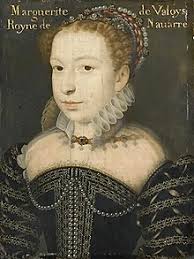
Marguerite of Navarre was born on 11 April 1492 at Angoulême, France, of the Angoulême branch of the House of Valois — sister of the French king Francis I. She was brought up at Amboise, studied Latin and French literature, and was taught Spanish and Italian besides. In August 1508 she moved with her brother to the court of Louis XII. Among the husbands proposed for her were the future English king Henry VIII and Charles of Austria, Count of Flanders.
Louis XII decided to marry her to Duke Charles IV of Alençon. The marriage took place in October 1509, Marguerite bringing a dowry of sixty thousand livres. For the first five years of the marriage she lived in her duchy of Alençon, while her husband campaigned on various military expeditions and rarely saw his wife. He died of pleurisy in her arms at Lyon, soon after the defeat at the Battle of Pavia in April 1525.
Deeply devoted to her brother, Marguerite traveled to Madrid in the summer of 1525 to plead for his release after the defeat at Pavia.
In January 1527, this time by her own choice, she married the young Henry d'Albret, King of Navarre. The wedding was celebrated in state at Saint-Germain-en-Laye and lasted eight days. She lived with her husband at Fontainebleau and in Paris. Their daughter Jeanne d'Albret, mother of the future king Henry IV, was born in 1528; a son, Jean, born at Blois in 1530, died at Alençon that Christmas, aged five and a half months.
Finding no happiness in marriage, and denied any part in raising her daughter — from the age of two, at the wish of King Francis I, the girl was brought up away from her parents at Plessis-lès-Tours — Marguerite gave herself entirely to literature and religion. Her outlook owed much to the Protestants Lefèvre d'Étaples and Guillaume Briçonnet, Bishop of Meaux, with whom she kept up a correspondence.
Marguerite's court was an important center of French humanism. She was patron to Guillaume Budé, Clément Marot, Des Périers, and other men of letters; she herself knew Latin (and possibly Greek) and exercised great influence over many of the outstanding figures of her day — in this she anticipated the hostesses of the literary salons of the seventeenth and eighteenth centuries.
After her brother's death in 1547 Marguerite withdrew to the convent at Tusson, where for four months she led a life of the utmost austerity, performing the duties of an abbess. In October 1548 she was present at Moulins for her daughter's wedding to Antoine de Bourbon.
She died at Odos on 21 December 1549, after an illness of twenty days, and at her husband's wish was buried with honors in the cathedral of Lescar, near the château of Pau.
Her writings reflect the intense religious and ethical searching that marked her, joining a meditative and at times mystical cast of mind to a certain dryness of style.
Publications
The Mirror of the Sinful Soul, a poem (1531); Dialogue in the Form of a Nocturnal Vision (1524, published 1533); The Ship (1547); The Comedy Played at Mont-de-Marsan (1548); an extensive correspondence with her brother and others (published 1841); The Invalid, a farce (1535–1536); Pearls of the Pearl of Princesses (1547); The Heptameron (1558; the complete version, free of ideological cuts, appeared only in 1853).