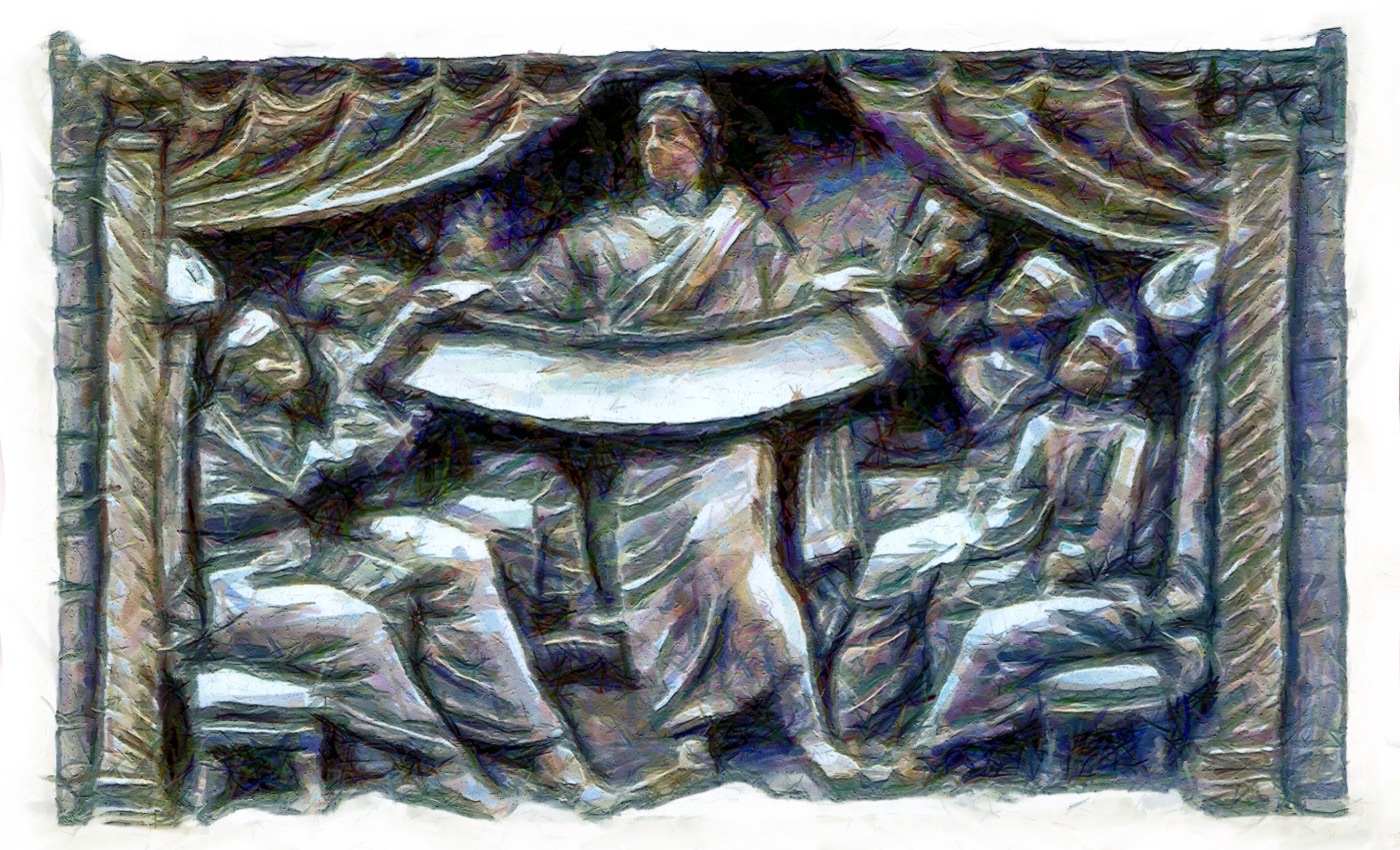
Marcion was born around the year 85 in Sinope on the Black Sea, the son of the bishop of the Sinope church. He himself was a shipowner, wealthy and energetic. Around 140 he arrived in Rome and made a generous donation — 200,000 sesterces. But his teaching proved unacceptable: in 144 the Roman church excommunicated Marcion and returned his money. From that moment he founded a church of his own, with a hierarchy, a liturgy, and communities across the empire.
His central thesis was radical: the God of the Old Testament and the God of Jesus Christ are two different gods. The God of the Old Testament — the Demiurge, maker of the material world — is just, but cruel and limited; he created an imperfect world and gave a Law founded on fear. The Father proclaimed by Jesus is the higher God, previously unknown, a God of love and mercy with no part in creation. Christ came not to fulfill the Law but to abolish it. It matters that Marcion was no Gnostic — he built no mythological systems of aeons and pleroma. Two gods, and that was that.
He compiled the first canon of Christian Scripture in history. The Evangelikon was a shortened version of the Gospel of Luke, with everything linking Jesus to the Old Testament removed, including the nativity narrative. The Apostolikon comprised ten epistles of Paul, without the Pastorals. The entire Old Testament was rejected outright. For Marcion, Paul was the one apostle who had understood Christ rightly; the rest had lapsed into Judaizing.
His chief opponent was Tertullian, whose five-book treatise Adversus Marcionem (around 208) argues in its first three books that the God of the Jews and the God of the Christians are one. Justin Martyr, Irenaeus of Lyon, and Ephrem the Syrian also wrote against him. The Marcionite church survived in Syria and Mesopotamia until the tenth century.
His significance is paradoxical. It was precisely Marcion’s attempt to create a purified canon that forced the Church to think about its own. Without Marcion, the New Testament in its present form — four Gospels, Acts, the epistles, Revelation — might never have taken shape, or would have done so later. Harnack called Marcion the first Protestant, for his drive to purge the faith of accretions. And the Marcionite impulse — to cast off the Old Testament and keep only the God of love — returns again and again in the history of Christian thought.