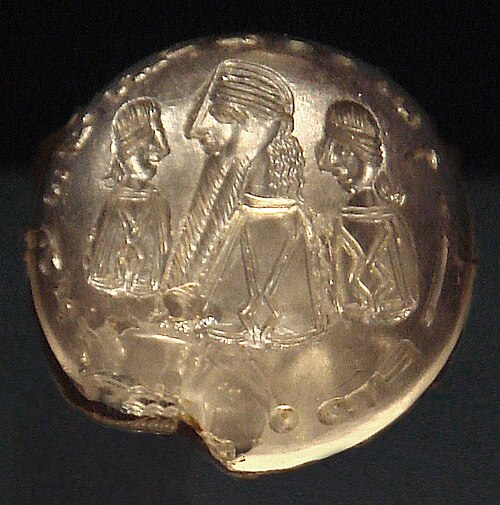
Mani was born around 216 AD in Babylonia, not far from Ctesiphon — the capital of the Parthian and later the Sasanian kingdom. His father, Patik, was a member of a Judeo-Christian baptismal sect, the Elchasaites, who believed in ritual purification and a strict diet. Mani grew up in this sect, but already in his youth he felt that it gave no answer to the central question: why is there evil in the world, if God is good? The question that has divided philosophers and theologians for millennia he resolved to rebuild from scratch.
At the age of twelve a "heavenly twin" appeared to him — al-Tawm in Aramaic, his spiritual alter ego. The vision said: not yet. At the age of twenty-four the apparition returned: now. Mani broke with his father's sect and began to build his own teaching — Manichaeism. He deliberately built a world religion: he wove into it elements of Zoroastrianism, Christianity, and Buddhism, composed sacred texts in several languages, and prepared preachers for every quarter of the earth.
The answer to the question of evil was given firmly and without loopholes. The universe is divided from the outset into two eternal and equal principles: the Kingdom of Light (the good Father) and the Kingdom of Darkness. Evil exists not because God permits it or tests us with it — evil simply has its own god, equal in power. The material world arose from the invasion of Light by Darkness; every human being carries within a spark of Light captured by matter. The meaning of life is the liberation of that spark through asceticism and knowledge.
Mani was not only a prophet but also an artist. He personally illustrated his sacred books with such refinement that his name later became a synonym for a painter of icons in medieval Persian. He wrote seven canonical books in Aramaic and Middle Persian; most are lost, and only fragments and quotations survive in the polemical writings of his opponents. His teaching spread from Egypt to China through the preachers he systematically trained and dispatched.
The Sasanian kings at first received Mani at court. Shapur I (241–272) and his son Hormizd I (272–273) extended their patronage — the new religion did not threaten the state. But Bahram I (273–274) gave way to pressure from the Zoroastrian priesthood. Mani was arrested, thrown into prison, and died in custody around 276–277. His body, according to tradition, was displayed at the city gates. His disciples shaped this into a symbol of sacrifice — consciously parallel to the crucifixion.
Manichaeism outlived its founder by a thousand years. In the west it penetrated North Africa, where the young Augustine of Hippo was its "hearer" (auditor) for some nine years before he converted to Christianity and wrote the "Confessions" — in part as a polemic against dualism. In the east Manichaeism spread through Central Asia as far as China: in Fujian province Manichaean temples still existed in the 13th and 14th centuries. In the Middle Ages, now without any direct link to the source, a similar dualism reappeared in the teaching of the Bogomils and the Cathars.
Mani built a system in which evil is neither explained nor justified but acknowledged as an equal participant in the order of the world. Such an answer satisfied many precisely because it did not lie: there is too much evil in the world to explain it as a "trial" or a "permission." Dualism is more honest — and for that very reason more dangerous to monotheistic systems. It was rooted out by Zoroastrian priests, by the Christian church, and by Islam — and still it returned in different guises, because the question it answers never goes away.