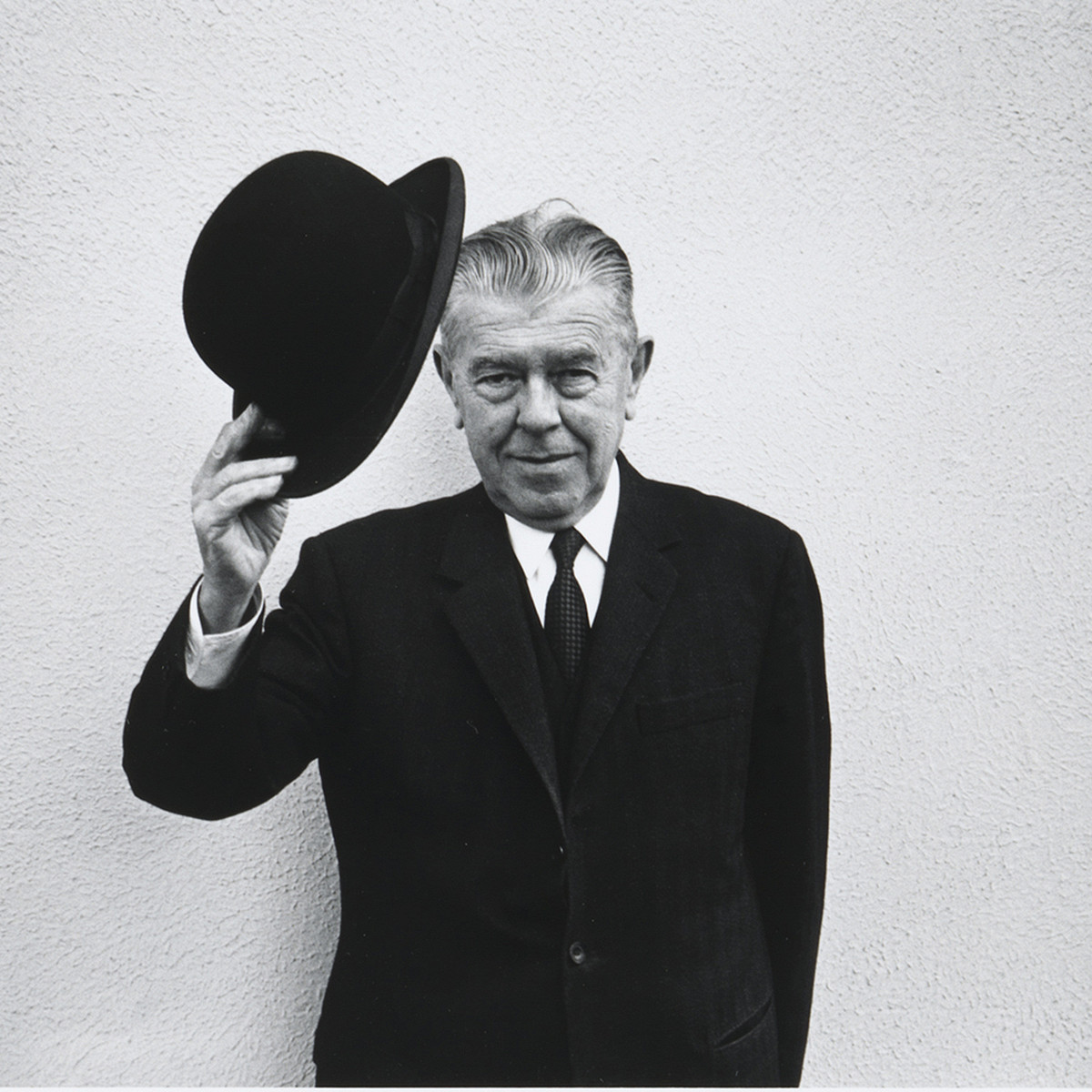
Rene Magritte (French: René François Ghislain Magritte; 21 November 1898, Lessines, Belgium – 15 August 1967, Lessines, Belgium) was a Belgian painter whose fame rests on surrealist canvases dense with riddles. He was born in Belgium and spent nearly his whole life there, leading a plain and quiet existence. When the future artist was thirteen, his mother took her own life, and the loss left its mark on his work. His friendship with the French surrealists gathered around Andre Breton shaped him too. He never explained what his paintings meant, and they remain the object of close study and interpretation to this day.
From 1926 onward Magritte painted surrealist canvases, each harbouring some hidden sense. A recurring figure is the man in the bowler hat — Magritte himself is thought to be the prototype — often shown without a face. In later years the painter frequently disowned surrealism altogether, insisting that his style was rather a kind of "magical realism."
Among his best-known paintings: The Son of Man, Golconda, The Lovers, The Treachery of Images (This Is Not a Pipe), The Lost Jockey.
Had Rene Magritte not chosen a painter's career, he would surely have become a conjuror. His entire body of work is one long sequence of tricks and illusions, substitutions and riddles, transformations and secret meanings — and many of his canvases contain outright allusions to the illusionist's art. One senses that all his life two impulses fought within him: the urge to dazzle and astonish a public, and the desire to remain invisible. The second won; the first simply found another outlet.
For most of his life Magritte took care never to step outside the part of an unremarkable man. He wore inconspicuous clothes, lived in a tidy little house with porcelain geese on the mantelpiece, and painted right in the dining room without once spilling paint on the floor. Meanwhile he spent years denying any connection whatever with the surrealists, maintaining that he painted in the genre of "magical realism." His unbridled appetite for spectacular puzzles broke through only when he picked up a brush. That was Rene Magritte's principal trick.
Rescue from the water. Magritte was born on 21 November 1898 in the small Belgian town of Lessines, into a family notable for nothing in particular. Indeed "notable for nothing" could describe almost the whole of the artist's life, apart from a few striking episodes and everything he painted — a genuine problem for the hacks who tried to dig up some scandalous morsel in his biography. At last they succeeded: at a certain point the childhood tragedy came to light.
For a long time even his wife did not know that Magritte's mother had killed herself. He carefully steered every conversation around the sad fact — and apparently with reason, for once the circumstances of her death became public property, devotees of psychoanalysis (which Magritte, incidentally, could not stand and mocked at every opportunity) began to detect an allusion to it in nearly every picture he made.
However that may be, on the night of 12 March 1912 Regina Magritte walked out of the house in Charleroi wearing only a nightdress and vanished. She had attempted suicide several times before; her husband had even taken to locking her in her room. The search lasted several days, until her body was found in the river Sambre. The water had pitilessly stripped her bare, winding the hem of her shift around her head. This is held to be the reason why, in certain Magritte paintings, faces are shrouded in cloth (The Lovers, 1928; The Heart of the Matter, 1928; The Invention of Life, 1928). The same source is claimed for his famous "mermaids in reverse" — creatures with the heads of fish and the legs of women (Collective Invention, 1934; The Song of Love, 1948). The artist himself insisted his mother's death had no such power over him. He said that when her body was found he even felt a certain gladness, because the sad event made their family famous in the neighbourhood. For the rest, Magritte admitted, his childhood held plenty of other events that shaped his art — though what those events were, he kept enigmatically to himself.
The woman in the box. Not long after his mother's death Rene met the person destined to matter most in his life. Georgette Berger, thirteen years old, was a butcher's daughter in Charleroi. The two adolescents spent all their free time together. On one of their walks through an abandoned cemetery, Rene and Georgette came upon a painter at his easel. The boy stood transfixed: he had never before seen an artist at work. As Magritte later confessed, it was at that moment he resolved to become a painter.
The childishly innocent romance did not last: Georgette's parents parted the sweethearts by moving to Brussels. A few years later Magritte too went to the capital, where he spent two years at the Royal Academy of Fine Arts. And on a foggy day in 1920 Georgette simply ran into him in the street. Fate, evidently, is also fond of conjuring tricks. The youthful love had not gone anywhere; Magritte firmly resolved to marry her — though he managed it only after serving in the army.
Magritte married Georgette in June 1922. She became his chief muse: he maintained that every female face on his canvases was painted from his wife. From then on they were never parted until his death — or almost never. In 1936 Magritte was suddenly taken with the performance enthusiast Sheila Legge, and Georgette, in retaliation, began an affair with his friend the artist Paul Colinet. The couple were finally reunited only in 1940.
That small scandalous episode is perhaps the only thing that strays outside the biography of the upstanding citizen Rene Magritte. He and Georgette lived in a pretty little house in a quiet quarter of Brussels and were hardly ever seen in society. The artist disliked travel and rarely left home at all. The house contained no purpose-built studio; he painted right in the living room, strictly by the clock, always breaking for lunch. Many painters, the kind who forget the world while they work, would have bristled at such sacrilege.
The man without a face and the dove up the sleeve. Most conjurors hide their true face from the public: they draw the eye away with bright scarves, flying playing cards, pyrotechnics; they hide behind greasepaint or masks. Just so, Rene Magritte carefully concealed his private life, offering the public instead elaborate, many-layered puzzles under enigmatic titles.
The protagonist of many Magritte paintings became a faceless man in a bowler hat. Sometimes the hat simply hovers in the air above the collar of a nondescript black coat; sometimes the face is hidden behind some unexpected object — an apple, or a white dove in flight. Very often he has his back to the viewer, becoming a still greater enigma. In some degree every one of these gentlemen stripped of individuality is a self-portrait of Magritte, who all his life insisted with astonishing persistence that there was nothing special about him.
His first "illusionist" picture, The Lost Jockey, was painted in 1926, opening a series of painterly experiments with reality. Here were levitating men (The Musings of a Solitary Walker, 1926) and levitating pianos (The Happy Hand, 1953), women's bodies cut into sections (Eternal Evidence, 1930), and white doves — the obligatory prop of any self-respecting magician's act (The Healer, 1937).
During his years in Paris, from 1927 to 1930, Magritte drew close to the French surrealists led by Andre Breton. It was in this period that the images which would one day make him famous began to emerge from the dark, and the inimitable world he recreated on canvas slowly began to crystallise. Later Magritte quarrelled with Breton and ceased to count himself a surrealist, devising his own "magical realism" instead. Even during the brief "sunlit" interval of the war years — sometimes called his "Renoir period" — Magritte never abandoned his experiments with the edges of reality. He painted a man in mask and top hat, at once resembling an illusionist and the artist's childhood passion, Fantomas (The Return of the Flame, 1943), and men with cannons for heads (Cicero, 1947), a nod to the famous circus turn of the human cannonball.
In the postwar years, in a calm era filled with calm bourgeois pleasures, Magritte painted the pictures that brought him world renown: The Treachery of Images (1948), The Son of Man (1964) and Golconda (1953). He died at sixty-eight of a thoroughly "trivial" pancreatic cancer, at the side of his beloved Georgette. Rene Magritte had pulled off an inconceivable trick: he lived the most extraordinary ordinary life imaginable.