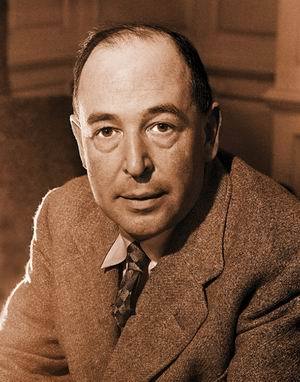
Clive Staples Lewis was an English and Irish writer, scholar, and theologian, and a leading member of the Oxford literary circle known as the Inklings. Born on 29 November 1898 in Belfast, Northern Ireland, the son of a solicitor, he spent most of his life in England. After leaving school in 1917 he entered University College, Oxford, but soon broke off his studies to serve as a junior officer in the British army. Wounded in the First World War, he was demobilized in 1918 and returned to the university to complete his degree.
In 1919, under the pseudonym Clive Hamilton, he published a volume of poems, Spirits in Bondage; a second volume of verse, Dymer, followed under the same name in 1926. He took his bachelor's degree in 1923, later a master's, and became a teacher of philology. From 1925 to 1954 he taught English language and literature at Magdalen College, Oxford.
In 1931, by his own account, Lewis became a Christian. One September evening he talked long about Christianity with J. R. R. Tolkien, a devout Catholic, and Hugo Dyson. That conversation prepared the ground for what happened the next day, which Lewis describes in Surprised by Joy: "When we (Warnie and Jack) set out (by motorcycle for Whipsnade Zoo), I did not believe that Jesus Christ is the Son of God; by the time we reached the zoo, I did."
During the Second World War he worked for the BBC's religious broadcasting service, and his book Mere Christianity grew out of those wartime talks. From 1933 to 1949 a circle of friends formed around him — the nucleus of the Inklings, the literary discussion group whose members included J. R. R. Tolkien, Warren Lewis, Hugo Dyson, Charles Williams, Dr. Robert Havard, Owen Barfield, Nevill Coghill, and others.
Between 1950 and 1955 he published The Chronicles of Narnia, which brought him worldwide fame. In 1954 he moved to Cambridge to teach English language and literature at Magdalene College, and in 1955 he became a fellow of the British Academy.
In 1956 Lewis married an American, Joy Davidman. In 1960 the two of them traveled to Greece with friends, visiting Athens, Mycenae, Rhodes, Heraklion, and Knossos. Joy died on 13 July, shortly after their return.
In 1963 heart trouble and kidney disease forced Lewis to give up teaching, and he died on 22 November of that year, having kept his Cambridge post to the end and been elected an honorary fellow of Magdalene College. He is buried in the churchyard of Holy Trinity Church in Oxford.