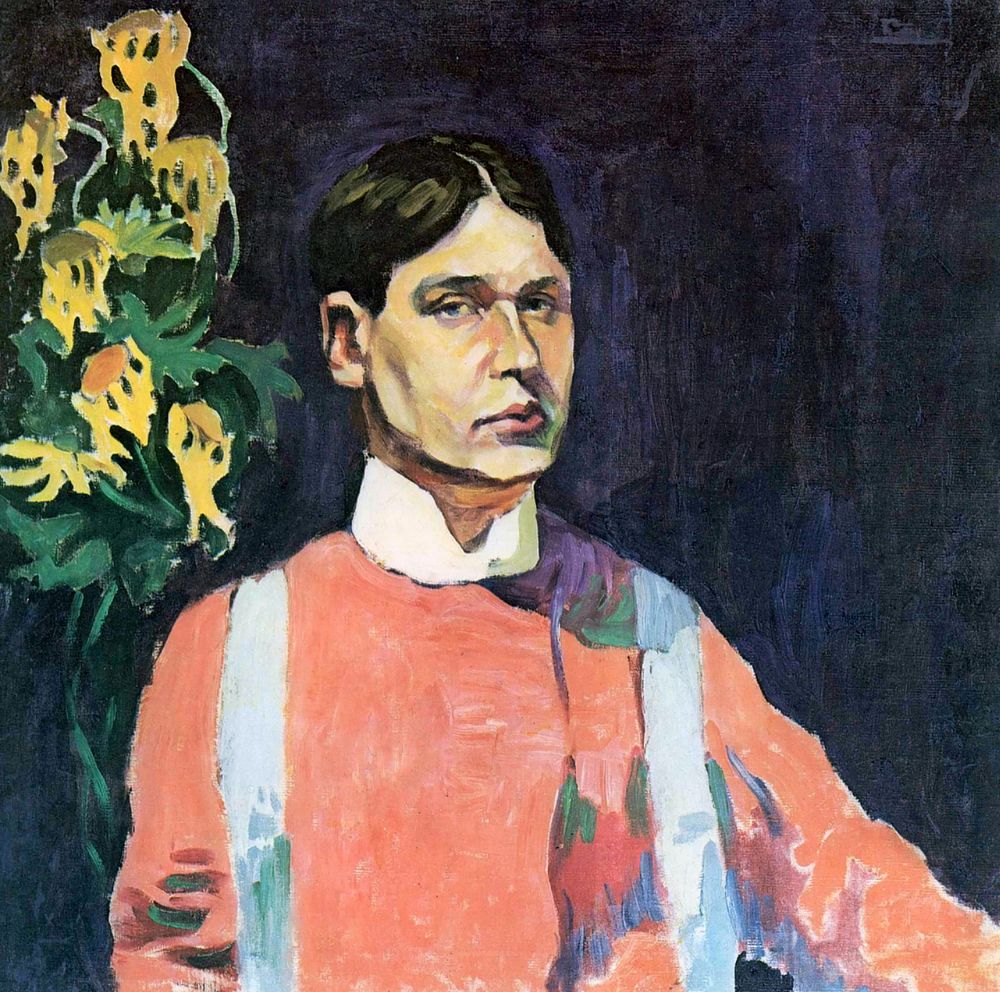
Aristarkh Lentulov, nicknamed "the painter of the sun," painted the sun all his life. Sunlight and sound are the two qualities that most distinguish his canvases. John Bowlt, the American scholar of Russian painting, holds that Lentulov matters to Russian art on the same scale that Matisse matters to the art of the world.
Young and Insolent
Lentulov was born into a priest's family in Penza Province. His father died when the boy was two, and his mother, hoping her son would carry on his work, sent him first to a church school and then to a seminary. That world held no attraction for him, though it left its mark: his sure knowledge of the Russian icon dates from those years.
He soon abandoned the seminary for the Penza Art School, and continued his studies at the art school in Kiev. Why Kiev did not work out is usually put delicately — his insolent temper got him expelled. That temper deserves a closer look. Lentulov once took it upon himself to "correct and embellish" a study by his instructor Seleznev; the logical sequel was a farewell to Kiev and a return to the Penza school, which he finished successfully (presumably without further attempts to teach his teachers how to draw).
The same unruly streak surfaced when he tried to enter the Academy of Arts in St. Petersburg. At the entrance examination he was painting a model when a passing instructor jeered, "And where, young man, did you find green on the model's nose?" Lentulov shot back: "You mean you can't see it? In that case I pity you!" He did, in fact, see color across a far wider spectrum than convention allowed. The faces of his wife and daughter: green, blue, gray, crimson, sky-blue — take your pick. After such a performance he might as well have packed his bags for Penza, but luck intervened: the defiant applicant caught the eye of Dmitry Kardovsky, who invited him to attend his classes unofficially, without examination or diploma.
The Jack of Diamonds and the Lentulov Household
The artist stayed on in St. Petersburg and fell in with the Futurists — the Burliuks, Kamensky, Konchalovsky. He showed his paintings at, among other venues, "The Wreath," the very first exhibition of the Russian avant-garde. In those years (1908–1910) the influence of the Symbolists and the Impressionists is plain in his work.
In 1908 Lentulov moved to Moscow, married a young student named Maria — with whom he would live happily to the end of his days — and, together with Mikhail Larionov and David Burliuk, founded the Jack of Diamonds group. The art historian Dmitry Sarabyanov thought him the boldest experimenter of that circle: he was among the first of the Jack of Diamonds painters to stand at the border of figuration and abstraction, and the first to take color as his compass. Lentulov himself said that he did with color what Mayakovsky did with words — and Mayakovsky's lines describe the process and the product of the "painter of the sun" better than anything else: "I at once smeared over the map of the everyday, / splashing paint from a glass…"
Aristarkh was impossible to overlook. A giant of a man (a fact he treated ironically in his self-portrait "The Great Artist"), a little clumsy, entirely natural, good-humored and optimistic — a "hearty fellow" out of a Penza village, in Abram Efros's description: "big and broad-shouldered, with a rolling voice and a sweeping gesture, with the upbringing of a seminary boarder."
In 1911 he went to Paris to continue his education, enrolling at the academy La Palette. He steeped himself in Delacroix and Géricault and struck up friendships with Fernand Léger and Henri Le Fauconnier; the French dubbed him "the Futurist à la russe." The strongest influence of all — one that would declare itself fully only later — was Robert Delaunay.
Cubism came to Lentulov as a discovery and a wellspring. On his return he produced a series of still lifes in which space is abstracted to the limit and the richness and saturation of color carry the picture ("Asters").
A Symphony of Color and Sound in the Architectural Landscapes
Lentulov returned to Russia in 1912. The encounter with Western masterpieces seemed to untie his hands: he painted easily, freely, with inspiration, flooding his canvases with sunlight. In this period he made the panels that would become famous, his so-called architectural landscapes — "Moscow," "The Ringing," "St. Basil's." Their peculiarity is the sensation of pealing bells, of noise and hum, and their illumination by an astonishing, frankly fairy-tale light. Lentulov's architectural pictures bear comparison with folk tales; looking at them, one wants to begin, "In a certain kingdom, in a certain land…"
The Lentulov home in these years became a magnet. Painters, directors, composers came and went constantly. Lentulov and his wife were hospitality itself: she knew how to create an atmosphere one wanted to return to again and again, and he simply loved having guests. The traditional evenings opened with philosophical talk about art; then, after the wine, came games, charades, poetry, the piano, songs. Lentulov had perfect pitch and a pleasant baritone. His daughter, the art historian Marianna Lentulova, remembered that he always sang at his work and could deliver entire arias from memory.
Lentulov in the Soviet Land
The ideas of the October Revolution Lentulov greeted with enthusiasm. Emigration never crossed his mind; he saw his place in the new Russia. He designed decorations for the celebration of the first anniversary of October — and while Marc Chagall was covering the fences of Vitebsk with graffiti like nothing seen before, Lentulov ran riot in Moscow. "Who, for the October anniversary, painted the trees and lawns of Theater Square a furious violet, in the tempera used for stage sets? Lentulov!" wrote Abram Efros.
Maria possessed a quality most men only dream of finding in a wife. When Lentulov came home to announce that in a few hours they were leaving for such-and-such a place to do such-and-such — the tickets already bought — she would answer, "Yes, dear," and pack the suitcase. So it was with the journey to the Volga in the spring of 1928, which yielded a series of Volga landscapes and, above all, brought the Volga sun to Moscow. Scholars have never settled who first called Lentulov the painter of the sun; whoever it was hit the mark. "My passion for the sun and for bright light has been with me, as they say, from the day I was born," he said.
The Single Exhibition, and a Socialist Realism Without Sun
Lentulov's first and only lifetime exhibition in the USSR opened in 1933. Marianna recalled that her father was in a state of nerves, barely slept that night, jumped up at five in the morning and rushed to the hall. He rearranged something, straightened something else, stepped out onto Kuznetsky Most, saw his great subject — the sun — and felt he had done everything well; he had passed the examination. Approaching the building where the show was held, he spotted from a distance the tail of a queue. An absolute success. Not one painting was taken down. Bubnov, the People's Commissar who inspected the exhibition, came back the next day with his wife and daughter and spent three hours there.
After that the artist withdrew into the shadows. In his last years he turned to Socialist Realism. In Soviet times the accepted gloss was that he had "attained maturity and his true manner"; we, unbound by any censor, will observe instead that the sun seems to have gone out of his pictures. Some of them, though, are now valued highly. "Images of a Generation" was offered at Sotheby's in London in 2011 for a million and a half dollars — though no buyer came forward. But in 2013 "Church in Alupka" (which is, of course, no Socialist Realism at all) went at Christie's for 3.5 million dollars, and in 2014 "Children with Umbrellas" fetched 3.5 million at Sotheby's. These were record prices for Lentulov's paintings.