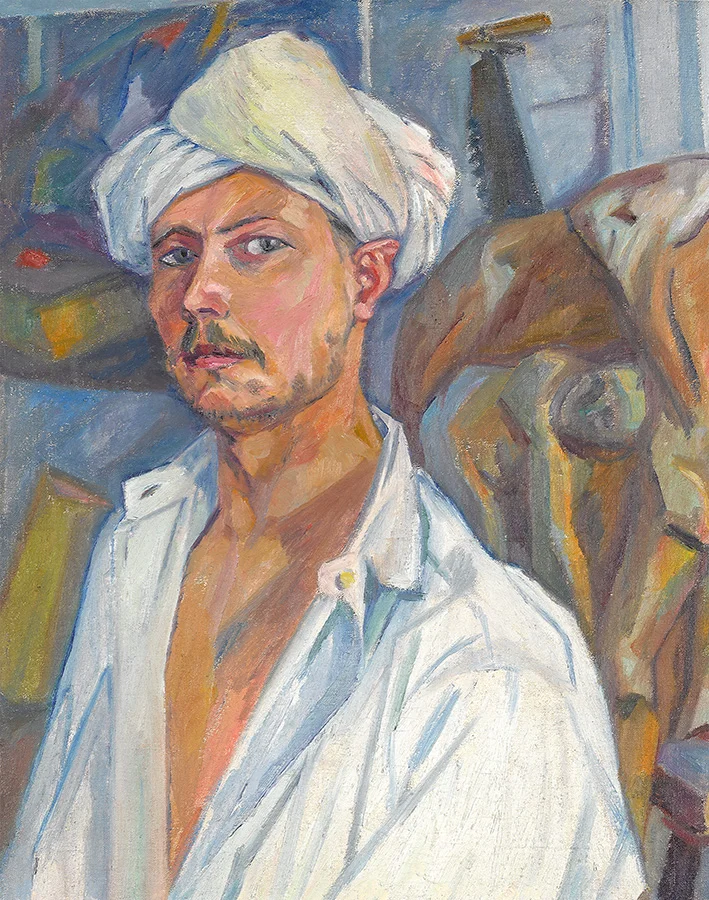
It was Larionov who broke the ground on which the Russian avant-garde would rise. His Rayonism never won a wide following, but everything began with it. He urged artists to attempt the absurd in order to achieve the great, demanded that they learn from children and sign-painters, and rejected the academicians. He was also, perhaps, the only painter to spend a long life with a woman fully his equal in talent, and in the same art. Yet in the grave he shares with Natalia Goncharova in Paris lie the ashes of one other woman.
Mikhail Larionov (22 May [3 June] 1881 – 10 May 1964) was born in Tiraspol; soon afterwards the family moved to the Zamoskvorechye district of Moscow. He studied at the Moscow School of Painting, Sculpture and Architecture under Isaac Levitan, Valentin Serov and Konstantin Korovin, entering in 1898 and almost at once meeting the chief woman of his life, Natalia Goncharova — a great-grandniece of that other Natalie Goncharova, Pushkin's wife.
He began, and successfully, with Impressionist landscapes and still lifes, a period that lasted until 1906. He was enchanted by Claude Monet; the student was especially taken with the Frenchman's idea of painting Rouen Cathedral at different hours of the day and in different light, and, determined not to be outdone, produced numerous variations on the theme of a lopsided barn. The naked women who gazed out from his canvases, however, moved the school's authorities to expel him "for a corrupting influence on his fellow students."
Summers he spent in his native Tiraspol, painting his Impressionist landscapes — Acacias in Spring, The Garden, Flowers — some of which, like Bathers at Sunset, already hint at the neoprimitivism to come. He showed these works with the Society of Russian Watercolourists and the World of Art; collectors bought them gladly, and Sergei Diaghilev invited him to take part in an exhibition in Paris.
At the Russian section of the 1906 Salon d'Automne in Paris his paintings caused a sensation — and Paris, in turn, overwhelmed him. Monet, it emerged, was yesterday; the heroes of the hour were Van Gogh, Cézanne, Gauguin. From morning to night Larionov roamed the museums and exhibitions. Strangely enough, this close acquaintance with European painting made him not a follower but an innovator. He returned to Russia, and the era of his neoprimitivism began.
Larionov now proclaimed the makers of shop signs the best of teachers. His Hairdressers are indeed aimed squarely at the viewer, deliberately demonstrative. He does not flirt with the popular print, does not smile politely at "the people" with an unspoken "we understand each other, of course." He enters their world. That is one of the marks of neoprimitivism: it is in no sense stylization but the common man's view of life itself — not "let us imagine for a moment a soldier's point of view, comfortably settled in our fashionable drawing room," but standing beside the soldier, becoming him. Some of these canvases were acquired by the Tretyakov Gallery, then the unquestioned measure of success.
The French innovators proved a springboard. Larionov created a radically new movement — Rayonism — and the critics, who had only just made their peace with his neoprimitivist pictures, were baffled all over again. "Where is nature set down? Where are life's moments? Where, for pity's sake, are the beautiful women?" they demanded, in vain. For all that, Larionov replied, mankind had already invented the camera; and he went on painting his "rayonist pictures."
He was convinced that every human being (even a fool), in the grip of any feeling, emits radiant energy; the other person receives those rays and generates rays in answer. These, he urged, are what the painter should paint. Herein lay his revolutionary influence. Everyone else still took the object, one way or another, as a point of departure; Larionov, with a flick of the wrist, consigned it to the scrap heap. Depict "not the object itself but the sum of the rays proceeding from it," he demanded — and a barrier fell: one might not merely paint objects strangely and unrecognizably, one could and should paint no objects at all.
The new movement was accepted neither quickly nor by everyone. The most effective publicity, Larionov and his faithful companion Natalia Goncharova concluded, was scandal — nothing new under the moon. They mounted provocative exhibitions and what we would now call performances, while Larionov dashed off manifesto after manifesto beyond the programmatic "Rayonism." In his Manifesto to Women he called on ladies to bare their breasts, which were then to be painted or tattooed. In the Manifesto to Men the law of male fashion was declared to be asymmetry: to wear both moustaches was vulgarity and reaction — one moustache only! Half the beard must without fail be shaved, and men's legs should go bare, tattooed, in sandals (mercifully, without socks). Soon, at one of his exhibitions, the esteemed public was offered a new service: to be painted by the famous Larionov himself. To the women he proposed decorating the parts of the body named in the manifesto, and ladies queued up for so piquant a piece of body art.
In 1914, at Diaghilev's invitation, the most scandalous couple of the Russian avant-garde (they registered their marriage much later) left for Paris to work with the Ballets Russes — forever, though they did not yet know it. The plan was for them to paint sets, but Larionov unexpectedly took an interest in other sides of the enterprise, working as stage designer and occasionally scenarist (the manifesto-writing had not been wasted), and in time as co-choreographer — not seldom arguing with Diaghilev, who by then knew the worth of his talent and entrusted him with the training of young dancers. The result: from under Larionov's "pen" came dancers of world renown, Leonide Massine and Serge Lifar.
Larionov and Goncharova had planned to return to Russia in October 1917 — a month for which Russia had considerable plans of its own. By 1918 Larionov understood that the stay in France would have to be prolonged. He went on working, though his passion for ballet — and, it must be said, for ballerinas — at times crowded painting aside.
He fitted easily into bohemian Paris, striking up friendships with the poet Guillaume Apollinaire, the writer Jean Cocteau, and the painters Pablo Picasso and Fernand Léger. Bohemia is not easily surprised by odd domestic arrangements, so no one was shocked when Goncharova's close friend Orest Rosenfeld — a Russian Menshevik émigré — settled in the Larionov household, followed some time later by Larionov's more-than-close friend Alexandra Tomilina, "Shurochka," as Larionov called her, the daughter of a Moscow banker who had likewise emigrated to Paris.
For thirty years Tomilina was Larionov's mistress — in effect his common-law wife. Her flat was in the same building, one floor down, and her existence was no secret from Goncharova. Holidays were taken either as a foursome with the "friends of the family" or by Larionov and Goncharova alone.
Larionov married his great muse Natalia Goncharova in 1955, above all out of concern for the inheritance: on the death of either, the survivor would inherit everything. Goncharova died in 1962, and Larionov then married the faithful Tomilina. One great dream warmed him — that his paintings and Goncharova's should reach their homeland. In his lifetime it did not happen.
After Larionov's death it was only in 1978 that Tomilina drew up a will in favour of the Soviet government. The transfer of the vast Larionov–Goncharova archive took place only in 1989, once the legal questions had been settled and the Tretyakov Gallery had set aside a room for it. Tomilina asked to be buried in the grave of Larionov and Goncharova — and so she was.