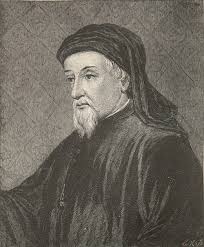
Almost nothing is known about William Langland. His name survives in late manuscript notes scribbled in the margins of the poem. Judging by the dialect of the text and its opening lines, he came from the region of the Malvern Hills in the west of England. He probably took minor clerical orders and lived in London, earning his keep by singing prayers for the dead. Everything else is only the text itself.
Piers Plowman is written not in rhymed stanzas but in alliterative verse — an archaic form that Chaucer, at the very same time, was deliberately ignoring. Langland was not courting a courtly reader and did not take his cue from French models: his language is the western provinces, his audience the parish world, where a literate cleric reads aloud to those who cannot read for themselves. The poem opens with a dream: the narrator falls asleep in the Malvern Hills on a hot summer day and sees a "field full of folk" — the whole world laid out before him like a diagnosis.
In the field a peasant, Piers, is at work. He knows the way to Truth and undertakes to guide the pilgrims there. But the way turns out to be not a route but a way of life: first the field must be ploughed, the hungry fed, the idlers dealt with. As the poem proceeds, Piers changes. The peasant guide gradually becomes a figure that a medieval reader recognized as an allusion to the apostle Peter and to Christ himself. Langland nowhere explains this directly — the metamorphosis takes place within the text itself, in the logic of its imagery.
The poem exists in three versions: the A-text, from the early 1370s; the B-text, around 1377; the C-text, around 1385. Langland returned to it again and again, rewriting whole sections, adding scenes, shifting emphases — as though each time he could not say what he meant with the precision he wanted. The B-text is considered the richest in content. The three parts of the poem are built around three questions: "Do Well" (Dowel), "Do Better" (Dobet), and "Do Best" (Dobest). The answer to what these mean in practice is never given conclusively — in any of the versions.
In 1381 the Peasants' Revolt broke out in England. Its ideological inspiration, John Ball, preached drawing on images from Piers Plowman. The rebels, many of whom could not read, knew the poem through readings aloud and parish sermons. Langland was not calling for revolt: he wrote about the spiritual path and about sin. But he wrote in the language, and about the people, who did not see themselves in literature at all. The poem became their voice not because it was political — but because it was honest.
Chaucer and Langland were contemporaries who never mention each other. Chaucer — courtier, diplomat, translator from Italian and French, author of The Canterbury Tales in the language of the capital. Langland — a provincial cleric, the voice of another England. In their simultaneous existence lie two different visions of what English literature might have become. Chaucer won the place in the academic canon; Langland won a place in the memory of those the canon overlooked.
Piers Plowman does not answer the question of how to survive in an unjust world. It asks another: how to live well within it — and leaves that question open. The poet rewrote the poem for twenty years — and, by all appearances, died before he found an answer he was satisfied with.