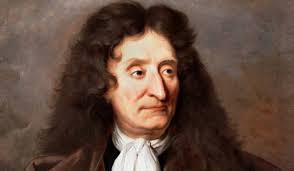
His father held a post in the forestry administration, and La Fontaine passed his childhood among woods and fields. At twenty he entered the Oratorian brotherhood to prepare for holy orders, but gave far more of his time to philosophy and poetry; by his own admission he was captivated by d'Urfe's "Astree". Fittingly, a libretto for Colasse's opera "Astree" proved to be his last work — the 1691 production was a complete failure.
In 1647 his father made over his office to him and persuaded him to marry a fourteen-year-old girl, Marie Hericart. He took his new duties, official and domestic alike, very lightly, and soon left for Paris, where he spent the rest of his life among friends and admirers of both sexes. He would forget his family for years at a stretch, returning home only briefly and only at his friends' insistence. His correspondence with his wife survives — he made her the confidante of his numerous romantic adventures. To his children he paid so little attention that, meeting his grown son in someone else's house, he failed to recognize him.
In Paris La Fontaine met with brilliant success; Fouquet granted him a handsome pension. He lodged first with the Duchess of Bouillon, and when she died and he left her house, he ran into his acquaintance d'Hervart, who offered to take him in. "I was just on my way there," came the fabulist's artless reply. The tradition that between 1659 and 1665 he was on friendly terms with Moliere, Boileau and Racine looks doubtful; but his friends certainly included the Prince de Conde, La Rochefoucauld, Madame de La Fayette and others. Only the royal court remained closed to him, for Louis XIV had no liking for a frivolous poet who acknowledged no obligations whatever. This delayed his election to the Academie francaise, of which he became a member only in 1684. In the quarrel of the Ancients and the Moderns he sided, not without hesitation, with the Ancients. Under the influence of Madame de la Sabliere, La Fontaine in his last years turned to piety and renounced the most frivolous of his writings.