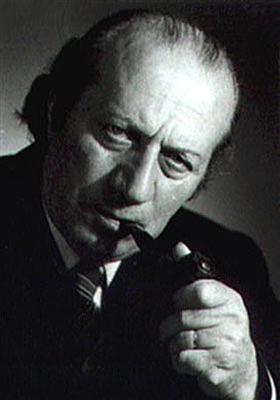
Member of the Union of Artists of the USSR.
People's Artist of the USSR (1976); laureate of the State Prize of the Armenian SSR.
He studied at the Nersisyan Seminary in Tiflis while attending courses in painting and sculpture at O. Schmerling's school (1906–1918), and then at the Moscow SVOMAS (1918–19) under P. P. Konchalovsky. By 1921 Yervand Kochar was a professor of painting in Tiflis and, before his departure for Paris, already an artist of note. From 1923 he lived and worked in Paris. In his thirteen years there he took part in numerous exhibitions of epochal significance and mounted five solo shows, earning the highest critical praise. In France he created a new form of plastic expression — peinture dans l'espace, painting in space — which admits time as an additional fourth dimension. In 1936 the Dimensionist Manifesto appeared, herald of the newest artistic principles of the day; the chronicles of art history would record that Kochar had been putting those principles to work a full ten years before the Manifesto was published. One need only glance down the list of its signatories to see not merely the whole select circle of the avant-garde's creators, but the place and weight of Kochar's own work in that time and in that company. In 1936 Kochar repatriated to the USSR. The bans, the imprisonment, the isolation that followed undoubtedly marked his path as an artist — though here, it seems, the law of counter-pressure did its work. The Khrushchev Thaw, too, without doubt played its part.
It was a time of creative flights of genius, of hopes awakened and of those hopes destroyed.
In those years came the canvases Ecstasy (1960) and The Horrors of War (1962); the sculptures The Eagle of Zvartnots (1955), Melancholy (1959), The Muse of Cybernetics (1972) and Vardan Mamikonian (1975); the work that became a symbol of Armenia, David of Sasun (1959); and other priceless creations.
Kochar died in Yerevan in 1979.