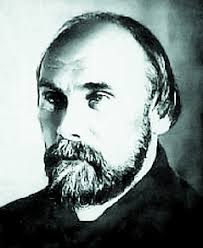
His father, a former rural police sergeant, kept a state liquor shop; his mother, Praskovya Dmitrievna — a keeper of the old Orthodoxy, a singer and ritual mourner — was the future poet's spiritual guide. “My mother,” Klyuev wrote, “was of the garden, not of the forest, in the order of Seraphim's Orthodoxy... She held in memory several thousand nests of words, in verse and in half-uncial; she knew the Swan and the Rose from the Shestokryl, the New Margarit — a translation from the tongue of the black Christians — the song of the redeemer Peter III, the comings of Christ from a wondrous Latin book, the fiery letters of the Archpriest Avvakum, the Indian Gospel and much else that secretly salts the people's soul — word, dream and prayer — and that salted me to the bone, to the nethermost depths of my spirit and my song...”
Of his early life the biographical record is exceedingly scant. It is known that in 1893–95 he studied at the Vytegra parish school, then at the two-year town college, and spent a year at a school in Petrozavodsk, which he left because of illness. In autobiographical notes written on the models of hagiography, Klyuev recalled that “at Solovki... I lived twice over... I wore chains then of nine pounds, after the number of the nine heavens — not those the Apostle Paul saw, but others. No day ended without four hundred prostrations to the earth.” He left the Solovetsky monastery with the “brother-doves” for Samara province: “There I lived, near enough two years, as King David of the great Golden Ship of the white doves — the christs.” He spoke too of wanderings in the Caucasus: “From Solovki to the Persian oases the crane-roads are known to me... My life is Batu's trail: from cold Konevets (the horse's head) to the porphyry bull of Siva it has run. Many are the tears upon it, and the sealed mysteries...”
Klyuev's first poems appeared in the Petersburg collection New Poets in 1904. In 1907 he began a correspondence with Alexander Blok, sending him verses inspired both by Blok's book Inadvertent Joy and by folk song (“The Song of the Falcon and the Three Birds of God”). Through Blok's mediation he published in the journals Bodroe Slovo and The Golden Fleece. In 1911 came his first book, The Chime of the Pines, dedicated “To Alexander Blok — Inadvertent Joy,” with a preface by Valery Bryusov; in 1912, Brotherly Songs, with a preface by V. Sventsitsky.
In this period three currents of sense and style converge in his poetry. His verses, religious hymns and songs are not stylizations of folklore but a created layer of song, organically alive within the musical and ritual element of the Russian North — and this organic joining, in a single creative world, of motifs that seem incompatible is among the distinguishing marks of his poetry. In effect he brought into twentieth-century Russian literature the attitude to the Word proper to the chroniclers and preachers of pre-Nikonian Rus: poem, prose, journalism, letter, an inscription in a gift copy of a book — all of these, in Klyuev's world, are merely different aspects of a single text. In his poetic world nature is inseparable from the church and the church from nature — a nature so inspirited that the living Christ seems to pass unseen among the Russian oaks and birches, elms and maples; the forest itself becomes an altar, and in its murmur one hears the litany: “In the gold-woven days of September the fringe of the pinewood seems a church porch. The pines are praying, censing incense, above your abandoned hut.”
Klyuev does not imitate the folk song or the bylina; he creates them (“Obida's Lament,” “The Song of the Falcon and the Three Birds of God”), just as he creates — rather than copies from known models — the religious hymn (“Accomplishing the way above the world...,” “Wedding Song,” “Songs of the Radenie”). In 1913 appeared his book Forest Tales, where we meet no longer the poet of revelation and mystical insight but the singer of the northern village and the remote Olonets forests. Here his Olonets speech reaches its densest concentration, woven organically into the classical meters of Russian syllabo-tonic verse — lines that carry the starry headdress to the water-sprite, call from the river shallows a girl with a russet braid, a wavering voice and cheeks like cherries, while the willows whisper that this day Solnopyok has exchanged rings with Beauty, and from the grove drift resin and wild strawberry, distance and waters in a blue haze.
In 1912–13 Klyuev lived in Moscow and Petersburg, often reading his work at literary evenings — in the salons of the folklore collector O. E. Ozarovskaya and of Countess P. S. Uvarova, at the Society of Free Aesthetics, at the Stray Dog. The impression those readings left is caught in a letter to A. Shiryaevets, with whom he began corresponding in the spring of 1913: “I was in Piter and in Moscow this winter; they dragged me around concerts and drawing rooms, but always forgot to feed me, and not one living soul wondered whether I had a piece of bread for breakfast — yet they listened, gathering five hundred at a time in various societies to hear me... It is hard for me with the little books, and the ladies, and the writers; better never to have seen or known them — curses on them, curses upon curses!” At the end of 1912 and beginning of 1913 he attended sessions of the Guild of Poets and formed close contacts with the Acmeists, who counted on him as a literary ally, though Klyuev kept himself apart and the rapprochement proved brief. His closest friend and comrade in poetry in these years was Sergei Klychkov. In 1915 a correspondence began with Yesenin, whom he met in the autumn of that year. Klychkov, Shiryaevets, Yesenin and P. Karpov formed the association of “new peasant poets,” with Klyuev as its spiritual elder. “My white dove,” he wrote to Yesenin, “you know that you and I are goats in the literary garden, tolerated there only on sufferance... For you I fear especially: you are like a bush of wild briar, which sheds the more, the more it rustles... To be green in the grass and gray on the stone — that is our program, if we are not to perish... I go cold at the memory of the humiliations and condescending caresses I endured from that dog-public... You see — what matters is not your spirit, not what is immortal in you; the only interest is that you, lackey and boor of the smerdyakovs, have begun to speak articulately...”
In 1916 came the book Worldly Thoughts, gathering his “war poems” — an expression of the people's view of the First World War — along with byliny (“The World's Thought,” “The Hidden Verse,” “A Talking Tune, a Fair-Written Verse”) and “Songs from Zaonezhye.” In the same years he composed the cycle Izba Songs, in memory of his mother — among the summits of his work. In it the Klyuevan cosmos of the izba is embodied entire: the hut, like a living being, grieves for its departed mistress, and every object of village use is humanly unable to accept the loss: “Where in the fair chamber the oak tables stand white as foam from the bowls of kissel, there Dmitry of Salonica, with Nikola and Vlas, robes the saints in camlet and satin, and John the Baptist pours them living Jordan water from a painted flagon.”
In the same year, 1916, Klyuev wrote the cycle Earth and Iron, in which the poetic word regains its original divine nature (“sound is brother to the angel, to the bodiless ray”) and the world and spirit of the Russian land stand as the last unbroken bulwark against the advancing end of the world — against iron, a soulless and dehumanized civilization threatening to wipe from the face of the earth all its many colors, its “flowering complexity.” Here he plainly shows the image of one who has gained the “flowering staff”: “We are grandchildren of the earth and kin to fire; dawns gladden us, and candle-flame; iron stings us, and the blackness of garments, and in our memory are only the colors of rainbows.” Klyuev undoubtedly knew the tales of the search for the blessed land of spiritual and bodily freedom — the Old Believer expeditions that continued down to the end of the nineteenth century — and knew that what was meant was not a mythical but a real land: India. “The Indian land, Egypt, Palestine have poured into our dreams as tin into a vessel. We are brothers to the clouds, and the shroud's linen is our faithful guide to the abode of stillness.”
To 1916 belong his first hymns to White India, which enters as an inseparable part into the izba cosmos created by the poet's imagination — and it was not only, and not chiefly, a “peasant paradise” that Klyuev foretasted in his dreams of White India. Realities familiar from childhood acquire cosmic meaning and universal significance, becoming symbols of an eternal, happy existence without in the least losing their earthly office — which only underscores how real the existence of the Invisible City was to Klyuev's perception. In that City is a feast of flesh and spirit, an eternal deathlessness whose motif echoes the overcoming of death; under the pen of the Olonets wanderer the treasures of world philosophy and culture, the immortal creations of painting, music and the word, stand in one rank with the uncreated beauty of northern forests and eastern deserts, with the loveliness of the Russian izba and the Indian pagoda. And where does this wondrous land, the found City of Kitezh, lie? Klyuev gives exact directions: “At the bottom of all worlds, oceans and mountains blooms, like a soul, the adamantine forest; the road to it runs from Solovki to Tibet, through the heart of the izba, where the world ends...” Bright pictures of Izba India stand beside the poet's spiritual recollections of Tibet and Palestine — recollections that pass as if imperceptibly into a present unfolding before our eyes, leaving at once the impression of a beautiful poetic fantasy, of what never was in reality and yet cannot fail to come. The image of the gypsy woman telling a porter's fortune, at once fantastic and real, is evidently another such mask, meant to help the poet conceal what should not be seen by a stranger's eye, to sow doubt about what has been glimpsed — while the poet himself knows: it was, and it will remain forever in memory, like a beautiful dream, a vision of the happy world to come.
From 1918 to 1923 Klyuev lived in Vytegra, with a brief trip to Petrograd in 1922. The great culture of peasant Russia remained the source of his inspiration. “The secret culture of the people,” he wrote in “Gem-Bright Blood,” “which our so-called educated society, from the height of its learning, does not even suspect, has not ceased to radiate to this very hour. (The ‘izba paradise' is the greatest mystery of the peasant's aesthetic knowledge — the heart of the izba, the horse-head ridge on the roof, is the sign of the universal way.)... Aiming the machine gun's sting at the firebird, declaring it fit for destruction, one ought to think hard about finding the way to an art that could quench the artistic hunger of deep-forest, black-ploughing Russia.” And in verse: “Stroganov icons — the peasant's gem-studded paradise; do not call us to your Washingtons, to the death-bearing iron land.”
In 1919 the two-volume Pesnoslov — the fullest collection published in his lifetime — appeared in Petrograd, together with the collection The Copper Whale; in 1921, in Moscow, the collection Lion's Bread. “Lion's Bread is, in the end, the fate of West and East. Russia will accept the East, because she is herself the East, but she will no longer be a shield for Europe. This recovery by the motherland — by Rus — of her original motherland, the East, is the Lion's Bread.” In 1922 the long poems The Fourth Rome and Mother Sabbath came out in Petrograd as separate editions.
In The Fourth Rome the motifs of Lion's Bread reach their utmost concentration, and Klyuev's eternal antithesis — earth against iron — is stated with extreme, indeed more than extreme, distinctness. A sense of being knocked wholly out of the rut, of all hope lost for the rebirth of the peasant paradise — the “Fourth Rome” — tells on virtually every page of the poem. Struggling to break that mood, Klyuev condensed his images to a density unheard of even for him, staging a veritable “feast of the flesh,” and loaded the poem besides with a most bitter anti-Yesenin charge. Yesenin's drift toward the Imaginists, the appearance of “Mares' Ships” and “Confessions of a Hooligan,” had been a true tragedy for Klyuev, and, attempting once more to raise the peasant world upon its ruins in its first-created form, he pronounced curses on his once-beloved fellow: “I do not want to be a famous poet in a top hat and lacquered shoes. I shall come before the world clothed in song, with a bear's sun in my pupils.”
Of Mother Sabbath, with its magical refrain — “the angel of simple human deeds” — Klyuev said to N. Arkhipov: “The izba has roots; they are like heart-pine: its needles are of rye, its cones steeped in gold. Seven cups have been poured upon the izba: the first cup is peace; the second, incorruption; the third, the seeing of spirits; the fourth, peace to the world; the fifth, the sacrifice of Abel; the sixth, victory; the seventh, unto ages of ages. The mystery of the izba is the Blue Sabbath, the slaying of the Lamb and His appointed resurrection. The loaf is the Christ of the izba, the living bread that gives life to the faithful. The nativity of bread, its slaying, burial and rising from the dead, awaited as beauty among the Russian people — that is what my ‘Blue Sabbath' tells. Communion with the Cosmic Christ through visible bread is the heart of this poem.”
In 1923 Klyuev was arrested in Vytegra and brought to Petrograd; on his release he resolved never to return to Vytegra. At the end of 1923 he renewed his friendship with Yesenin, visited him in Moscow, and took part with him and A. Ganin in an “Evening of the Russian Style.” In 1926, after Yesenin's death, he wrote the Lament for Sergei Yesenin, published in full in 1927. In his preface the critic and literary scholar P. Medvedev observed that “this is not a poema. Nor is it a funeral keening giving vent only to the feeling of personal loss and grief. It is precisely a lament, of the kind raised by Jeremiah, by Daniil the Exile, by Yaroslavna, by Prince Vasilko. In it the personal is interwoven with the public, the deeply intimate with the broadly historical, grief with meditation...”
In 1926–27, in the journal Zvezda and the collection Kostyor, appeared the poems The Village and Zaozerye, which foretold, with a seer's clarity, the savage destruction of root, popular Russia. After The Village the label of “kulak poet” was fastened on Klyuev once and for all — a political sentence. In 1928 came his last lifetime book of poems, Izba and Field, and in the same year he finished one of his finest long poems, Pogorelshchina — The Burned-Over Land — which he tried in vain to place in the journals, read at numerous writers' gatherings, and which passed from hand to hand in manuscript copies.
In Pogorelshchina the images of Chirin, Paramshin and Andrei Rublev serve as a kind of bulwark of the izba cosmos, of the old village that the serpent threatens to lay waste. The vanishing of the image of George the Victorious from the icon is the sign of inescapable catastrophe: “On the icon-shelf a serpent and a blue sea...” The people of Sigovets will fall victim to the monster; the sea waves will swallow the last stronghold of the old folk world so dear to the poet — the peasant world living by its ancient, thousand-year laws — like Kitezh, hidden forever beneath the waters of Lake Svetloyar. The last prayer of the inhabitants of that fabled world — a plea for Yegory's return, addressed to St Nicholas and to the Ever-Virgin Mother of God before icons by Russian masters of genius who had embodied the different faces of the Theotokos — is charged with truly tragic force. The heroes of the poem are peasant icon-painters, led by the best among them, the painter Pavel, laying on colors not one of which is called by its own name. As once in Klyuev's verse the “Nativity of the Izba” was accomplished under the hand of the “Red Woodwright,” so now is accomplished the “Nativity of the Icon,” which leaves the sense of a thing not made by hands. The very Appearance of the Icon — the “flight of the crane” — and the painting of all but the face are the setting that frames the “Vision of the Face,” which is not painted with the brush at all: down to humble Pavel's fingers and pupils fly hosts of rainbows with peacocks, leading in “blue swans”... The Vision of the Face the icon-painters take now from the dark of the pines, where labor glimmers, now from the depths of lakes, where the weaver-moon grieves at her amber loom by the window. Yegory's horse is painted from a drake; Nikola's chasuble from a cross-marked maple; the Dormition from the feathers of doves in a tree-hollow, when the threshing is done and the village at rest; the Crucifixion from a radish — for as the nails of the cross, so does radish juice scald the lips... Nature herself helps the icon-painters in their work, yielding her finest colors to an image that ceases to be perceived as the artist's own art; the “divine industry” gathers into itself all the wealth and variety of the outer, natural, visible world. The classical line existed in Klyuev's mind as adamantine gates, whose entrance is open not to those who take poetry lightly but to those ready to bow before genius, before the immortal tradition of Pushkin and Koltsov; for the uninitiated, eternal art remains the “Unbreakable Wall” girding the world of the Great Word.
In 1929 Klyuev wrote the poem Cain, preserved in fragments found in the archive of the former KGB of the USSR only in the early nineties. It was a poem of repentance. The fratricide Svyatopolk was called by the people okayanny — “Cained”; repentance is deliverance from Cain's power. Klyuev understood that he himself needed this repentance for what had been done to Russia more than anyone else. Hundreds of versifiers, gifted and talentless alike, were in this respect beyond hope: drunk on the blood of lawless reprisals, they sang on in the same spirit, indifferent to whether one set of their verses' heroes, already stood against the wall, gave way to another not yet stood there. Klyuev's sins bear no comparison with those of his poetic brethren; but it was a vital necessity for him to cleanse himself, before himself and before God, for the moments when he had yielded to the common intoxication. The result was one of the greatest works of Russian epic poetry of the twentieth century. In poetic power and force the poem is kin to Lermontov's Demon — but its Cain is the more terrible for no longer attracting or entrancing: he seduces openly, pointing to the work of his hands: “Look upon winged Radonezh: was it not lately the bright Alkonost? Now, a horned she-ass, it multiplies rot and dung! Zadonsk, rose of the Bride of God; Sarov, with Diveyevo for its lacework — where the face of Russia, lions and goats, was embroidered by an angel's hand — all is mould now, the dwelling-place of refuse. The fratricide has no need of the burning veil and the lakes of tears of the Unburnt Bush! Know me, weaver of thoughts and words: I am the enemy of the cross — it is a canker to us, sovereign sons of Tartarus who have hungered after the shameful sceptre!” The whole poem is perceived in the key of a dream, in which pictures of past, present and future alternate.
In the early thirties Klyuev wrote the epic Song of the Great Mother, confiscated from him at his arrest; in the same years he composed the lyric cycle What the Gray Cedars Murmur About, created for the most part after his move to Moscow in 1932. On 2 February 1934 he was arrested, and all his last works were seized in the search. By good fortune they survived, having been sewn into the case file as material evidence of the poet's anti-Soviet sentiments; he was charged with reading and disseminating the “counterrevolutionary” Pogorelshchina. “I have burned on my ‘Pogorelshchina,'” he wrote to Klychkov from Kolpashevo, where he had been sent to serve a five-year exile, “as once my great-grandfather the Archpriest Avvakum burned on the Pustozersk pyre. My blood, willingly or not, binds two epochs: the epoch of Tsar Fyodor Alexeyevich, lit by resinous bonfires and the kindlings of self-immolation, and our own — so young, and therefore ignorant of much.” After long petitioning he was transferred to Tomsk. In exile he went on writing verse, and wrote two long poems: The Kremlin, whose text survives but has still not been published, and Narym, now unknown. On 5 June 1937 the gravely ill poet was arrested in Tomsk on a charge of belonging to a mythical monarchist organization, the “Union for the Salvation of Russia,” and on the 23rd or 25th of October of that year he was sentenced to be shot, in the Tomsk prison.