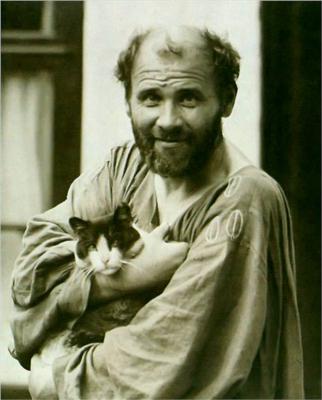
Gustav Klimt (July 14, 1862, Baumgarten, Austria-Hungary – February 6, 1918, Vienna, Austria-Hungary) was an Austrian painter and one of the founders of European Art Nouveau. The son of an engraver and goldsmith, he set his sights on art from childhood. Trained academically in Vienna, he painted for a considerable time within the academy's canons, and at twenty-six his decorative work for a Viennese theater and museum earned him an imperial award. Soon afterwards he was leading a revolt of young Austrian artists against the confines of academic painting, founding the Vienna Secession. Whatever barbs the critics threw at him, Klimt remained a favorite of the public until his death, and his pictures never wanted for buyers.
His first notable works were decorative in character, yet his favorite subject, from beginning to end, was the female nude. Klimt could make every woman he painted frankly sexual and sensual without ever tipping into vulgarity or coarseness. In the late 1890s came the so-called "golden" period: the paintings of these years, executed with genuine gold leaf, became his most celebrated and most expensive works.
Among his best-known paintings: The Kiss, Portrait of Adele Bloch-Bauer, Judith and Holofernes, Pallas Athena, Danae, Nuda Veritas, The Three Ages of Woman.
It is safe to say that Gustav Klimt lived a happy life. He did what he loved from childhood and shot to popularity before he turned twenty. He never lacked for money, which left him free to be choosy about commissions. And he was surrounded, always, by ardent admirers, by the women he loved, and by young colleagues who idolized him. This darling of fortune would hardly have been surprised to learn that his paintings are now ranked as masterpieces and fetch astronomical sums.
Evolution and Revolution
In 1898 the Austrian capital saw the first exhibition of the Vienna Secession, an independent association of artists who had thrown down a challenge to traditional art. The success was enormous: more than sixty thousand visitors came, and Austrians could at last see the French Impressionists and the Viennese modernists for themselves. But many of the canvases left the conservative public in genuine shock — above all those of the Secession's president, Gustav Klimt. Critics and viewers were baffled. What had gotten into him? Was this really the same Klimt who painted "proper" classical portraits to order? The man who, only a few years earlier, with the Company of Artists, had decorated the hall of the Burgtheater and painted the walls of the Kunsthistorisches Museum? Some of the more indignant members of Viennese high society even proposed jailing him, or expelling him from the country.
But groups of this kind were then springing up all over Europe, and the modernists were slowly winning the right to be seen and acknowledged. Klimt, whose style in these years was transforming inexorably, dreamed like many others of shedding the rules and demands imposed on him. To every malicious attack he answered with a still more provocative picture. In 1899 he showed Nuda Veritas, unsettling in its frank nudity, drawn out in full anatomical detail. He even dedicated a painting to his opponents and called it exactly that — To My Critics (1901–1902): much of the canvas is taken up by a voluptuous red-haired beauty who has turned her backside to the viewer and glances slyly at him over her shoulder. Later he retitled the picture Goldfish.
After the scandal over his paintings for the University of Vienna, Klimt stopped taking large state commissions. He had put aside a respectable sum and could well afford to paint only what interested him — and what interested him above all was the female body. For all the unambiguous eroticism of many canvases, the public received them more than warmly; even his most contested pictures found buyers at once. It was the works of the golden period — The Kiss, Portrait of Adele Bloch-Bauer, the Beethoven Frieze, The Tree of Life — that brought him his widest fame, let him work out and perfect an inimitable style of his own, and made Klimt a national treasure of Austria.
Another genre he loved was landscape, painted mostly in summer on holiday at Lake Attersee. Landscapes let him withdraw from the bustle of the city into non-figurative painting while keeping every trait of his unmistakable manner. Like most of his pictures, he painted them on square canvases, convinced that the format let space expand endlessly in every direction. In his final years he turned to landscape almost entirely. The First World War told on his style, making the canvases darker and more anxious; color and ornament now interested him more than recognizable forms. But the public was never to see this new, reborn Klimt. He died at fifty-five after a stroke.
The Burden of Passions
Legends circulated about Klimt's sexual appetite and temperament. One young artist claimed he had pursued her all the way to Venice to win her over. Rumor had it that he slept with practically every model who posed for him — and of models he had no shortage. Society women all but queued at his studio for a portrait from his hand; the rest of the time he resorted to prostitutes, and he was not particular in his liaisons. Yet look closely at his paintings and two quite different types emerge, both of which evidently held him. Opulent red-haired sirens with ample bodies (Danae) alternate on his canvases with refined brunettes with narrow faces and boyish figures (Emilie Floege, Adele Bloch-Bauer).
Not only his appetite but his astonishing fecundity became a byword. By various counts Klimt fathered anywhere from fourteen to forty children by different women, and some of them he acknowledged officially. Yet he never once married, though rumor says he came close more than once. His life was otherwise fairly modest; the passion for women was the one vice he could not deny himself.
The moral side of the matter concerned him little — as did questions of health. After years of consorting with prostitutes he predictably contracted syphilis, one of the commonest afflictions in the Europe of the late nineteenth and early twentieth centuries. The 2006 film Klimt made play with this fact of his biography: in it the artist, evidently under the sway of the disease, converses with people who are not there and suffers mysterious visions.
Worth Its Weight in Gold
For all the affairs and flings, two women remained constant presences at Klimt's side, and to both he was deeply attached. The first was his mother, Anna Klimt. She had dreamed of a professional life in music, of touring the world with concerts, but it was not to be — whether for want of talent or because of marriage and seven children, no one knows. In the end Anna gave her life over entirely to her famous son. She did not appear in society with him or claim any share of his laurels; she simply lived, quiet and unnoticed, in his house, seeing to it that he always had a hot meal and clean clothes. He took this as his due, though his wants were few: absorbed in work, he often forgot to eat, and to any other clothing he preferred the craftsman's traditional blue smock.
There was one other woman in Klimt's life, an attachment he carried to the end. It was to her that he invariably returned after each new adventure; beside her he found peace. This was Emilie Floege. They met in the early 1890s, when Klimt's brother Ernst married Emilie's sister Helene. But Ernst died as early as 1892 — the artist's father had died shortly before — and the care of the family, his brother's widow and small daughter included, fell on Gustav's shoulders. It was then that he grew close to Emilie. They spent every summer together at Lake Attersee, traveled together now and then (he rarely left Vienna at all), and passed all their free hours in each other's company.
And yet Klimt painted only a couple of portraits of Emilie. The canvas of 1902 deserves particular attention. Paying tribute to her calling — she was co-owner of the fashion house Floege Sisters and a gifted designer — he dressed her in a gown of intricate ornament in his signature style. But what matters more in the picture is the meticulous care with which her face and hands are rendered. Scholars take such fine detail as a sign that he knew that face and those hands by heart.
Biographers still cannot agree on what exactly bound Klimt and Floege together. Some hold that she was his standing mistress, whom he never got around to marrying; others are certain the bond was purely platonic, which is why Emilie bore him no child. However it was, their relationship lasted twenty-seven years, and by the accounts of witnesses, the artist's last words after the stroke that felled him were a request to send for Emilie.