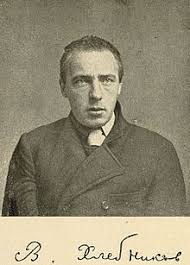
Among the remarkable Russian poets who began writing long before the revolution and who, immediately after October, gave their talent with full passion to the new life, Velimir Khlebnikov occupies a place apart. In everything he did in poetry one felt a kinship with those methods of knowing the objective world which, though they certainly underpin art as well, only science commands with full authority. In Khlebnikov the poet argued with the scientist — or, more precisely, the poet made incursions into neighboring fields of knowledge, above all history and linguistics, and moved with perfect ease even in so remote a realm of "far-fetched ideas" as mathematics. To poets and to people of the arts, Khlebnikov, with an encyclopedism almost unbelievable in the twentieth century, seemed an enigma; his poetry, not always and not in everything accessible, drew readers with its premonitions of things not yet known.
Velimir — his real name was Viktor Vladimirovich — Khlebnikov was born on November 9, 1886, in the village of Malye Derbety in Astrakhan province, into the family of the ornithologist and forester Vladimir Alekseevich Khlebnikov, who served as trustee of the Maloderbetovsky ulus. His father came from a line of hereditary honorary citizens of the city of Astrakhan; his mother, Ekaterina Nikolaevna, from a Petersburg noble family. The Khlebnikovs had five children, Viktor the third among them. Only the poet's youngest sister outlived their parents.
Through the 1880s and 1890s the family moved several times, as the father's postings took him to different corners of the country. In 1897 Viktor Khlebnikov entered the third class of the gymnasium in Simbirsk, and he finished his schooling in Kazan in 1903. That same year he enrolled in the mathematics division of the physics and mathematics faculty of Kazan University. Beyond mathematics and physics he was drawn to biology, chemistry, and philosophy; languages came easily to him as well, and he took up the study of Japanese and Sanskrit.
His first work was in prose — a play called "Elena Gordyachkina," printed by the St. Petersburg publishing house Znanie, and it opened his literary career. Maxim Gorky did not care for it, and criticized the beginner.
Beginning in 1904, Viktor went on ornithological expeditions to the northern Urals and to Dagestan. Two years later he became a member of the university's Society of Natural Scientists. On one of these expeditions he discovered a hitherto unknown species of cuckoo — but this proved his first and last discovery, for Khlebnikov had by then fallen in earnest under the spell of literature.
In 1908 Khlebnikov returned to Petersburg and rejoined the university fold. He settled at first on the natural sciences faculty, but after meeting the poets of the Symbolist camp he continued his studies in the historical-philological faculty. He began to frequent the poetic "Wednesdays" hosted by Vyacheslav Ivanov, where he came to know the Acmeists. It was then that he took his pseudonym and began signing himself Velimir (in some editions published during his lifetime and after, the spelling Velemir occurs).
The literary movement to which Khlebnikov and his friends belonged is now known as Cubo-Futurism. Khlebnikov himself devised for the group the name "budetlyane" — men of the future — wishing to mark its independence from the models of Western European Futurism.
In 1912 his first book, "Teacher and Pupil," appeared in Kherson — a philosophical dialogue with the subtitle "On Words, Cities and Peoples," in which the poet set out in print, for the first time, the foundations not only of his theory of numerical regularities in the world but of his unorthodox linguistics (in particular the doctrine of the "internal declension of words"), while also subjecting contemporary Russian letters to criticism.
In the years before the First World War, Khlebnikov was published by D. Burliuk, A. Kruchenykh, and Matyushin. Among the lifetime editions of the poet shown at the exhibition are "Trebnik troikh" ("A Missal of the Three"), a collection of verse and drawings (Moscow: published by G. L. Kuzmin and S. D. Dolinsky, 1913, 95 pp.), and "My" ("We"), a collection by K. Balmont, V. Ivanov, R. Ivnev and others, issued by the All-Russian Union of Poets (Moscow: Chikhi-Pikhi, 1920).
While working on scientific expeditions, Khlebnikov became fascinated by the Kalmyk astrologers known as zukharchi, who foretold the future by means of the so-called "zukharchin modi" — Boards of Fate. One of his own works he named accordingly: "The Boards of Fate." He held that our world is governed by numerical regularities, and that all events repeat themselves every 317 years. The material bearing on these "laws of time" Khlebnikov gathered into "The Boards of Fate" — a work characteristic of him, in which poetic and prose texts, mathematical calculations, and philosophical essays are combined. From then on he was far more anxious to publish the results of his discovery than to publish poems; yet during his lifetime only a single excerpt (a "sheet") of "The Boards of Fate" reached print. He managed to prepare two further "sheets" for publication, which were issued by P. Miturich soon after the poet's death; four more were reconstructed and published only in 2000. The exhibition shows the second "sheet" of "The Boards of Fate," issued after the poet's death: "Excerpt from the Boards of Fate (Sheet 2): The Fates of Individual Peoples" (Moscow: printing house of the Khudozhestvennaya Pechatnya partnership, 1922).
A large section of the exhibition presents what leading literary critics and Khlebnikov's contemporaries wrote about his life and work. Among the exhibits: "A Lef Notebook" by A. K., with notes on Khlebnikov, in "Novy Lef," the journal of the left front of the arts, no. 2, February 1928; O. M. Brik's "We Are Futurists," in "Novy Lef," nos. 8–9, 1927; Dmitry Petrovsky's autobiographical sketches (Moscow: Federatsiya, 1929); Korney Chukovsky's "Faces and Masks," a collection of articles (St. Petersburg: Shipovnik, 1914); E. Neumayer's "On Velemir Khlebnikov," in "Raduga," the monthly literary-artistic and socio-political journal of the board of the Union of Writers of Ukraine, November 1965; and others.
"Unpublished Khlebnikov" was the title under which, at the end of the 1930s, a "group of friends" together with Alexei Kruchenykh brought out hectographed issues of the poet's manuscripts in editions of only 100 to 150 copies. Five issues of these remarkable publications are on display.
In May 1922, at the invitation of the artist P. Miturich, Khlebnikov traveled to the village of Santalovo in Novgorod province, where the artist's family lived. By then the poet was already gravely ill. On June 28, 1922, Velimir Khlebnikov died. He was buried in the churchyard of the village of Ruchyi, and in 1960 his remains were transferred to the Novodevichy Cemetery in Moscow.
Khlebnikov's works have been translated into nearly every European language, as well as into Korean, Japanese, Arabic, and many others.