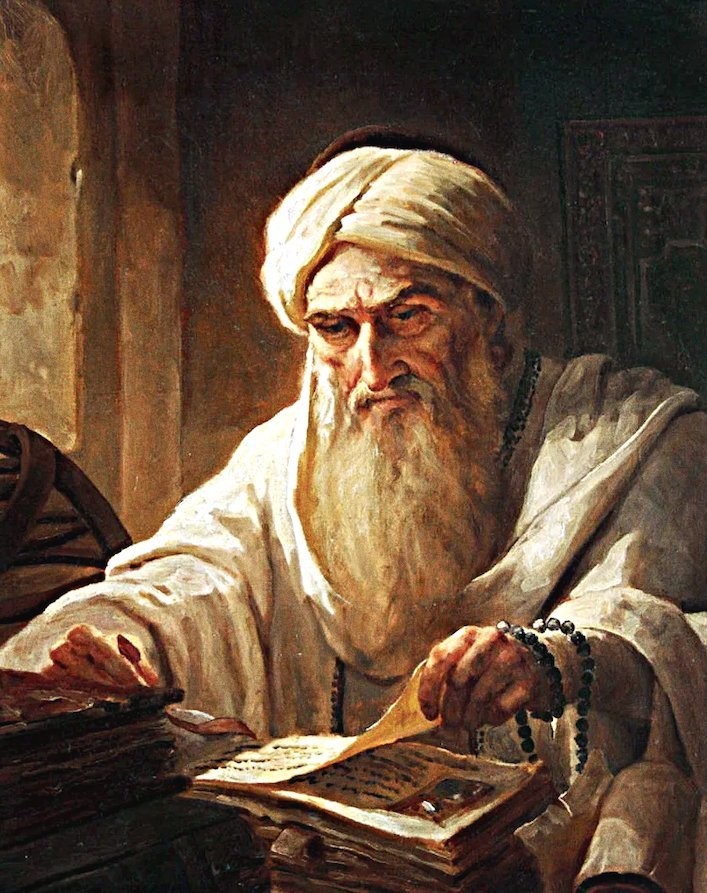
Omar Khayyam was a Persian philosopher, mathematician, astronomer, and poet.
Omar Khayyam Nishapuri was born on 18 May 1048. From the age of eight the boy studied mathematics, astronomy, and philosophy, and four years later entered the madrasa of Nishapur, a Muslim school of learning. He went on to study at the madrasas of Balkh, Samarkand, and Bukhara, completing courses in Islamic law and medicine with distinction and earning the qualification of hakim — physician.
In 1074 Khayyam took charge of the largest astronomical observatory of his day, at Isfahan, and later made the pilgrimage to Mecca. From 1097 he practiced as a physician. In the last ten or fifteen years of his life the philosopher kept largely to himself, preferring solitude. He died on 4 December 1131. Historians record that he spent his final hours reading the Book of Healing by Ibn Sina (Avicenna). Reaching the section "On Unity and Universality," he laid a toothpick on the page, rose, prayed, and died.
Khayyam's work is an astonishing phenomenon, and not only for the culture of Central Asia and Iran but for all humanity. His scientific discoveries in physics, mathematics, and astronomy have been translated into many of the world's languages. His verses, "stinging like a snake," still captivate by their extreme compression, their laconic force, their imagery, the simplicity of their means, their supple rhythm. His philosophy recalls the humanists of the Renaissance: he denounced the established order, religious dogma, and the vices that ruled society, holding this world to be a passing thing.
Over the years the philosopher produced a number of books: the treatise On the Proofs of Problems of Algebra and Almuqabala; Commentaries on the Difficult Postulates of Euclid's Book; and the Rubaiyat, his collection of quatrains. Each quatrain is a small poem in itself. He created the form of the short verse and fixed the inner laws of the rubai.