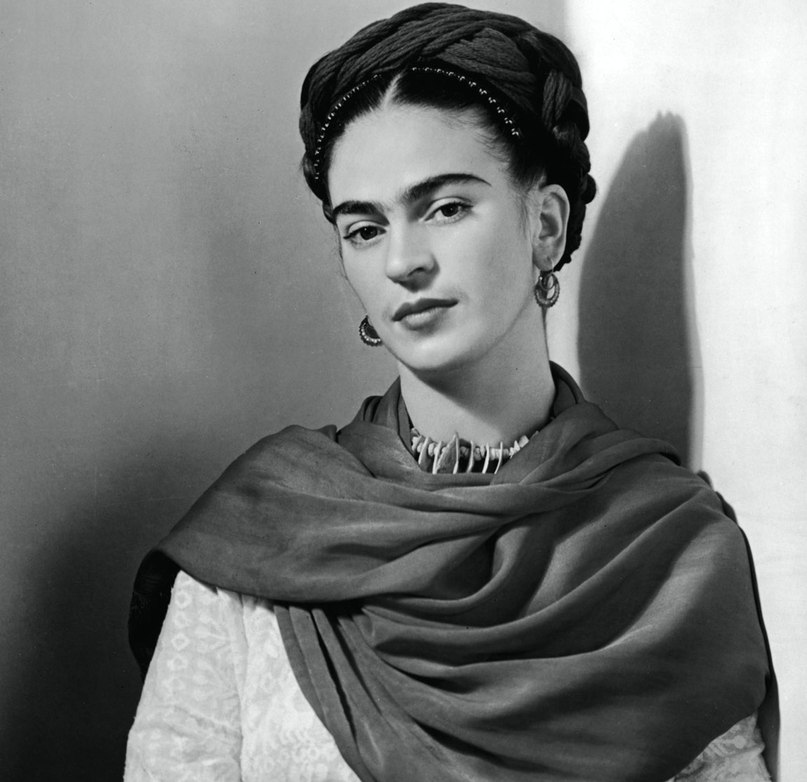
Frida Kahlo (Frida Kahlo de Rivera; July 6, 1907, Coyoacán, Mexico – July 13, 1954, Coyoacán, Mexico) was a Mexican painter celebrated for her surrealist canvases. A road accident in her youth left its mark on her whole life and on her art: Kahlo began to paint while confined to bed. She found fame in Europe — thanks in part to her husband, Diego Rivera — yet she always dreamed of recognition at home. Her first solo exhibition in Mexico came in 1953, shortly before her death.
What distinguishes Kahlo's art: her symbolic works are, for the most part, about herself — her experience, her physical and spiritual pain. Self-portraits make up a substantial share of her paintings, and in them she usually appears surrounded by plants and animals. Illness and death are themes to which she returns again and again.
Among her famous paintings: "The Broken Column," "The Two Fridas," "A Few Small Nips," "The Dream (The Bed)," "Frida and Diego Rivera," "Henry Ford Hospital," "The Wounded Deer."
Mexicans are a strange people — a most unusual one. They paint their clothes, their houses, their whole lives in the colors of sky and sun; they speak a Spanish all their own, singularly melodious; and their songs can draw the soul right out of you. They venerate Santa Muerte, "Holy Death," and turn their chief national holiday, the Day of the Dead, into a true celebration of life. Where else, if not here, could someone like Frida Kahlo have been born?
Frida is one of those rare cases in art where a painter's popularity rests largely on a tragic personal story that crowds her gifted work into the background. All her life she seemed to be running a race with death — now falling behind, now pulling ahead, now clinging desperately to life, now dreaming of "leaving and never coming back." Paradoxical as it sounds, death proved the most faithful companion of Kahlo's entire journey.
The turning point
Frida Kahlo's story properly begins with her parents. It was they, long before her birth, who opened this dance with death — each to a music of their own.
Wilhelm Kahlo, arriving in Mexico from Germany, took the Spanish name Guillermo and renounced Judaism. His first wife bore him three girls; the middle daughter died soon after birth, and the mother herself did not survive her third labor. Left alone with two children, Guillermo very quickly married again — Matilde Calderón y González, a young woman who had already lived through a tragedy of her own: her fiancé had killed himself before her eyes. Frida later wrote in her diary that her mother never fully recovered from that terrible loss, and never came to love her husband.
Matilde bore Guillermo four daughters — Matilde, Adriana, Frida, and Cristina — while their only son died of pneumonia a few days after birth. Magdalena Carmen Frida Calderón came into the world on July 6, 1907. Years later the date would strike Frida as insufficiently momentous, and she would "adjust" her birthday to the outbreak of the Mexican Revolution — July 7, 1910.
When she was six, the muscles of her right leg began to ache. Despite the doctors' efforts, and despite Guillermo Kahlo's determined attention to his daughter's physical training, polio withered the leg and left her lame for life. The real tragedy still lay ahead. She would yet have time to grow up, enter a prestigious German school, gather a "gang" of loyal friends, fall in love for the first time, and begin planning a career in medicine.
It all collapsed on September 17, 1925, when a tram slammed into the bus carrying Frida home from school. The doctors doubted she would live, let alone walk again: a shattered pelvis, a broken spine, and a host of other injuries kept her bedridden for months and announced themselves in constant pain for the rest of her life. In that moment death noticed her for the first time, stepped closer for a better look, and never strayed far again. In that moment Frida's life ended — and an entirely different one began.
A dance with death
One peculiarity of Kahlo's paintings is that they are built up entirely of tiny brushstrokes — punishing work for the hands and spine, and one can only guess how hard it was when she first began to paint. Before the accident her only training had been a few lessons with the engraver Fernando Fernández. Her first brushes and paints were bought by her father, who earned his living as a photographer; her mother ordered a special easel that let Frida paint lying down. Her works of this period are mostly still lifes and self-portraits. Years later Kahlo would say she painted so many self-portraits because her own face was the thing she knew best. But in the months of her convalescence she feared she would die and be quickly forgotten, and so she tried to leave behind as many reminders of herself as she could. The first was "Self-Portrait in a Velvet Dress" (1926).
Another thing that sets Kahlo's paintings apart is their raw emotional charge. Whatever she cannot say in words, whatever she is forced to keep silent about, she carries onto the canvas. She shows the viewer blood, pain, human entrails — the unlovely truth of life. She lays out her anguish over the endless infidelities of her husband, the famous painter Diego Rivera ("A Few Small Nips," 1935); her grief at yet another lost child ("Henry Ford Hospital," 1932); the unending pain of injuries, illnesses, and countless operations ("The Broken Column," 1944; "Without Hope," 1945; "The Wounded Deer," 1946). All her life Kahlo cut her soul open as mercilessly as the doctors cut open her tormented body again and again, showing the viewer her own bared heart, tender and defenseless ("The Two Fridas," 1939).
And Frida would not be Frida had she not inherited the Mexican attitude toward death — respectful, certainly, but with a generous measure of humor. An integral part of Mexican culture are the retablos, naive pictures on small metal plates painted in gratitude to the saints (Diego and Frida assembled an enormous collection of them). It was from the retablos, in particular, that death in its many guises migrated into Kahlo's paintings. It stands at full height in a square in Coyoacán near Frida's house ("Four Inhabitants of Mexico," 1938); it stares through the empty sockets of a mask crowning a little girl in a pink dress ("Girl with Death Mask," 1938); it waits, smiling, for its hour above the bed of the sleeping Frida ("The Dream (The Bed)," 1940). Only in this way could the artist master the fear that this constant, invisible presence inspired in her.
Viva la vida!
Recognition in her native Mexico was long in coming, though as early as 1938 Kahlo had caused a stir in New York, where her first solo exhibition was held at the Julien Levy Gallery. The critics, initially skeptical of "Mrs. Rivera," were won over by her and by the originality of her paintings.
Soon afterward Kahlo left for Paris at the invitation of André Breton, who had promised to arrange a solo exhibition for her. They had met when Breton and his wife Jacqueline Lamba visited Mexico; the poet, struck by Kahlo's work — above all by the then-unfinished painting "What the Water Gave Me" (1938) — informed her that she painted in the surrealist style, to her considerable surprise. Yet for all his promises, Breton never got around to organizing the show. Frida discovered this only on arriving in Paris; furious with Breton, she took to calling the Parisian surrealists "a bunch of crazy sons of bitches."
Far from Mexico, Kahlo was deeply ill at ease. Neither New York nor Paris impressed her; she longed to be back in her Blue House, where she had been born and lived nearly all her life — back with her Diego. They left and returned, quarreled and made up, divorced and remarried, lived in separate houses joined by a slender little bridge. And all the while doctors tried to hold Frida's crumbling body together with metal corsets, endless operations, and medicines.
Her first solo exhibition in Mexico came only in 1953. By then the artist was bedridden, kept going on powerful painkillers and alcohol. But an event of such importance in her life she could not conceivably miss: at the opening she was carried into the Gallery of Contemporary Art on a stretcher and laid on a bed in the middle of the hall.
In her final years painting grew steadily harder, and she returned to where she had begun — still lifes, painted lying in bed. Her last work is held to be "Viva la Vida, Watermelons" (1954), though its crisp lines and confident strokes suggest it was painted well before then. The final touch was only the inscription in blood-red paint, as if carved into the ripe flesh of the melon: "Viva la vida!" — "Long live life!" What else could Frida Kahlo have written, already looking death in the eye, if not this last defiance?