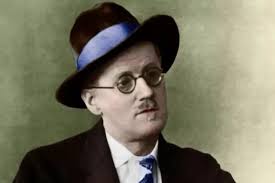
James Augustine Aloysius Joyce was an Irish writer and poet, one of the representatives of modernism.
He was born in Rathgar, a district of Georgian houses on the south side of Dublin, into the large family of John Stanislaus Joyce and Mary Jane Murray. His father's unlucky business dealings brought the family close to ruin and forced him to change professions more than once; the household moved repeatedly from one part of Dublin to another. James contrived nonetheless to receive a decent education, but the poverty and disorder of his early years stayed in his memory for good, and something of them passed into his books. Joyce himself often drew biographical parallels between his own life and that of Stephen Dedalus, the hero of several of his works and one of the central figures of A Portrait of the Artist as a Young Man and Ulysses.
At the age of six Joyce entered the Jesuit college of Clongowes Wood at Clane; then, in 1893, Belvedere College in Dublin, from which he graduated in 1897. A year later he entered University College, completing his studies there in 1902. In 1900 his first publication appeared in the Dublin Fortnightly Review — an essay on Ibsen's play When We Dead Awaken. At the same period he began writing lyric poems. From 1916 he was published in the American literary journal The Little Review, founded by Jane Heap and Margaret Anderson.
At twenty Joyce left for Paris — his first departure for the Continent, where, pressed by money troubles, he changed occupations as often as his father once had, working as a journalist, a teacher, and so on. A year after his arrival in France came a telegram announcing that his mother was gravely ill, and he returned to Ireland. After her death in 1904 he left his homeland again, settling this time in Trieste, in the company of the chambermaid Nora Barnacle — whom he eventually married, twenty-seven years later.
Shortly before the outbreak of the First World War Joyce and his wife moved to Zurich, where he began work on A Portrait of the Artist as a Young Man and, later, on the opening chapters of Ulysses. Moving about Europe, he wrote poems, some of which appeared in Imagist anthologies. He also kept working at Ulysses, a novel that first saw the light not in the writer's homeland, where it was published only in 1933, but in France. It is Joyce's most celebrated book: across six hundred pages the author recounts a single day — 16 June 1904 — in the life of the Dublin Jew Leopold Bloom. Though Ulysses was written abroad, Joyce himself maintained that from this book Dublin “could be rebuilt were it ever destroyed.”
In Paris Joyce began work on his last large-scale composition, the novel Finnegans Wake, published in 1939. This difficult, experimental novel was not well received by the public, however, and to this day it remains a book “for specialists” — unlike Joyce's earlier collection of stories, Dubliners, which is now regarded as a model of its genre. His early novel A Portrait of the Artist as a Young Man is also widely read today.
After the defeat of France and the German occupation of part of its territory at the beginning of the Second World War, Joyce returned to Zurich. He suffered badly from the effects of glaucoma; his health continued to decline, and on 13 January 1941 he died.