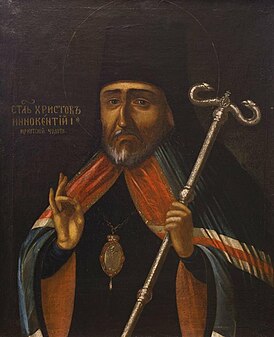
Glorified among the saints, wondrous in miracles, honored near and far, the wonderworker Innocent, first Bishop of Irkutsk, was born at the end of the seventeenth century in Little Russia, in the province of Chernigov. By tradition he was born into the family of a priest named Kolchitsky (or Kulchitsky), a descendant of an old Polish line. At baptism the boy was named John and was raised in the spirit of piety.
Having received his early education at home, he continued his studies at the Kiev Theological Academy. He studied superbly, mastering every subject thoroughly; there was not one discipline he failed to make his own. He applied himself with particular diligence to letters, hoping one day to labor in the preaching of the Word of God. By the time he finished the academy John had been tonsured a monk with the name Innocent; the chosen one of God received the tonsure in the cave of St Anthony near Kiev.
On completing the academy, around 1706-1708, the devout monk was summoned to Moscow as teacher and prefect at the Slavic-Greek-Latin Academy, and from there was taken to St Petersburg, where the Nevsky monastery, the future Lavra, was then being founded, to serve there as an example of good monastic life.
The arrival of an educated and devout monk stood out among the brethren, and the young man soon drew the attention of Emperor Peter I. Relying on the opinion of Filofei (Leshchinsky), Metropolitan of Siberia, the sovereign had settled on his wish to establish a Russian Orthodox spiritual mission in Peking, which by the tsar's plan was to be headed by a bishop. The metropolitan recommended for the post the hieromonk Innocent, a man fully worthy of the tsar's trust.
On the third week of Great Lent, Sunday, 5 March 1721, at the liturgy in the Trinity cathedral of the Alexander Nevsky monastery, the hieromonk Innocent was consecrated bishop. The mystery was performed, in the presence of the autocrat of all Russia, by members of the Most Holy Synod: Stefan (Yavorsky), Metropolitan of Ryazan, and Feofan (Prokopovich), Archbishop of Novgorod.
Immediately after Pascha, in Bright Week, Bishop Innocent, styled Bishop of Belsk, set out from St Petersburg for the land of the unknown Chinese. He was accompanied by two hieromonks, a hierodeacon and five singers with three attendants. It took them nearly a year to reach Irkutsk; from there they pressed on beyond Lake Baikal and halted at Selenginsk, on the Chinese frontier. There the mission was to await the decision of the Peking officials on its right of entry.
At that time the Jesuits had unexpectedly acquired great influence in Peking, and under various pretexts they induced the local officials to evade receiving a Russian bishop. A ground for refusal was found. In the letter requesting permission to enter, Bishop Innocent had been called "bogdo" — that is, "great" — and among the Chinese that form of address belonged only to the emperor; two great personages, therefore, could not be in China at once.
Awaiting new instructions from the Holy Synod, Bishop Innocent remained in Selenginsk, never leaving it, for three years. The saint's life was one of sorrow. Receiving no salary — though he had been assigned 1,500 rubles a year — he supported himself and his suite on the alms of well-wishers. To keep from starving, the mission fed itself by fishing or hired itself out to local householders. The bishop mended his own worn clothing. He found consolation in prayer and in the services, which he celebrated in the old Selenginsk cathedral.
"Where shall I lay my head, and where finish the remainder of my life's course, the Most Holy Governing Synod will judge," he wrote to the Synod. "I humbly beg a gracious decree as to what I am to do: sit in Selenginsk and wait for I know not what, or turn back... for even the foxes have holes for their rest, while I to this day have nowhere to lay my head, but wander from yard to yard and pass from house to house."
The bishop and his suite found lodging, after a fashion, at the grange of the Trinity monastery of Selenginsk. And so as not to eat the monastery's bread for nothing, he and his deacon painted icons for the church.
It was not without the Providence of God that the Chinese refused the bishop entry. His enforced sojourn in Selenginsk proved of great importance for the preaching of the Word of God among the local Mongol tribes. Using his episcopal right of ordination, the saint made good the shortage of clergy beyond Baikal and spared candidates the long journey to Tobolsk, the capital of Siberia, to receive holy orders.
Only in March 1725 did Bishop Innocent receive the order to move to the Ascension monastery of Irkutsk and remain there until further instructions. In the absence of the archimandrite, Antony Platkovsky, the monastery was governed by the hegumen Pakhomy. He assigned the eminent guest and his suite quarters on the eastern side of the monastery, on the bank of the Angara. There, on monastery land, they were also given plots for a kitchen garden, and life thus acquired a certain stability, especially in summer, when the garden had to be worked. Learning that a bishop was living at the monastery, people began to stream to him in search of spiritual consolation. Children and the native peoples were drawn to him above all.
That same year Emperor Peter I died. His widow and successor, Catherine I, appointed Count Savva Vladislavovich Raguzinsky ambassador extraordinary to China and charged him to take Bishop Innocent with him to Peking — if, of course, the Chinese agreed.
Raguzinsky arrived in Irkutsk on 5 April 1726. Meeting the bishop, he proposed that he return to Selenginsk and wait for him there, while he himself remained in Irkutsk to make the necessary preparations for the road. At this time Archimandrite Antony Platkovsky, who had been in Peking before with the ambassador Izmailov, returned to Irkutsk from Moscow. He wanted very much to head the mission there, and set about winning over Count Raguzinsky. Every art of cunning, obligingness and lavish hospitality, even slander and abuse of Bishop Innocent, was pressed into service. The fruit of these maneuvers was a letter from Raguzinsky to Petersburg in which he wrote that he had no hope of the Chinese receiving the bishop, and therefore judged Archimandrite Antony Platkovsky fit for the office of head of the mission. The letter was sent to Petersburg by courier and accepted there without verification. In March of the following year St Innocent received a new decree — to move once more to the Ascension monastery. Archimandrite Antony Platkovsky was named head of the mission in Peking.
The bishop had scarcely settled in the Ascension monastery when a new imperial command arrived from Petersburg: he was to be the independent Bishop of Irkutsk and Nerchinsk. By this decision a new see was created, and with Bishop Innocent began the independent line of the bishops of Irkutsk.
Installed in his new place, Bishop Innocent met the same troubles as in Selenginsk. As before, there was nothing to live on and no roof over his head. The consistory refused to pay his salary, on the ground that it had supposedly been assigned for residence in China, not in Irkutsk. Irkutsk had not yet grown out as far as the Ascension monastery, and the bishop often had to travel the bad road into town and back. Being a man of poor health who bore journeys hard, he asked the citizens of Irkutsk to lend him lodgings for a time. Not one of them was found to take into his house the future intercessor before the throne of God for the whole Irkutsk flock. At last the provincial chancery took pity on the bishop and assigned him the house of the boyar's son Dimitry Elezov. On that spot a stone chapel now stands in memory of the saint's residence there.
For little more than four years he shepherded the Irkutsk flock, but even that time, short by human measure, he turned to great profit for salvation. As has been said, Bishop Innocent was not blessed with strong health — he suffered especially from headaches — yet he abandoned none of his labors, neither of prayer nor of the mortification of the flesh. On his body he wore a hair shirt, over which he always had a cassock of elk hide and a leather belt with an iron buckle. The saint loved to pray in a cave beyond the monastery wall, dug by the elder Gerasim, founder of the Ascension monastery. He had, too, a custom of walking round the Ascension church at night and praying toward it from its four sides.
The bishop dearly loved to work with his own hands. By day he helped haul the nets with those assigned to the fishing, and by night he sewed footwear for the pupils. With his own hands he planted two cedars in the monastery.
The good shepherd labored not with his hands alone: not for a moment did he leave off the chief work, the preaching of the Word of God. The pagans who lived in great numbers around Irkutsk he brought to the holy Church not only by families but by whole encampments. Thus from the newly baptized Buryats a whole settlement, Yasachnoye, was formed.
Bodily infirmities could not check his inexhaustible love for God, which he hastened to share with all. Following Christ was for him not a mere summons but the meaning of life, and by that principle he was guided in everything he did — whether he sewed shoes, taught the Buryats, or raised a church, he kept before him the image of our Savior Jesus Christ.
His office required him to sit in judgment, and he never shifted that unpleasant duty onto others. He always decided cases himself, entered into all the circumstances, reached his decisions swiftly, and covered the strict truth of the law with love.
Despite all the difficulties of communication with the town, the building of the Epiphany cathedral was almost wholly completed during his rule. A Mongolian school had been set up at the Ascension monastery by Archimandrite Platkovsky; St Innocent not only sustained this useful undertaking but opened in addition a Slavonic-Russian school for all estates. The first bishop of Irkutsk obtained from the sovereign's treasury a maintenance for his successors and funds for the building of a bishop's residence; he also fixed the boundaries of the diocese.
From his righteous labors the bishop liked to rest in the small settlement of Malaya Yelanka, fifteen versts from the Ascension monastery, where novices, monks and peasants sent out from the monastery worked the fields. Helping those who labored and were heavy laden on weekdays, he saw to it that on Sundays and feasts no cares kept them from the service of God. A chapel was established at Malaya Yelanka, and the bishop more than once foretold that in time a church would rise in its place. The prophecy was fulfilled at the end of the nineteenth century. In his lifetime the bishop more than once astonished his contemporaries by his spiritual foresight.
Once, on the day of Cyril, Patriarch of Alexandria (June 9), the people of the village of Fekskoye asked the bishop to serve the Divine Liturgy among them. "Very well," he answered, "we shall serve it. Only we shall go there by summer, and come back by winter." At that moment the villagers did not grasp his meaning; but the day after the liturgy such snow fell that the bishop had to return by sleigh.
There was another astonishing incident, which confirmed all in the belief that the bishop was truly a chosen vessel, filled with the Holy Spirit. Once, during a procession of the cross around the town, a downpour began and everyone was soaked to the skin. Only the bishop's vestments were touched by not a single drop.
Such manifestations of God's grace upon him won him the love and reverence of his flock while he yet lived, and after his death became the ground of the devout veneration of his memory.
St Innocent loved above all to serve the Divine Liturgy. To the last days of his life he strove to let no opportunity pass of being united, here on earth, with Christ. He celebrated the Divine Liturgy for the last time on the feast of the Protection of the Most Holy Theotokos, and then on Sunday, October 3. After that human infirmity confined him to his bed. The illness now worsened, now relented. In his worse moments the bishop would call the brethren together, thank those who served him for their love and care, and give away some of his belongings as keepsakes; those for whom no gift remained he promised to reward without fail at the first return of his strength. He grieved deeply that he was leaving the Ascension church in disrepair, and said more than once that if a salary were assigned him, the first thousand rubles would go to the building of a stone church.
He never saw a salary in his lifetime. The decision granting him his maintenance and meeting some of his needs arrived when he no longer needed anything earthly.
On Thursday, November 25, the saint's sufferings became extreme. He asked the brethren and all the priests of the town to pray for him and to serve a paraklesis after the liturgy. On Saturday, 27 November 1731, in the seventh hour of the morning, the Lord gave the saint his everlasting rest. The monastery bell announced his death, which came in the presence of his confessor, the hieromonk Kornily (Bobrovnikov), the brethren and his cell attendants. The departed was clothed in his hair shirt, over which were placed a cassock of Chinese silk and a silk mantle. His head was covered with the klobuk he had worn in life.
The bishop's death was reported to the vice-governor, Zholobov. The vice-governor, a man of measureless greed and rapacity, decided to profit by the occasion and seized not only all the bishop's property but part of the monastery's substance as well. Having thus stripped the monastery, he left the brethren unable not only to bury St Innocent but even to celebrate the liturgy, for want of wine. Only after insistent pleading did Zholobov release three hundred rubles for the saint's burial, forbidding them to apply to him again.
The burial took place on December 5. The coffin of pine was covered with black velvet. The most pure body of the bishop was laid in a stone vault beneath the altar of the wooden church of the Tikhvin Icon of the Mother of God, built in 1688 by the elder Isaiah.
Soon after the saint's death the Lord made manifest His judgment on those who had wronged him. Archimandrite Antony Platkovsky, disgraced to the last degree in Peking by the unbeliever Lang, who beat him publicly and cruelly, was carried in fetters past the Ascension monastery to Petersburg, where degradation from his rank and confinement awaited the unhappy man. The vice-governor Zholobov was beheaded in Petersburg by sentence of the criminal court. Both events struck everyone, even the most hardened in unbelief, with their providential force.
But if some of little faith still needed outward persuasion, the faithful flock kept in their hearts the hope that the Lord would not "suffer His holy one to see corruption." Thirty-three years after the saint's death, during repairs to the Tikhvin church, it was discovered that his body, his vesture and even the velvet on the coffin were untouched by decay, though the burial place itself was damp and musty.
Two years later the superior of the Ascension monastery, Archimandrite Sinesy — a future beacon of the Siberian Church, glorified by the Lord in 1984 — witnessed the following miracle on the monastery's feast of the Ascension. Present at the meal after the Divine Liturgy was the governor, a German named Frauendorf. He had heard much of the incorrupt remains of the saint and greatly wished to view them. However the bishop present at the feast — Sofrony, himself a future saint of God — tried to deflect the wish of a man of another faith, the governor could not be turned from his purpose. Bishop Sofrony, the venerable Sinesy and Frauendorf approached the saint's burial vault — and could not see the coffin: it was covered with a dense, impenetrable layer of snow. After the governor's departure not even a trace of snow could be found.
Seventeen years after this miracle, after numerous declarations from private persons who had experienced the saint's prayerful intercession after praying at his honored remains, there came yet another assurance that the relics of the saint stood under the special protection of God.
On 11 June 1783, in a strong wind, the Ascension monastery caught fire. All Irkutsk, young and old, ran to the blaze, but to extinguish it was impossible. The flames engulfed all the stone buildings of the monastery — and, of course, threatened the wooden Tikhvin church beneath which the saint's relics rested. No hope remained of saving the incorrupt relics of God's servant. Then the townspeople turned to Bishop Sofrony's successor, His Grace Mikhail (Mitkevich), who had come to the fire, begging him to try to bring the relics out of the flames. "If the departed Innocent pleased God," he answered, "then for the sake of his incorrupt relics the Almighty Lord will save the church as well." In that very minute the fire lost its power over the church, overshadowed by grace. By God's mercy it stood until the beginning of the twentieth century amid the newly rebuilt stone walls and buildings of the monastery, an irrefutable witness of the miracle wrought upon it. In the chronicle of Irkutsk, witnesses of the fire recorded: "On the Sunday of All Saints (June 11) of the year 1783, in the fourth hour of the afternoon, the Ascension monastery burned: namely all the cells, three churches — two of stone, without and within, to nothing; two bells besides were shattered and others spoiled. Great was the terror! And there was besides a mighty gale. And the holy images and all that was in the churches — books, vestments and the rest — the whole enclosure and the two archbishop's cedars burned to nothing. There remained only the wooden church of the Tikhvin Mother of God, where the archbishop lies buried."
The miracles from the saint's relics multiplied. Faith in his intercession before the Lord passed from generation to generation. Many served panikhidas at his grave and received what they asked. The fame of the new intercessor spread among the Orthodox; the servant of God did not reject the prayers of his venerators in Tula, in Yakutsk, in Petersburg, and written testimonies of his intercession were sent to the diocesan authorities from every quarter. In the last days of September 1800, His Grace Veniamin, Bishop of Irkutsk, received a letter over the signatures of 389 persons setting out the request that the honored and incorrupt relics of the saint be opened for veneration by all the people. This last petition threw Bishop Veniamin into some perplexity, which was resolved by a secret inspection of the Irkutsk region. By supreme command the senators Rzhevsky and Levashov were then in the region, and they too addressed a letter to Bishop Veniamin. "As eyewitnesses," the senators wrote, "not only of the incorruption of this body, as men who have ourselves breathed its fragrance, as personal witnesses of the accounts of his manifold miracles, we hold it our duty to have from Your Grace, who have governed the diocese these ten years, all information concerning the incorrupt wonderworker, for report, as our duty requires, to the Sovereign Emperor."
The bishop handed the senators a letter for the sovereign and appended to it an extract of the cases of miracles wrought at the saint's relics, more than a hundred in number. The sovereign required the Synod to examine the matter, and by the Synod's direction the vicar bishop of Kazan, Iustin, came to Irkutsk. Bishop Iustin personally examined the saint's relics, questioned certain witnesses of the miracles under oath, and together with Bishop Veniamin reported to the Synod on 5 March 1801. The report contained a detailed description of the examination of the relics, conducted for greater credibility in the presence of laymen — the governor, Alexei Ivanovich Tolstoy, with his officials, and the mayor, the merchant Pyotr Avdeev, with many honored citizens. All the participants in the examination confirmed the true preservation of the saint's remains. The coffin and the saint's vesture were likewise in perfect incorruption — this more than seventy years after burial.
The report of Bishops Veniamin and Iustin plunged the Most Holy Synod into deep reflection. Two years later the Synod sent Bishop Veniamin an inquiry: were any changes observed in the body of St Innocent, and had there been any memorable events in the interval? His Grace Veniamin answered that no change in the state of the relics was observed, that the veneration of the saint by all the people continued and spread, and that he himself, Bishop Veniamin, was "persuaded in conscience to acknowledge the intercession of Saint Innocent as accepted by the mercy of God." But even this letter had no effect. The Synod kept silence for yet another year. Finally a representation was sent to the first member of the Synod, Metropolitan Amvrosy, and to the chief procurator Golitsyn, from the governor-general of Siberia, Selifontov, in which he personally attested the incorruption of the saint's relics and voiced his own insistence, and that of all Siberia, on their opening.
Delay was no longer possible, and on the first day of December 1804 the Most Holy Synod, with the sovereign's assent, declared: the body of the first Bishop of Irkutsk, Innocent, was to be proclaimed wholly holy relics, and Bishop Veniamin of Irkutsk with the rest of the clergy, with due reverence, was to place it in the church of the Irkutsk Ascension monastery above, or in another worthy place, with the establishment of his feast on November 26, the day of the saint's repose; vigils and services of supplication to the saint were henceforth to be celebrated, and the necessary additions made in the church books: "November 26, the memory of the repose of Saint Innocent, first Bishop of Irkutsk, Wonderworker."
The longed-for news of the opening of St Innocent's relics was received in Irkutsk on 19 January 1805. On the very next Sunday, literally two days later, a public service of thanksgiving to the Lord God was celebrated, after which preparations began for an extraordinary solemnity.
On February 2, the feast of the Meeting of the Lord, His Grace Veniamin received the holy relics from the vault, set them in the middle of the Tikhvin church, and celebrated the Divine Liturgy before them. A week later, on February 9, the saint's relics, before an immense concourse of people, were solemnly translated with a procession of the cross, the wonderworking Kazan icon of the Mother of God borne before them, from the Tikhvin church to the cathedral church of the Ascension.
There the relics rested for fifty-five years, until the Ascension church had to be taken down for decrepitude. For twelve years they lay in the Dormition church of the Ascension monastery, and on 15 October 1872 they were returned beneath the vaults of the splendid church of the Ascension of the Lord, newly rebuilt on the old site.
In memory of the first translation of the saint's relics a procession of the cross with the Kazan icon of the Mother of God was held every year in Irkutsk. So it continued until 1920, the time of the most savage persecutions of Christians.
From the winter of 1920 the arrests of the inhabitants of the Ascension monastery began. The superior of the monastery, Zosima (Sidorovsky), Bishop of Irkutsk, was arrested and subjected to torture. On February 1 prominent hierarchs of Siberia, who had come to venerate the relics of St Innocent, were arrested at the monastery: Gavriil (Voevodin), Bishop of Barnaul (d. 1938); the Bishop of Petropavlovsk (Krasnoperov, d. 1921); and Irinarkh (Sineokov-Andreevsky), Bishop of Berezov (d. 1933).
In 1921 the authorities committed an act of sacrilege: the relics of St Innocent were opened for "medical examination." The new superior of the monastery, Boris (Shipuchin), Bishop of Kirensk (d. 1937), wrote to the clergy and parishioners: "Yesterday, January 11, the relics of Saint Innocent were opened. The vestments and clothing were removed, the incorrupt body stripped and left exposed in the church. The church is locked. The services have ceased. The monastery is guarded by Red Army soldiers." Later, under heavy guard, the relics were carried off to an unknown destination.
The Irkutsk flock was orphaned. Together with the whole Russian Orthodox Church it wept over its sins, humbly accepting what God had permitted.
For a long time the saint's relics were held to be lost beyond recall — but the Lord "will not always chide, neither will He keep His anger for ever." In 1990, in one of the utility rooms of the Yaroslavl church of St Nicholas Nadein, unknown relics were discovered. To identify them, an examination was conducted at the department of forensic medicine of the Yaroslavl medical institute. The description of the relics made by the Yaroslavl physicians coincided completely with the data of the act drawn up in Irkutsk in 1921. The relics of St Innocent, left for seventy years in a damp, unheated room, the Lord had preserved for the revelation to us of the miracle of His mercy.
And now, trusting in the intercession of the servant of God newly revealed to us, Saint Innocent, we turn to him with our prayers.