The city where the followers of Christ were first called Christians was Antioch — one of the largest cities of the Roman Empire, third in importance after Rome and Alexandria. In the second half of the first century its bishop became a man named Ignatius, who called himself the God-bearer. Little is known of his origins and the early years of his ministry: the details are legendary, and reliable information begins where his final journey begins — the journey to his death.
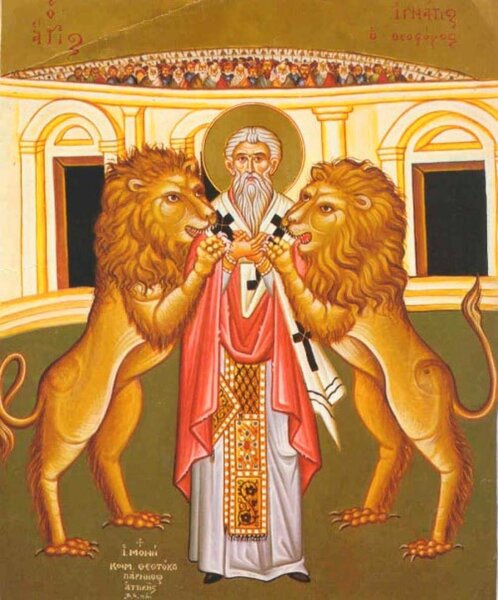
Under the emperor Trajan (98–117) persecutions of Christians broke out in Antioch. Ignatius was arrested and sentenced to the most disgraceful execution — to be torn apart by wild beasts in the arena, and not in his own city but in Rome, the capital of the empire, to which the condemned were brought from every province. The bishop was sent on a long journey by land and sea under the guard of ten soldiers, whom in his letters he sardonically called "ten leopards": the more kindly they were treated, the worse they became.
The route across the provinces of Asia Minor stretched out over weeks. In the cities through which Ignatius was taken, Christian communities sent delegates to him — some came to bid him farewell, some brought letters and gifts. In Smyrna he was met by the local bishop, Polycarp; from here and from Troas Ignatius wrote most of his epistles, making use of the convoy's brief halts.
Seven of his letters survive in all — to the communities of Ephesus, Magnesia, Tralles, Philadelphia, and Smyrna, a separate epistle to Polycarp, and an epistle to the Romans. These are among the earliest Christian texts to have come down to us outside the New Testament — Ignatius is counted among the Apostolic Fathers, who wrote at the turn of the first and second centuries. In his letters he insists on the unity of the church around its bishop and is the first known author to use the very phrase "catholic church."
The most personal of the epistles is the letter to the Roman Christians. Ignatius, knowing that the community there might try to obtain his pardon, directly asks them not to interfere with his execution: death in the arena he regarded not as an end but as the beginning of true discipleship. "I am God's wheat," he writes, "and let me be ground by the teeth of the beasts, that I may prove to be pure bread of God." This phrase has since remained one of the most quoted images in early Christian literature on martyrdom.
No eyewitness accounts of the execution itself survive: tradition places Ignatius's death in the Roman arena at the very beginning of the second century, in the reign of Trajan. The wild beasts, if the tradition is to be believed, left almost nothing of him that could be buried — just as he himself, judging by his letters, had hoped.
Both traditions, Eastern and Western, honor Ignatius as a saint and martyr: the Catholic Church celebrates his memory on 17 October, the Orthodox on 20 December. But the main thing that remains of him is neither the date nor the place of his execution, but the letters. This is a rare direct testimony to what church life looked like just a few decades after Christ: with bishops and deacons, disputes over doctrine, and a man who preferred execution to recantation.