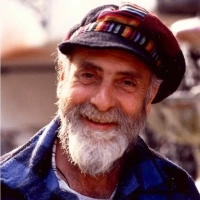
Friedensreich Hundertwasser (German: Friedensreich Regentag Dunkelbunt Hundertwasser; December 15, 1928, Vienna, Austria – February 19, 2000, aboard the liner Queen Elizabeth 2, Pacific Ocean) was an Austrian architect and painter who created and decorated a remarkable number of highly unusual buildings around the world. Born Friedrich Stowasser, he used various names over the course of his life and won fame as Friedensreich Hundertwasser. His talent was first noticed while he was a pupil at a Montessori school in Vienna. He lost his father very early; his mother, Elsa, was Jewish, and the two only narrowly escaped persecution under the Nazi regime. There is a certain irony in the fact that in 1945 Friedrich entered the Vienna Academy of Fine Arts — the very academy that had once turned away Adolf Hitler.
He lasted only a few months at the academy, however, before setting off to travel through Europe and Asia. In a sense Hundertwasser spent his whole life on the road — he even died aboard an ocean liner sailing from New Zealand to Europe.
His first taste of fame came in the early 1950s, with his first solo exhibition in Vienna. Around the same time, though, he realized that his true calling was architecture. Over that decade he carried out several major architectural projects, among them the famous Hundertwasser House in Vienna, all the while traveling widely and taking commissions around the world. In the early 1970s he bought several buildings in New Zealand, where he lived for the rest of his life. A passionate and committed defender of nature, he opposed nuclear technology and environmental pollution, joined demonstrations, and even delivered lectures in the nude. "We are guests of nature," Hundertwasser said. "Behave accordingly."
What defines Hundertwasser's work: throughout his career he insisted that people, even those living in apartment blocks, should have the right to shape their homes as they pleased — to decorate them, to paint them in any colors or patterns, even to scrape away the plaster and bare the brickwork. He was convinced that our houses are the third layer of our "skin" (the first two being the epidermis and our clothes), and that a person should feel at ease in every one of them. The modern world, he often said, surrounds us with far too many unnaturally straight lines, and so his architectural projects favored forms close to those of nature. He first read out his manifesto renouncing the straight line and conventional architectural design as early as 1958. In architecture as in painting, his favorite form was the spiral; he also loved capricious, winding lines, inspired above all by the Vienna Secessionists, and by Gustav Klimt in particular.
Among Hundertwasser's famous works: the Hundertwasser House, the Forest Spiral, the Green Citadel of Magdeburg, the Maishima Sludge Center, and the public toilets at Kawakawa.