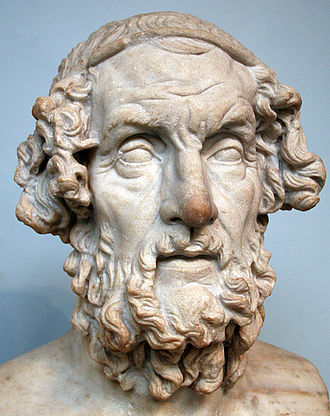
Homer — the great poet of ancient Greece, bard, gatherer of legends, author of the monumental epics the Iliad and the Odyssey — is a figure children first meet at school. The surviving ancient testimonies tell us that antiquity treated his poems as a fund of wisdom: from them one could learn about almost every sphere of life, from the foundations of morality to the secrets of war. Plutarch records that Alexander the Great, that great conqueror, carried a copy of the Iliad with him on campaign; the Odyssey served in Greek schools for teaching children their letters; and the Pythagorean philosophers prescribed passages of Homer as a means of purifying the soul.
A great deal of scholarship has been devoted to Homer's biography, and yet it remains full of riddles and so-called dark patches. What follows is a brief account of that life, dwelling on the chief points scholars have never fully settled — points interesting in themselves and well worth our attention.
Why do the accounts of his life differ?
About a dozen lives of the great blind bard survive. His portrait is drawn in fair detail by ancient and later medieval writers — who, however, were composing many centuries after the poet's death. Since no reliable record of Homer's life was preserved, their versions abound in inaccuracies. The proof is that every one of these biographies admits mythical figures, gods among them, who supposedly took a hand in the poet's fate, along with invented episodes said to have occurred in his life.
So let us turn to Homer's biography — briefly, and to the essentials. "The greatest thing about Homer," said the Roman historian Velleius Paterculus (19 BC – AD 31), "is that before him there was no one he could imitate, and after him no one has been found who could imitate him."
The riddle of his birth
Nothing precise is known of when or where the bard came into the world, and this obscurity opens a whole chain of mysteries in his biography. Scholars place his life most probably in the tenth to eighth centuries BC. Argos, Rhodes, Chios, Salamis, Smyrna, and Athens are all named as his possible homeland, and studies of his biography mention a dozen further Greek cities besides. The commonest conjecture is that the great poet was born at Smyrna.
Dating his life, from birth onward, is complicated by the fact that all his poetry looks back to ancient history: it contains not a single mention of the author's contemporaries. One legend has it that the bard himself did not know where he had been born, and learned only from the Oracle that his mother's homeland was the island of Ios.
The riddle of his name
Historians are equally doubtful about the origin and meaning of the name. Many accounts of the great bard's life hold that the name that has come down the centuries — Homer — was given him in consequence of his blindness; on one reading it means "the unseeing" or "the one who is led." At birth his mother, Cretheis, had named him Melesigenes, "born by the river Meles." Legend says the poet went blind after beholding the sword of the invincible Achilles, and that the goddess Thetis, to console him, granted him the gift of song.
There is another view. Some scholars hold that the poet was not "led" at all — that the name should rather be read as "the one who leads," and that he came to be called Homer not after losing his sight but after the goddess restored it and made him a sage. In the Ionic dialect the name is pronounced "Omiros"; it is first attested in the seventh century BC. At various times it has been glossed as "composer," "accompanist," "hostage," "one who follows." Whether it is a true name or merely a byname, scholars have never agreed.
His character and way of life
No brief life of Homer can pass over the fact that scholars disagree, too, in their descriptions of the great bard's person and manner of living.
By the researchers' account, the bard's creative years fell at the very height of Greece's flourishing. Homer performed at civic assemblies, in marketplaces, at the feasts of the nobility; traveling from city to city, he recited passages of his poems, and the Greeks listened with delight. Against those scholars who picture him as a wretched, filthy vagrant begging alms at rich men's doors, most researchers believe that in those times, blessed for the country, a traveling poet commanded immense respect, was welcomed everywhere, and never lacked food or a night's lodging.
The making of the poet
One story of how Homer became a poet holds particular interest for admirers of the blind bard's work. It comes from the pen of the celebrated ancient researcher Herodotus of Halicarnassus, whom Cicero called "the father of history," and no brief life of Homer should omit it.
At birth, as already noted, the poet was named Melesigenes. He lived with his mother in the city of Smyrna, was uncommonly intelligent, and excelled at his studies. He became a pupil of Phemius, master of a school, and when the teacher died the school passed by inheritance to his best pupil: Melesigenes became a schoolmaster in his turn. In time he understood that the moment had come to deepen his knowledge of how the world is made. He became acquainted with a certain Mentes, a native of the island of Leucas, who invited him on a sea voyage aboard his ship; Melesigenes, who had long wanted to see new lands and cities, closed the school and set out.
During his wanderings, Herodotus continues, the young man gathered stories and legends, questioning the inhabitants of the cities where the travelers put in about their customs. On Ithaca he fell ill; Mentes had to leave his companion in the care of trustworthy people and sail home alone. Thereafter Melesigenes traveled on foot, reciting as he went the curious stories he had collected. It was at Colophon, in Herodotus's telling, that the bard went blind and took his new name. Modern researchers doubt this story, as they doubt the other ancient historians' accounts of Homer's life.
On Homer's homeland
Scholars also describe a poetic contest between the two great poets of ancient Greece, Homer and Hesiod. Tradition has them meeting on the island of Euboea, at games held in honor of the dead Amphidamas, each reciting his finest work. King Panedes, who judged the contest, awarded the victory to Hesiod, whose verses called for peace and husbandry rather than, like Homer's, for war and slaughter. The public's sympathies, however, lay with Homer.
On the bard's blindness
Some students of the great Homer's life and work believe the poet could in fact see. In ancient Greece, philosophers and thinkers were held to be men deprived of ordinary sight but endowed with the gift of seeing the essence of things; on one scholarly hypothesis, the ancient and medieval biographers may have used "blindness" as a name for something synonymous with wisdom. And Homer's wisdom was plain to all: he was held to be the author of the genealogy of the gods, one of the makers of an all-embracing picture of the world.
Of his physical blindness there is no reliable confirmation. Many outstanding Greek bards and poets were blind — the affliction barred them from other work — and since the ancient Greeks linked the gift of poetry to the gift of prophecy and paid blind singers immense honor, it may well have been Homer's very calling that suggested the idea of his blindness to the biographers.
The Iliad and the Odyssey
In the Iliad Homer recounts a single episode of the Trojan War, revealing the characters of his personages and the intrigues that preceded the outbreak of the conflict.
The Odyssey describes events ten years after the Greek victory over Troy. Its hero, Odysseus, king of the island of Ithaca, making his way home to the faithful Penelope, overcomes enormous obstacles with his companions and endures trial after trial.
In the nineteenth century the prevailing scholarly view was that Homer's two masterpieces, the Iliad and the Odyssey, had no historical basis. That view was overturned by the excavations of Heinrich Schliemann, who discovered Troy; a little later, documents came to light confirming that the Trojan War was real.
Other works
Historians and literary scholars believe Homer wrote more than the Iliad and the Odyssey. The bard is also credited with the Homeric Hymns and the comic poem Margites, and with several texts recounting the homecoming of the heroes of the Trojan War: the Sack of Ilium, the Cypria, the Little Iliad, the Aethiopis, and the Nostoi, or Returns. His poetry is marked by a language and a manner of narration without parallel in common speech, which have made it arresting and unforgettable.
The riddle of authorship: the Homeric question
In 1795 Friedrich August Wolf, prefacing an edition of the poems, advanced the theory that came to be known as the "Homeric question." A blind wandering singer, Wolf argued, could not have written works of such complexity, for in Homer's day poetry was an oral art; to Homer belonged the hymns, songs, and epic material on which the Iliad and the Odyssey were built, while the labors of other authors gave the poems their finished form.
Other scholars took up the idea that the great bard was not the sole author of the poems that made his fame. Many students of Homer's work and life maintain that the Iliad and the Odyssey are by different hands, the singer himself being merely their performer.
Historians also entertain the theory that Homer belonged to a clan of bards. Ancient Greece knew its craft dynasties, in which the secrets of a trade passed from generation to generation; if so, any member of a lineage in which the stories of the poems, and the manner of performing them, were handed down from one family member to another could have appeared under the name of Homer. That would explain both why the Iliad and the Odyssey were composed in different periods and why the date of the poet's birth remains unsettled to this day.
The so-called "Homeric question" has never been resolved. Students of Homer still divide into camps: the "analysts," who follow Wolf's theory, and their opponents the "unitarians," who hold to the strict unity of the epic.
On Homer's death
Legend tells the great poet's end thus. In advanced old age the blind bard came to the island of Ios, where he met two young fishermen, who put a riddle to the sage: "We have what we did not catch; what we caught, we threw away." Long as he pondered the puzzle, the poet could not find the right answer, and the old man was so mortified by his defeat that he killed himself, dashing his head against a rock at a run — death being less terrible to him than the loss of a clear mind. The meaning of the riddle was that the fishermen had been catching not fish but lice; that was the answer they had expected of the sage.