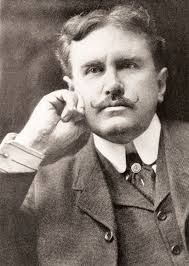
William Sydney Porter was born in 1862 in Greensboro, North Carolina, into the family of a physician. His mother died when he was three; he was raised by an aunt. In his youth he changed occupations several times: pharmacist, shepherd on a Texas ranch, draftsman. From 1891 he worked as a teller at the First National Bank of Austin, where a shortfall in the accounts was discovered. Whether it was intent, negligence, or a muddle in the bookkeeping remains an open question; Porter himself did not admit guilt. When the investigation closed in on him in 1896, he fled to Honduras, beyond the reach of American extradition. On learning that his wife was dying of tuberculosis, he returned, was arrested, and in 1898 was sentenced to five years. For good behavior he was released after a little over three.
In the penitentiary in Columbus he took a place in the pharmacy block and at night wrote stories, sending them to New York magazines under the name "O. Henry." The pseudonym concealed the fact that the author was behind bars. Where the name came from is not known for certain; there are several versions, none confirmed. By the time he left prison in 1901 he already had a readership and a reputation as a storyteller.
New York became his chief material. He rented cheap rooms in Greenwich Village and other parts of Manhattan, wandered the streets, and eavesdropped on conversations in cafés and bars. Clerks, immigrants, waitresses, petty swindlers, penniless artists — this whole motley city turned into stories. Over ten New York years he published more than three hundred stories. The pace was dictated by want: the money ran out as quickly as it was earned.
"The Gift of the Magi" (1905) became the model of what is called the "O. Henry ending": a young couple at Christmas, neither with money for a gift, but each with a single treasure. Della sells her long hair to buy a chain for her husband's watch. Jim sells the watch to buy tortoiseshell combs for his wife's hair. A symmetry of sacrifice that mutually cancels itself out. It is precisely in this absurdity that the purity of intention shows through — and in no other way. This device — an unexpected turn that recasts everything that came before — O. Henry used again and again, until he himself became a synonym for the device.
But his best story, perhaps, is built differently. "The Last Leaf" (1907) is about a painter dying of pneumonia: she looks out the window at the ivy on the wall across the way and decides that she will die when the last leaf falls. The leaf does not fall — even under the autumn rain. The ending explains why: old Behrman, the painter, on the last night of his life painted it directly on the brickwork. Pneumonia carried him off, not her. The miracle was made by another's hand and another's death — and there is nothing in the story beyond this simple fact. None of the conjuror's mechanics.
O. Henry died in June 1910 in New York, at forty-eight, of cirrhosis and diabetes. His last years were hard: failing health, alcohol, debts. In the literary hierarchy he occupied a strange place — a master loved by all and about whom one is a little embarrassed to speak seriously: too deft, too aimed at effect. But his stories land exactly where the hope for an unforeseen turn lives in a person — and remind us that sometimes another's quiet sacrifice turns out to be more real than reality itself.