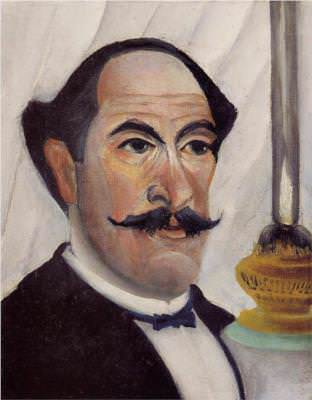
Henri Julien Félix Rousseau was born on May 21, 1844, in the town of Laval, into the family of a tinsmith. He never finished school, served four years in the army, and from 1871 took a post with the Paris customs office, collecting tolls at the city gates. Hence the nickname that stuck with him for life: "Le Douanier" — the Customs Officer.
He took up painting on his own as an adult, around 1880, without any academic training. He painted as he saw: flat, without classical perspective, with an almost childlike directness of line. He first showed his work to the public in 1886 at the Salon des Indépendants — and became a constant target of ridicule: critics called his paintings amateurish daubs, and the public came specifically to his section to laugh.
The best-known part of his legacy became the jungle scenes — tigers in the undergrowth, lions over a sleeping gypsy, exotic flowers of impossible size. Yet Rousseau himself never once set foot in Africa or South America: all his tropics grew out of Sunday walks through the Paris Jardin des Plantes and its greenhouses, out of the zoo, and out of illustrated catalogues. He was happy to let rumors of his own travels go uncorrected — the legend suited him.
Among his major works are "The Sleeping Gypsy" (1897), in which a lion sniffs at a woman asleep in the desert beside a mandolin and a jug, and "The Dream" (1910), an enormous canvas of a nude on a divan in the middle of the jungle, shown at the Salon des Indépendants in the year of his death. Both paintings rest on the same device: a scene of utter calm, almost dreamlike, in which predator and human exist side by side without any tension — as though the laws of nature had been suspended for a moment.
The poet and playwright Alfred Jarry was among the first to see in this naive directness not helplessness but a language all its own, and did much to make Rousseau taken seriously. But the real paradox of his fate is bound up with Picasso. Picasso bought Rousseau's "Portrait of a Woman" for five francs at a flea market before he had even met the artist — simply as a curious find. Then in 1908 he threw a boisterous, half-serious, half-mocking banquet in the painter's honor at his studio in the Bateau-Lavoir, drawing the whole artistic crowd of Montparnasse.
Rousseau, it seems, never suspected the irony, and accepted the tribute in complete earnest — he genuinely believed himself a true master of the academic school, only purer and more honest than the fashionable painters. This unshakable self-confidence, with nothing outward to support it, was perhaps the main pillar of his entire life: to the very end he remained a poor artist, earning his living by giving drawing and music lessons.
He died on September 2, 1910, in the Necker Hospital in Paris, of gangrene that set in after he injured his leg. True recognition came only after his death: the Surrealists saw in his hallucinatory precise jungles and still, faintly unsettling figures a premonition of their own method — an art born not of observation, but of inner vision.
Even before the Surrealists, the German Expressionists had already taken notice: Wassily Kandinsky included a reproduction of a Rousseau painting in the almanac "The Blue Rider" (1912), placing the self-taught customs official alongside the professional painters of the new art. And so a man who spent his whole life collecting tolls at the gates of Paris, and never once saw a real jungle, became one of those who opened for the twentieth century another, non-academic path into painting — the path of a direct gaze, unfiltered by schooling.