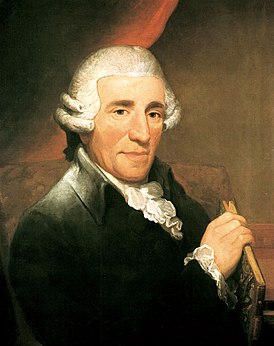
The career of Joseph Haydn — the great Austrian composer, elder contemporary of Mozart and Beethoven — spanned some fifty years, crossed the divide between the eighteenth and nineteenth centuries, and embraced every stage in the development of the Viennese classical school, from its beginnings in the 1760s to the flowering of Beethoven's art at the dawn of the new century. The intensity of his creative energy, the richness of his imagination, the freshness of his perception, and his harmonious, whole feeling for life stayed with Haydn's art to the very end of his days.
The son of a wheelwright, Haydn showed rare musical gifts. At six he was sent to Hainburg, where he sang in the church choir and learned violin and harpsichord; from 1740 he lived in Vienna as a chorister in the choir of St. Stephen's, the cathedral of Vienna. There, however, only the boy's voice was prized — a treble of rare purity, entrusted with the solo parts — while the compositional leanings that had stirred in childhood went unnoticed. When his voice began to break, Haydn had to leave. His first years on his own in Vienna were especially hard: he lived in poverty, went hungry, drifted without a fixed roof over his head, only occasionally finding private pupils or a violinist's place in a strolling ensemble. Yet through all fortune's reversals he kept his openness of character, a sense of humour that never once deserted him, and the seriousness of his professional ambitions: he studied the keyboard works of C. P. E. Bach, taught himself counterpoint, read the leading German theorists, and took composition lessons from Nicola Porpora, the celebrated Italian opera composer and teacher.
In 1759 Haydn obtained the post of Kapellmeister to Count Morzin, for whose court ensemble he wrote his first instrumental works — symphonies, quartets, keyboard sonatas. When Morzin disbanded his musicians in 1761, Haydn signed a contract with Prince Paul Esterházy, the wealthiest of the Hungarian magnates and a patron of the arts. The duties of vice-Kapellmeister — and, five years later, of the prince's chief Kapellmeister — went well beyond composing. Haydn had to run rehearsals, keep order in the ensemble, and answer for the safekeeping of scores and instruments. Everything he wrote was the property of the Esterházys; he had no right to accept commissions from others, nor could he leave the prince's domains at will. (He lived on the Esterházy estates, Eisenstadt and Eszterháza, with occasional visits to Vienna.)
Yet the advantages — above all the command of a splendid orchestra that performed everything he wrote, together with a measure of material and domestic security — persuaded Haydn to accept. He remained in court service for nearly thirty years. In the humiliating position of a princely servant he preserved his dignity, his inner independence, and his drive toward constant creative refinement. Living far from the world, with scarcely any contact with the wider musical scene, he became, during his Esterházy years, the greatest master in Europe, his works performed with success in the great musical capitals.
In the mid-1780s, for instance, the French public came to know the six symphonies now called the "Paris" symphonies. As time passed, though, the composer chafed more and more at his dependent position and felt his loneliness more keenly.
Dramatic, anxious moods colour the minor-key symphonies — the "Mourning," "La Passione," the "Farewell." The finale of the "Farewell" has invited every kind of reading — autobiographical, humorous, lyrical-philosophical: over the course of its endlessly unwinding Adagio the musicians leave the orchestra one by one, until only two violinists remain on stage, playing the melody out, quiet and tender...
Yet a harmonious, lucid view of the world always prevails, in Haydn's music as in his feeling for life. He found sources of joy everywhere — in nature, in peasant life, in his own labours, in the company of those close to him. His acquaintance with Mozart, who arrived in Vienna in 1781, grew into a true friendship — a bond of deep inner kinship, understanding, and mutual respect that told happily on the creative growth of both composers.
In 1790 Anton Esterházy, heir of the late Prince Paul, disbanded the musical establishment. Haydn, now wholly free of service and keeping only the title of Kapellmeister, began to draw a lifelong pension under the old prince's will. Soon the chance came to fulfil an old dream — to travel beyond Austria. In the 1790s he made two concert tours of London (1791–92, 1794–95). The twelve "London" symphonies written for those visits completed the genre's development in his work, confirmed the maturity of Viennese classical symphonism (Mozart's last three symphonies had appeared a little earlier, in the late 1780s), and remain summits in the history of symphonic music. They were performed under conditions new and immensely attractive to the composer: accustomed to the closed atmosphere of the court salon, Haydn appeared for the first time in public concerts and felt the response of a broad, democratic audience. He had large orchestras at his disposal, close in makeup to the modern symphony orchestra. The English public received his music with enthusiasm, and at Oxford he was made a Doctor of Music. Under the impression of Handel's oratorios, heard in London, he composed two secular oratorios, "The Creation" (1798) and "The Seasons" (1801) — monumental, epic-philosophical works affirming the classical ideals of beauty and the harmony of life, of the unity of man and nature, a worthy crown to his career.
Haydn's last years were spent in Vienna and its suburb of Gumpendorf. He remained as fond of life as ever — sociable, fair-minded, benevolent toward people — and he still worked hard. He died in a troubled hour, at the height of the Napoleonic campaigns, when French troops had already occupied the Austrian capital. During the siege of Vienna he comforted his household: "Do not be afraid, children — where Haydn is, nothing bad can happen."
Haydn left an immense legacy — some thousand works in every genre and form the music of his day knew: symphonies, sonatas, chamber ensembles, concertos, operas, oratorios, masses, songs. The large cyclic forms — 104 symphonies, 83 quartets, 52 keyboard sonatas — make up the core and the most precious part of his output, and they fix his place in history. Of the exceptional importance of Haydn's works for the evolution of instrumental music, Tchaikovsky wrote: "Haydn immortalized himself, if not by inventing, then by perfecting that superb, ideally balanced form of the sonata and the symphony which Mozart and Beethoven afterward brought to the final degree of finish and beauty."
The symphony travelled a long road in Haydn's hands: from early examples close to the genres of domestic and chamber music — serenade, divertimento, quartet — to the "Paris" and "London" symphonies, in which the classical laws of the genre took hold: the order and balance of the movements (sonata Allegro, slow movement, minuet, fast finale), the characteristic types of theme, the techniques of development. In Haydn the symphony becomes a generalized "picture of the world," in which the different faces of life — serious, dramatic, lyrical-philosophical, humorous — are brought into unity and equilibrium. The rich, complex world of his symphonies has a remarkable openness and sociability, a turning toward the listener. The chief source of their musical language is the intonation of everyday genres, of song and dance, sometimes borrowed directly from folk sources. Drawn into the intricate process of symphonic development, these reveal new expressive and dynamic possibilities. The finished, ideally balanced, logically built forms of the movements — sonata, variations, rondo and the rest — admit an element of improvisation; striking digressions and surprises sharpen one's interest in the very unfolding of the musical thought, always absorbing, always full of incident. Haydn's beloved "surprises" and practical jokes eased the reception of the most serious genre of instrumental music and planted in listeners the concrete associations that stuck as nicknames — the "Bear," the "Hen," the "Clock," the "Hunt," the "Schoolmaster." Even as he shaped the genre's typical laws, Haydn revealed the wealth of ways they might be realized, sketching the paths the symphony would take in the nineteenth and twentieth centuries. In his mature symphonies the classical orchestra takes shape, with all its groups of instruments — strings, woodwind, brass, percussion; the string quartet likewise settles into its lasting form, its four instruments (two violins, viola, cello) now equal partners in the ensemble. Of great interest, too, are the keyboard sonatas, in which Haydn's truly inexhaustible fancy finds ever new ways of building the cycle, original means of shaping and developing material. The last sonatas, written in the 1790s, are plainly aimed at the expressive resources of a new instrument — the fortepiano.
All his life, art was Haydn's chief support and a constant source of inner harmony, spiritual balance, and health, and he hoped it would remain so for listeners to come. "There are so few happy and contented people in this world," the seventy-year-old composer wrote; "everywhere sorrow and care pursue them; perhaps your labour may sometimes be a spring from which the careworn, burdened man may draw a few moments' peace and rest."
Haydn's operatic legacy is extensive — twenty-four operas. Though here he never scaled Mozartian heights, a number of these works are of real significance and have not lost their currency. The best known are "Armida" (1784) and "The Soul of the Philosopher, or Orpheus and Eurydice" (1791, first staged in Florence in 1951); the comic operas "La canterina" (1767, Eszterháza, revived in 1939) and "The Apothecary" (1768); "Infidelity Outwitted" (1773, Eszterháza), "The World on the Moon" (1777), "Fidelity Rewarded" (1780, Eszterháza), and the heroic-comic "Orlando Paladino" (1782, Eszterháza). After a long spell of neglect, some of these have been staged in our own time with enormous success — "The World on the Moon" in The Hague in 1959, "Fidelity Rewarded" at the Glyndebourne Festival in 1979. A true champion of Haydn's operas is the American conductor Antal Doráti, who recorded eight of them with the Lausanne Chamber Orchestra — among them "Armida," with the soloists Norman, C. H. Ahnsjö, N. Burrowes, and Ramey, on Philips.