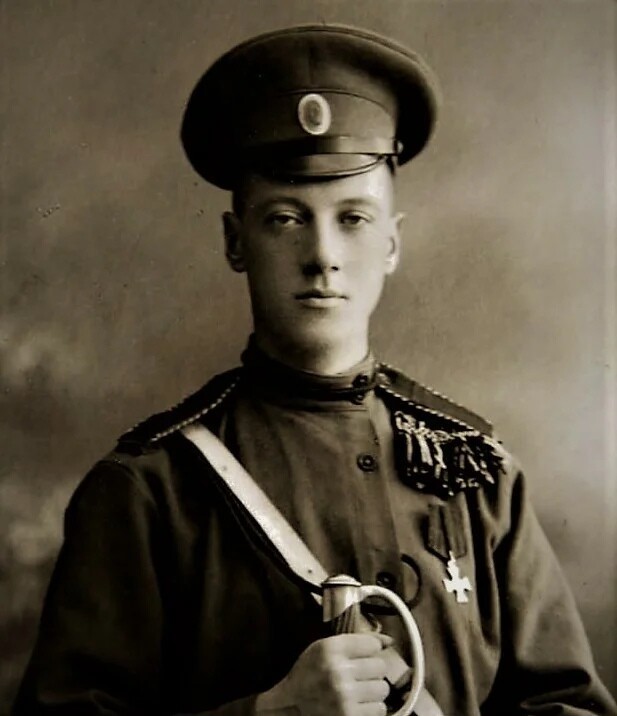
The Eternal
I am in the corridor of the closing days,
Where even the sky is a heavy yoke;
I look into the ages, I live in minutes,
But I await the Sabbath of Sabbaths —
An end to alarms and to good fortune,
To the blind wanderings of the soul...
O day when I shall see at last,
And strangely know — make haste!
I shall put on another soul,
Having caught all that once taunted me.
I shall bless the golden road
That leads from the worm up to the sun.
And he who walked beside me
Through thunder and through gentle stillness —
Who was severe toward my delights
And plainly merciful toward my guilt;
Who taught me silence, taught me struggle,
And all the ancient wisdom of the earth —
Will lay his staff down, turn around,
And simply say: “We have arrived.”
Nikolai Stepanovich Gumilev — poet of the Russian Silver Age, founder of the school of Acmeism, translator, literary critic, traveller and officer — was born on 3 (15) April 1886 in Kronstadt, the son of a ship's doctor. His schooling began at the Tsarskoye Selo gymnasium, whose director at the time was the celebrated poet Innokenty Annensky; later he attended lectures on art and literature at the Sorbonne in Paris.
He began publishing in 1902. In 1903 he met Anna Gorenko — Anna Akhmatova — who would become his wife. His book The Path of the Conquistadors appeared in 1905, followed by Romantic Flowers in 1908 and Pearls in 1910. In 1911 he organized the literary group known as the Guild of Poets, and in 1912 published Foreign Sky. In 1913, together with Sergei Gorodetsky, he proclaimed Acmeism — a new literary movement that declared a sensuous perception of the world and called for returning the word to its primary rather than allegorical meaning. Among those who counted themselves Acmeists were Osip Mandelstam, Anna Akhmatova, Vladimir Narbut and Georgy Ivanov.
Gumilev was drawn to the East and travelled three times to Africa. When the First World War began he went to the front as a volunteer, and for his courage and daring was awarded two Crosses of St George. The October Revolution found him in France, where he was then serving with the Russian Expeditionary Corps. In 1918 he returned to Russia, to Petersburg. There he occupied himself with translation, founded the Sounding Shell, a studio for young poets, and worked with World Literature, the publishing house established by Maxim Gorky.
On 3 August 1921 he was arrested on suspicion of taking part in the conspiracy of the “Petrograd Combat Organization of V. N. Tagantsev.” For several days Mikhail Lozinsky and Nikolai Otsup tried to secure their friend's release; despite their efforts the poet was soon shot. On 24 August the Petrograd GubCheka issued its resolution ordering the execution of the participants in the “Tagantsev conspiracy” — sixty-one people in all — published on 1 September with the note that the sentence had already been carried out. He died on 26 August 1921 in Petrograd.
The date and place of his execution and burial remain unknown. Several versions circulate: Bernhardovka, in the valley of the river Lubya near Vsevolozhsk — a memorial cross now stands on the bank by the bridge over the Lubya; the area of the Lisy Nos pier, behind the powder magazines; and a remote spot near the Razdelnaya railway station (now Lisy Nos), formerly used for executions ordered by courts-martial. Akhmatova believed the killing took place on the edge of the city, out toward Porokhovye.
Of Gumilev's connection to the Tagantsev conspiracy there are four versions: that he took part in it — the official Soviet account from 1921 to 1987, supported by some emigres; that he did not take part but knew of it and failed to inform — a version dating from the 1960s and widespread in the Soviet Union of the perestroika years (1987–1991); that no conspiracy existed at all, the whole affair having been fabricated by the Cheka in connection with the Kronstadt rising — the modern view; and that he took no part in the Tagantsev plot (itself perhaps fabricated) but was involved in another, earlier conspiracy that was never uncovered. Only in 1992 was Gumilev rehabilitated.