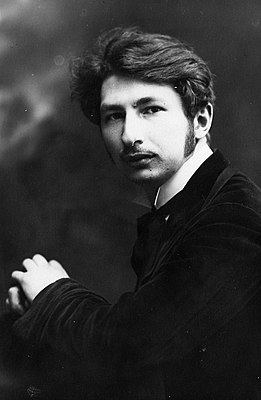
Sergei Gorodetsky was the son of the writer and ethnographer Mitrofan Ivanovich Gorodetsky. After finishing the Sixth St Petersburg Gymnasium he entered the historical-philological faculty of St Petersburg University in the 1900s — at the same time as Alexander Blok — and though he never took his degree, it was there that poetry claimed him. In 1905 he frequented Vyacheslav Ivanov's "Tower," and in 1906–1907 published the collections Yar, Perun and Wild Will: Symbolist work with a pronounced folkloric strain.
In the 1910s he parted ways with the Symbolists, and in 1912 became one of the organizers of the Guild of Poets. In 1915 he took under his wing the so-called "new peasant poets" — Sergei Yesenin, Sergei Klychkov, Nikolai Klyuev, Alexander Shiryaevets. From the autumn of 1916 he was on the Caucasus front of the First World War as a representative of the Union of Cities and a war correspondent; later he worked for a time as an orderly in a camp for typhus patients.
After the October Revolution he brought out the collection Angel of Armenia, which took up, among other things, the theme of the Armenian genocide. In Baku he directed the art section of ROSTA, then worked in the political administration of the Caspian Fleet. From 1921 he lived in Moscow, publishing widely and translating poetry, both of the peoples of the USSR and from abroad. Until 1924 he was literary director of the Moscow Theatre of the Revolution, and then, until 1932, worked in the literary section of the newspaper Izvestia.
In the 1930s he devoted himself largely to opera librettos — a decent and comparatively safe way for a writer to earn a living. He translated the librettos of Beethoven's Fidelio, Cherubini's The Water Carrier, and Wagner's Die Meistersinger and Lohengrin, and wrote a new, "non-monarchist" text for Glinka's A Life for the Tsar, which under his hand became Ivan Susanin. During the Second World War he was evacuated to Uzbekistan and Tajikistan, where he translated local poets.
He was active as a critic and literary scholar as well: in 1911 he prepared and published a two-volume edition of Ivan Nikitin's poems with an introductory essay of his own, and in 1958 he brought out the autobiographical sketch My Path.