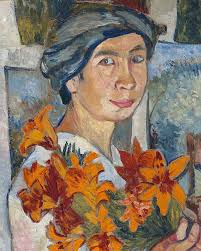
"All of Goncharova in two words: gift and labor," Marina Tsvetaeva wrote of her. Goncharova worked, it seems, in every direction going — and at that moment there were many, for revolutions in society and revolutions in art have a way of synchronizing, as Russian history confirms. Tsvetaeva, who admired the artist without reserve, insisted that Goncharova's life could not be divided into a life story and a story of her art; she was probably right.
Natalia Goncharova — a great-grandniece, through a collateral line, of Pushkin's wife Natalie Goncharova — was born in the village of Ladyzhino in Tula province. She kept her love of the countryside all her life and regarded cities strictly as a necessary evil. Her father was an architect, and Natalia at first saw her own path leading the same way. In 1901 she entered the Moscow School of Painting, Sculpture and Architecture in the sculpture department, and did well there, studying with distinction. But soon came the most important encounter of her life, the one that changed everything. Mikhail Larionov, not standing on ceremony, told her: "You have an eye for color, and you busy yourself with form. Open your eyes to your own eyes!" According to one legend, a quarrel flared between them soon afterward, and for three days the young pair neither met nor spoke. What does a young woman do in such a case — weep and suffer, seek distraction with someone else, complain to her friends? Natalia Goncharova took another way. When Larionov could bear it no longer and came to her, he was met by a painted wall hung with pictures, scraps of drawings, daubs of paint. Her whole room, it seemed, had turned into a canvas. "I arrive — the entire wall is covered in wonders. 'Who did this?' — 'I did...'" Larionov recalled.
So it all began. Goncharova transferred to the painting course under Korovin, and painted — copiously, without pause, vividly. She started with impressionist things: Haymaking, Landscape at Ladyzhino, Still Life with Slipper and Mirror.
She was, in effect, Russia's first woman of the avant-garde — and her first solo exhibition ended with her arrest. A couple of her paintings were seized as well and declared pornographic. It was not as if the nude had never been painted before; but a woman had done it for the first time. Goncharova was acquitted the very next day, her lawyer arguing that the exhibition had been "closed" — which was true only in the most formal sense. The show had not been billed as a public event, yet it was held at the Society of Free Aesthetics, one of the most popular cultural venues of the day, and getting in was no trouble at all.
Her chief exhibition, however, lay ahead: 1913. It was preceded by a run of scandalous stunts — the flamboyant Larionov painting designs on ladies' bare breasts, painted futurists strolling the city streets (the famous face-art in which David Burliuk is always depicted comes from here). Sergei Diaghilev put his finger on what made Goncharova's doings fresh and unrepeatable: "If Goncharova simply rouged her cheeks, I would be bored. Goncharova was not painting over wrinkles — she was painting roses." She had turned her own face into a canvas.
The "publicity campaign" did its work: her exhibition in the autumn of 1913, at the Art Salon on Bolshaya Dmitrovka, became one of the most visited shows of its time. Visitors were treated to a mesmerizing biography of the artist. Paris, and work under the personal guidance of Monet, Renoir, Van Gogh. No, all wrong — Tahiti! The island of Saint-Domingue and apprenticeship to Gauguin. Cézanne? Wrong again! A return to Russia and religious paintings executed in a monastery. And then Madagascar — excavations, sculptures! — and the turn to the East. "Europe is a recidivist thief!" Goncharova declared. Why look West, when everything best can be had firsthand in Russia? One small detail: the whole enthralling biography was pure mystification. Goncharova had at that point never left Russia.
"Who is she?" the visitors asked. "In what style does she work?" "Everything before me is mine," Goncharova announced — and worked in every style. Her talent and prodigious industry would not let her be held within any single movement. She painted, it seems, everything: impressionism, primitivism, cubism, futurism, rayonism, pictures on religious themes, the many non-canonical images of saints that drew the censure of the church. "Everythingism"! And Goncharova insisted categorically that everythingism was in no way eclecticism: "Eclecticism is a blanket of patches, seams everywhere. Where there is no seam — it is mine. The influence of the icon? Of the Persian miniature? Of Assyria? I am not blind. I did not look in order to forget."
The exhibition presented 761 of her works — the output of thirteen years, which comes to more than a painting a week. It changed the standing not only of Natalia Goncharova but of the avant-garde as a whole. The Tretyakov Gallery bought several of her canvases, among them Rowan Tree: Panino near Vyazma and Still Life with Bouquet and a Flask of Paints.
Marina Tsvetaeva, a passionate worshipper of Pushkin, heard someone mention a Natalia Goncharova and was struck by the coincidence. Discovering that it was not coincidence but kinship, she wished to meet her, and then to write about them both — two universes, two Natalia Goncharovas. Tsvetaeva presents Natalie as beauty in its absolute, and emptiness; the artist Natalia as a creator who became the first one's opposite: "For the opposite of a beauty is not a monster, as it may seem at first, but essence, personality, imprint."
Curiously, Pushkin's Natalie — the star of the ballrooms, "a beauty, and nothing more," in Tsvetaeva's phrase — made herself felt after all. Her artist great-grandniece was no devotee of society gatherings, but she left her mark on fashion. It was she who put Russian women into the chemise dress, and she was among the first to wear trousers and a cap, at a time when this was a serious affront to society. She made sketches for the Russian fashion house of Nadezhda Lamanova, and later, in Paris, worked with the houses of Chanel and Myrbor. Her designs were published in Vanity Fair and Vogue.
In 1915 Diaghilev sent Natalia Goncharova fifty telegrams proposing collaboration. Fifty refusals. In the fifty-first it occurred to him to invite her and Larionov together. They went — for good, as it turned out, though they did not suspect it. Goncharova designed the sets and costumes for The Golden Cockerel, and it was a genuine revolution: brilliance, sincerity, no imitation, no style à la russe, but authenticity, a fine feeling for detail — tradition rather than restoration. The Cockerel became an event; her designs opened a new chapter in the art of stage decoration. Her followers in the field included Larionov himself, Sergei Sudeikin, Nikolai Remizov; Pablo Picasso's work for the theatre bears the unmistakable imprint of her Golden Cockerel, notably his costumes for the ballet Le Tricorne.
The invented biography suddenly began to come true. Now Goncharova traveled all over Europe, she and Larionov accompanying Diaghilev and his ballets. Until Diaghilev's death, indeed, she remained his prima in the realm of stage design, his leading artist. Spain made the deepest impression on her, and remained a source of inspiration for nearly ten years; her "Spanish women" form one of her strongest series.
In 1918 Goncharova and Larionov settled in France. To this day, in the Latin Quarter of Paris on the rue Jacques Callot, one can step into the café La Palette on the ground floor of their house. It was there that they most often dined.
"Larionov and I met, and we never parted," Goncharova said. Larionov took great pride in her successes and treated them far more seriously than his own. What united their lives was something larger than love. Vocation? Art? Kinship of soul? Call it what one will, the fact remains: even when Larionov acquired his Shurochka (Alexandra Tomilina, his mistress of thirty years and, after Goncharova's death, his second wife), and Goncharova her Orest Rosenfeld (an émigré from Russia and a French socialist), the essential thing between them was never broken.
They were to each other more than partners, more than lovers, more than husband and wife. Only in 1955 did Natalia Goncharova marry Larionov — so that, should anything happen to either of them, the paintings would remain in the family. Since they had no children, only a lawful spouse could inherit. In time they hoped to send their paintings home to Russia; in Goncharova's lifetime it never came to pass.
"Larionov is my working conscience, my tuning fork," she wrote. "There are children who from birth know everything. A touchstone for falseness. We are very different, and he sees me from within me, not from within himself. As I see him." One cannot say which of them influenced the other more. They were simply impossible without each other — as the Russian avant-garde is impossible without their names and their work.