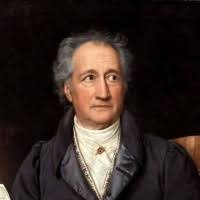
Johann Wolfgang von Goethe was a German poet, statesman, thinker, and natural scientist. He was born on 28 August 1749, between noon and one o'clock, into the family of a Frankfurt burgher. At his birth everyone took the child for dead, but within a couple of minutes it became clear that the infant was alive. From the very beginning illness dogged him.
Goethe's parents set great store by their children's education. In 1755 he was sent to a public school, where he spent a single year; after that his father took the children's schooling into his own hands. Goethe studied French, English, Italian, and Hebrew, along with painting, the exact sciences, history, music, and fencing. He was a thoroughly rounded person; everything interested him, and very early the young Johann developed a passion for books. At ten he saw, for the first time, several performances by a French troupe. Enchanted by the French theater, he began writing plays and devotional verses of his own.
Goethe was gifted in every direction, and the many-sidedness of his talent astonishes people to this day. Besides his literary work he was a philosopher, a politician, and a scientist, and he played an excellent game of chess. His father taught him the rudiments of law, dreaming that his son would become a lawyer.
In 1765 Goethe went off to Leipzig and enrolled in the faculty of law. During his Leipzig years he twice made an attempt on his own life. A spiritual crisis brought on a seizure; he coughed blood, and illness once again reduced him to exhaustion. While he was ill he was nursed by Friederike, daughter of the painter Oeser, and he dedicated poems to her. Three collections date from the Leipzig period: "Annette," "Odes to My Friends," and "Songs and Melodies Dedicated to Mademoiselle Friederike Oeser." In the summer of 1768 he returned to his father's house.
Having recovered his strength after the grave illness, he left in 1770 for Strasbourg to continue his legal studies. But the law would not hold his attention: Goethe preferred to sit in on medical lectures or to write. One day he chanced to meet Herder, who awakened in him an immense interest in folk poetry. In this period he came more and more to think of himself as a poet.
In 1771 Goethe defended his dissertation and took the academic degree of licentiate of law. He then returned to Frankfurt and began to practice as a lawyer, without giving up his writing. He produced the drama "Götz von Berlichingen," worked on the dramatic fragment "Mahomet," wrote the drama "Prometheus" — and began work on "Faust."
In the spring of 1774 he was at work on the novel "The Sorrows of Young Werther." In a letter to Sophie La Roche, Goethe wrote: "I shall soon send you a friend who has much in common with me; I hope you will receive him well — his name is Werther." And in Werther there is indeed "much of Goethe's character and cast of mind." That autumn Goethe presented the novel at the Leipzig book fair, provoking an enormous scandal. The book was banned as "a danger to public morality."
Goethe decided to move to Weimar, at the invitation of Duke Karl August himself; a friendship grew up between them. There Goethe fell in love with a lady of the court, Charlotte von Stein — a love that lasted ten years. Then, in 1786, he slipped away in secret to Italy; many believe he wished to forget Charlotte. He spent two years there, and in that time something in him turned: inner torment gave way to lightness, to a feeling of happiness, rebirth, and liberation. Back in Weimar he met Christiane Vulpius, who eighteen years later became his wife.
In 1831 Goethe finished the second part of "Faust" and directed that it be published after his death. In the spring of 1832 he caught a severe cold, and his health declined sharply. Goethe's heart stopped on 22 March, at exactly noon — the hour of his birth. His last words were "Mehr Licht..." ("More light...").
Bibliography
Plays: 1768 — Die Laune des Verliebten; 1769 — The Accomplices / Die Mitschuldigen; 1773 — Götz von Berlichingen mit der eisernen Hand; 1774 — Ein Fastnachtsspiel vom Pater Brey; 1774 — Jahrmarktsfest zu Plundersweilern; 1774 — Götter, Helden und Wieland; 1774 — Clavigo; 1775 — Hanswursts Hochzeit; 1775 — Egmont; 1775 — Erwin und Elmire; 1776 — Die Geschwister; 1776 — Stella; 1777 — Der Triumph der Empfindsamkeit; 1778 — Proserpina; 1779 — Iphigenie auf Tauris; 1780 — Torquato Tasso; 1792 — Der Groß-Cophta; 1793 — Der Bürgergeneral; 1802 — Mahomet der Prophet; 1803 — Die natürliche Tochter; 1807 — Pandora; 1774–1831 — Faust.
Novels and stories: 1774 — The Sorrows of Young Werther / Die…