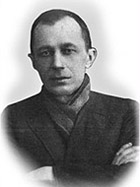
Sergei Iosifovich Fudel was born in Moscow on 13 January 1900, the son of the Orthodox priest Iosif Fudel — then serving at the Butyrka prison — and Evgenia Sergeevna Emelyanova. A priest's son, he was steeped from childhood in the faith, culture and moral discipline of Christianity: taught to pray, taken to the services of the church. In due course he was enrolled in a Moscow gymnasium, from which he graduated in 1917. His father's circle included some of the celebrated thinkers of the day — the philosophers Vasily Rozanov and Konstantin Leontiev, Father Pavel Florensky — and Sergei's own outlook was probably formed not without their influence. After the gymnasium he entered the historical-philological faculty of Moscow University.
He never finished. The two revolutions of February and October shook the country to its foundations, many of its institutions collapsed, and like a great number of students he had to break off his studies. The persecutions that the new authorities unleashed on believers soon reached Fudel himself: in July 1922 they came for him, and he was taken into custody for his part in the resistance to the Renovationist movement. Renovationism sat outside the traditions of the Church; born of the revolutionary chaos, it aimed at radical internal reform and supported the new regime — which made its adherents, in the eyes of the secular powers, more congenial and comprehensible than the most steadfast portion of the Orthodox clergy: easier to bargain with, easier to control. Working against the schism, Fudel explained to people where its danger lay, and with like-minded friends pasted up leaflets to that effect. In 1923 he was charged under the notorious Article 58 of the Criminal Code and exiled to the Zyryan country, to Ust-Sysolsk.
His fiancée, Vera Maximovna Sytina, followed him, and they were soon married — the sacrament performed in the lodgings of the exiled Bishop Afanasy (Sakharov), with three hierarchs taking part: Afanasy himself, Archbishop Thaddeus (Uspensky) and Bishop Nikolai (Dobronravov). The wedding crowns were woven from what lay to hand — willow twigs. Fudel afterwards became one of Bishop Afanasy's closest adherents.
In 1933 he was arrested again, under the same article, and sent this time to a labour camp at Vel. From 1934 to 1941 the family lived in Zagorsk, where, despite material hardship and the danger of fresh charges, they gave shelter to the then-persecuted Archimandrite Serafim (Bityugov). In 1941, with the outbreak of war, Fudel was called up into the Red Army and served to the war's end as a private, in a unit guarding military freight.
After the victory he came once more to the attention of the security organs. In 1946 he was arrested in the case of Alexiy Gabriyanik, a priest of the catacomb Church — Father Alexei was married to the sister of N. Golubtsov, a close friend of Fudel's. The court sent him to Minusinsk, and then to the village of Bolshoy Uluy in Krasnoyarsk Krai. Returning in 1952, he settled in Zagorsk; but the ban on former criminal and political convicts living in Moscow or its province forced him to look for a new home. The choice fell on the small town of Lebedyan; after a time the family moved on to Usman in Lipetsk province, where they bought a house and where, after many hours of reflection, he completed one of his best-known works, The Path of the Fathers. In 1958 he settled in Pokrov, in Vladimir province, and went on writing.
He translated as well, as did his wife: he commanded seven languages, she five, and the work helped patch a threadbare family budget — their pensions were very small.
Toward the end his strength failed. On 6 March 1977 he lost consciousness; that day he responded to almost nothing, neither drinking nor eating, yet when the Holy Gifts were brought to him he received and consumed them. Through his last night on earth his wife and son took turns reading the Psalter. Toward morning the son dozed off; his mother woke him to say that his father was departing. The dying man's breathing grew ever rarer, and soon his heart stopped. It was dawn on 7 March.
On 8 March, when the family sought some way of bringing the body to church for the funeral, no car could be found. The coffin was laid on two children's sleds and drawn to the church that way. The service took place the following morning, celebrated by two priests. A great crowd gathered to see Fudel off, and afterwards the procession moved with hymns and prayers to the town's Pokrovskoe cemetery, where his body was committed to the earth.