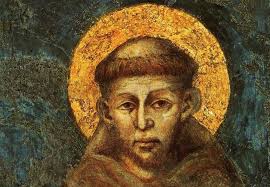
Saint Francis of Assisi was born in Assisi, Italy, around 1181. At school he studied Latin and French. A pampered boy who wanted for little, he probably rebelled in adolescence, and he dreamed of becoming a knight rather than a cloth merchant like his father.
After the war with Perugia he was captured and held for ransom, and during his imprisonment he appears to have had visions of God. In his twenties he turned toward God and pursued a path of piety, finally renouncing worldly goods and the luxuries of his former life. Francis repaired the church of San Damiano, restored a chapel dedicated to the Apostle Peter, and rebuilt the chapel of Saint Mary of the Angels.
In 1209 Francis wrote a simple rule for his band of friars, the Regula primitiva, drawn straight from the Bible: to follow the teachings of our Lord Jesus Christ and to walk in His footsteps. He and his twelve disciples then traveled to Rome, where Pope Innocent III gave his approval to the Franciscan rule.
The Franciscan order was a company of street preachers who owned nothing and had only the Porziuncola for a home. Quite possibly no one else ever attempted to imitate the life of Christ and carry on His work as Francis did. He has been called a lover of nature, a social worker, an apostle of poverty, a preacher. Poverty mattered so much to him that his final work, the Testament, insisted it was vital for the members of his order.
In 1212 Francis organized an order for women, the Poor Clares. For those who could not leave their lives or their families he created the Third Order of Brothers and Sisters of Penance, a fellowship that demanded no vows, only adherence to the principles of Franciscan life. Francis traveled beyond Italy to Egypt and attempted other journeys to preach to the Muslims and spread his message. Later he had to compose a First Rule to preserve order and devotion within his community, and then a Second Rule, which Pope Honorius III confirmed in the bull Solet annuere; it became the official rule of the order.
In 1223 came the experience in which Francis was marked with the wounds of the crucified Christ and received his most important message from God. Two years later he died in Assisi. He was buried temporarily in the church of San Giorgio there, and on July 15, 1228, he was canonized by Pope Gregory IX. In 1230 his body was moved to the lower church of the basilica built in his honor.
The achievements of Saint Francis of Assisi
He repaired and restored churches, among them the chapel of Saint Mary of the Angels and the church of San Damiano. He left a life of wealth and traded it for poverty and a life devoted to Christianity. He founded three orders, each following rules he wrote on the basis of the Bible. Touched by God, he was told to continue his life in devotion. He preached, spread his message, and won followers in Italy and beyond, his teaching and his way of life alike shaped by Christianity. He was canonized two years after his death.
Sayings of Saint Francis
"For it is in giving that we receive."
"It is in pardoning that we are pardoned."
"Start by doing what is necessary; then do what is possible; and suddenly you are doing the impossible."