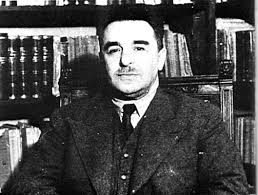
Ilya Isidorovich Fondaminsky (pseudonym Bunakov; 1880, Moscow – 1942, Auschwitz) was a Russian revolutionary, public figure, and publicist.
He was born into a prosperous merchant family that kept the Jewish traditions. Barred by the numerus clausus from the gymnasium attached to the Lazarev Institute of Oriental Languages, he entered Kreiman's private gymnasium in 1893. As a youth he belonged to a self-education circle of friends and relatives — A. Gots, M. Tsetlin, Maria Tumarkina (1882–1976), Amalia Gavronskaya (1882–1935), and others — many of whom would later join the Socialist Revolutionary Party (the SRs).
From 1900 to 1904 Fondaminsky studied philosophy at the universities of Berlin and Heidelberg. Early in 1902 he married Amalia Gavronskaya, a granddaughter of K. Wissotzky; in May of that year he was arrested at the Russo-German frontier and held for two months in a Petersburg prison for his ties to the Socialist Revolutionaries, whose party he formally joined at the end of 1902 or the beginning of 1903. Taking his degree in December 1904, he returned to Moscow and became one of the leaders of the party's city committee there, occupied chiefly with propaganda. He was among the party's finest orators: he spoke constantly at rallies, enjoyed great popularity — above all when he spoke on the agrarian question — and debated the Social Democrats with success. In September 1905 he and his wife were arrested and confined in the Taganka prison; they were released that October.
Fondaminsky gave most of his fortune, and his wife's dowry, to the revolution; the money bought arms for the SR fighting squad in Moscow. In early December 1905, largely at his urging, the congress of railway workers in Moscow voted for a general political strike, which grew into the December armed uprising; Fondaminsky was among the leaders of the insurgents' SR headquarters. In January 1906 he attended the party's first congress in Helsingfors (now Helsinki), representing Moscow together with V. Rudnev.
After the First State Duma was dissolved on 9 July 1906, the party's Central Committee sent him to Reval (Tallinn) to organize a rising aboard the ships of the Baltic Fleet. The rising broke out — and was crushed — before he ever arrived, and the moment he stepped onto the deck of the cruiser Pamyat Azova he was arrested. A court-martial acquitted him that August, since he had boarded the ship only after the mutiny was over; yet he was not released, and in October 1906 he faced a second court-martial in Petersburg, which acquitted him as well. Fearing yet another trial, he emigrated to France with his wife.
From 1907 to 1917 he lived in Paris. At the party's Fifth Council (May 1909) he was elected to the Foreign Delegation, one of its governing bodies, and he oversaw the fighting group of B. Savinkov, which was planning terrorist acts against Russia's highest leadership, the emperor included. In emigration, after the exposure of E. Azef and under the influence of his close friends D. Merezhkovsky and Zinaida Gippius, Fondaminsky revised much of what he believed. He grew interested in Christianity and financed the religious-philosophical journal Voprosy Zhizni (Questions of Life). With N. Avksentyev he edited the journal Pochin, which held to a consistently anti-terrorist line. From the outbreak of the First World War he took a defensist position, editing with G. Plekhanov the journal Prizyv (The Call), which set itself against the defeatists.
In April 1917 Fondaminsky returned to Petrograd and was elected deputy chairman of the Executive Committee of the Soviet of Peasants' Deputies. His report "On the Land" aroused enormous interest and was printed in a run of several million copies. In the summer of 1917 the Provisional Government appointed him commissar of the Black Sea Fleet, where he fought vigorously against Bolshevik influence. By an overwhelming majority he was elected the fleet's deputy to the Constituent Assembly, and he sat on the bureau of the Socialist Revolutionary faction. At the Assembly's single session, on 6 January 1918, he was very nearly shot by a Black Sea Fleet sailor guarding the hall. After the Assembly was dispersed he went underground; from the summer of 1918 he lived in Odessa, and in the spring of 1919 he and his wife emigrated to France and settled in Paris.
Fondaminsky played a great part in the social and cultural life of the Russian emigration. He was one of the editors of its leading journal, Sovremennye Zapiski (Contemporary Annals, 1920–40), and it was thanks to him that the journal stood open to writers of the most varied political and literary persuasions: its pages carried the work of L. Shestov, S. Frank, G. Florovsky, and D. Merezhkovsky, and the fiction of I. Bunin, V. Nabokov, A. Remizov, and M. Aldanov. He gave generous help to figures of Russian culture — paying 18,000 francs toward the publication of books by authors who had appeared in the journal, aiding young writers, and organizing literary evenings, Nabokov's among them. On his initiative, and largely at his expense, the Russian Theater in Paris was founded. In emigration Fondaminsky gradually became a conservative Christian thinker. In Sovremennye Zapiski, between 1920 and 1940, he published a series of seventeen articles under the general title "The Paths of Russia," in which, among other things, autocracy is called "the political faith of the Russian people" and the Muscovite tsardom "the supreme disclosure of the Russian idea in the past." He saw Russia's salvation in a singular synthesis of Christianity, socialism, autocracy, and freedom; he believed that a small band of like-minded companions could change the country's fate, and dreamed of founding a kind of "order" to bring this about. He initiated and edited the journal Krug (The Circle), which gathered young Russian writers, many of them shaped by his ideas — among them B. Vildé, hero of the French Resistance, the writer Yuri Felzen (1894–1943), and the poet Yuri Mandelstam (1908–43). He also edited, and helped to finance, the Christian religious-philosophical journals Put (The Way) and Novy Grad (The New City).
In June 1940 he fled Paris before the advancing German army into the unoccupied zone, but then returned. In July 1941 the German authorities arrested him along with many other émigrés from Russia. Most of those arrested, being ethnically Russian, were soon released; Fondaminsky, as a Jew, was kept in the camp — where, by some accounts, he was baptized. His friends tried to arrange an escape, but he refused, wishing to remain with his people. In 1942 he was deported to Auschwitz and murdered there in November of that year.
His brother Matvei (1866, Moscow – 1896, Irkutsk) was also a revolutionary. In 1885 he entered the Petrovskaya Agricultural Academy. In 1880, for taking part in a Narodnaya Volya circle, he was sentenced to exile in Siberia. On 22 February 1889 he joined a protest of the exiles against the anti-Semitic abuse inflicted by the administration and the convoy guard — the so-called Yakutsk tragedy — and was bayoneted in the stomach. Sentenced to penal servitude for life, he served his term in the Akatui and Zerentui hard-labor prisons. Released under amnesty in 1895, though forbidden to live in the European part of Russia, he died soon afterward of tuberculosis.