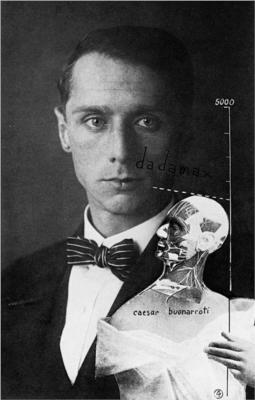
Max Ernst (2 April 1891, Brühl, Germany – 1 April 1976, Paris) was a German painter and sculptor who worked in France and America and figured among the leaders of several movements at once — Dada, Surrealism, Expressionism. He invented the techniques of frottage and grattage.
Ernst lived to eighty-five and managed to take part in — and sometimes to instigate — the most improbable episodes and artistic projects. He was twenty-three when the First World War began; of that time he later wrote, "On 1 August 1914 M.E. died. He was resurrected on 11 November 1918." A philosophy graduate who had specialized in psychology, he never practiced the profession he trained for. He quarreled with his parents, who dreamed of seeing him a teacher, and gave himself to art.
For a long time his chosen occupation brought him no money, yet he made friends quickly and won recognition among the initiated — painters, poets, sculptors. In 1919 he organized and took part in one of the first exhibitions of the German Dadaists; the scandal of the event carried as far as Paris and even New York.
He slipped illegally into France, where his paintings were greeted with enthusiasm; lived through an exhausting ménage à trois with the poet Paul Éluard and his wife Gala (the same Gala who would later leave Ernst and Éluard for Dalí); helped create a production for Sergei Diaghilev's company; appeared in a film by Buñuel; saw his own canvases in photographs from the "Degenerate Art" exhibition; was arrested as a German at the outbreak of the Second World War; twice escaped from an internment camp; and in 1940 emigrated to America by way of France, Spain, and Portugal. That he came through the adventure unscathed he owed to Peggy Guggenheim, who took a lively interest in his art and had by then acquired a good number of his paintings. Peggy became his third wife — though not for long: soon Ernst married the American artist Dorothea Tanning.
After ten years in America, Ernst returned to a France that had come back to life after the war, took part in the Venice Biennale, and lived to see two large solo exhibitions — in Paris and in New York.
It is said that Max Ernst gave Jackson Pollock his method: it was Ernst who thought of pouring paint into a punctured tin can and swinging it over the canvas. He invented a great deal besides — grattage, in which a layer of paint is scraped away to reveal the texture of objects placed beneath the canvas, and frottage, in which paper is rubbed with a pencil to bring out the relief of what lies underneath. He loved collage and gave his works absurd titles. Bird-people, machine-people, hats, unearthly creatures, constructions never seen before — the imagination of Ernst the Surrealist seemed to know no bounds.
Among his best-known paintings: The Forest and the Dove, Europe After the Rain, Bird-People, King Ubu, The Voice of Angelica.