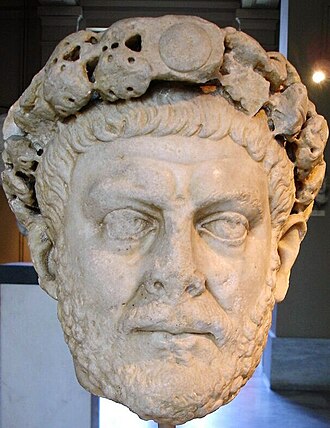
He was born around the year 245 in Dalmatia, on the eastern shore of the Adriatic, and was named Diocles. The sources disagree about who his parents were — a minor scribe, perhaps, or a senator's freedman. Neither offered any chance of power in Rome. The only path upward for such a man was the army, and Diocles walked that path to its end: he rose to a command in Moesia, and then joined the personal guard of the emperor Carus — the elite corps of bodyguards from which, with luck, a man might emerge into the ranks of the great.
Luck came at a terrible price. In 284, during a campaign against the Persians, the co-ruler and son of Carus, Numerian, died under mysterious circumstances — according to the ancient authors, his body was found already decomposing in a closed litter. Diocles publicly accused the praetorian prefect Aper of the murder and, before the assembled army, cut him down with his sword. That same day, 20 November 284, the soldiers proclaimed Diocles Augustus. He took for himself a more euphonious name in the Latin manner — Gaius Aurelius Valerius Diocletianus.
The empire he inherited had been shaken for half a century by mutinies, usurpations, and invasions — one man physically could not hold its borders. Diocletian answered this not with conquests but with a rebuilding of the system of power. In 293 he established the Tetrarchy: the rule of four — two senior Augusti and two junior Caesars, each with his own stretch of frontier and his own army. He kept the East for himself and moved his residence to Nicomedia, while Rome, in effect, ceased to be the capital — the city he ruled he visited only once in twenty years.
In parallel ran a reform of the very structure of power: military and civil administration were separated into different hands, the number of provinces was nearly doubled, and a new system of taxation was introduced, based on a regular census of people and land. In 301, with the Edict on Maximum Prices, Diocletian tried to halt inflation by setting a ceiling on the prices of hundreds of goods and services under threat of death for violators — and almost at once he lost: trade went underground, and the edict quietly ceased to be enforced.
In February 303 Diocletian launched the most severe, and the last in the history of Rome, persecution of the Christians. The first edict ordered the churches destroyed, the sacred books burned, and Christians stripped of their offices and civil rights. The following edicts went further: the arrest of the clergy, and then — on pain of death — the demand of a universal sacrifice to the pagan gods. The decrees were enforced most harshly in the East of the empire, where Diocletian himself ruled; in the West the matter was almost limited to the demolition of individual buildings. In less than a hundred years everything would turn into its opposite: under the emperor Theodosius I Christianity would become the state religion of the empire.
The persecutions did not bring what Diocletian had counted on, and by 305 his health had been broken by a long illness. On 1 May of that year he did what no Roman emperor before him had done — he voluntarily renounced power, laying aside the purple in Nicomedia, and persuaded his co-ruler Maximian to do the same. He withdrew to Dalmatia, to the city of Salona, beside which he had built himself a fortified palace — Spalatum, out of which would later grow the Croatian city of Split.
When, several years later, he was summoned to return and adjudicate the disputes among the new claimants to power, Diocletian, by tradition, replied that if his guests could see the vegetables he had grown with his own hands, they would never again propose that he trade this garden for a throne. The system of four rulers that he devised his successors could not hold — it collapsed in wars among the new claimants to power. But the administrative backbone of the empire, built by Diocletian, outlived both the man himself and the Tetrarchy.