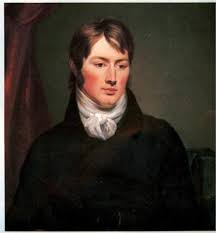
He was the first to see that clouds were a subject in their own right. Not a backdrop for people and castles, not a frame — clouds for their own sake. In the 1820s he painted cloud studies: sky alone, no ground at all, noting on the back the hour, the direction of the wind, the type of cloud.
John Constable was born in 1776 in Suffolk, a miller's son; his father owned mills and water wheels. He grew up among water and wind — and they became the only things that interested him.
At the Academy of Fine Arts he was told that landscape was the lowest of genres: one ought to paint history, mythology, religion. He paid no attention. The Hay Wain, 1821: a cart fording a river, a farm in the distance, clouds overhead. The jury of the Paris Salon gave him a gold medal, and French painters were astonished — was such a thing allowed?
His green was a green of his own. He flecked white paint over it to catch the glitter of dew and sunlight on the leaves. People called it "Constable's snow" and laughed. Later they understood it was the truth.
Delacroix, after seeing his work in Paris, repainted a whole passage of one of his own canvases — on the very eve of the exhibition.
He outlived his wife; they had been happy, and she died young. His landscapes darkened after that.
He died in 1837. Turner outlived him by fourteen years — and went on, all those years, painting clouds in his own way.