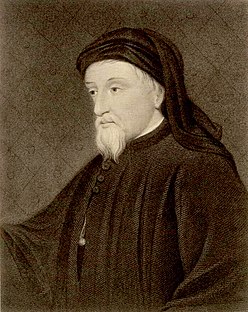
Geoffrey Chaucer's contemporaries called him "the father of English literature"; posterity judged his work the greatest of the Middle Ages and broke it into quotations that are still current today. He was among the first to win a wide audience for writing in English at a time when Latin and French held sway in Britain.
Chaucer was born around 1343 in London. His father was a wine merchant who supplied the royal court, and it was through a relative's connections that the young Geoffrey obtained, at seventeen, a place as page to Countess Elizabeth, wife of Duke Lionel.
In 1359 he took part in England's campaign against France, was captured, and was ransomed by the king, who made him his personal valet and squire. Alongside his duties the young man composed verses to a lady who did not return his affection.
When the war ended, Chaucer entered London's school of law, where he acquired his literary grounding — studying not only the classics but patristic writing, medieval Latin literature, and the French authors of his own day. That knowledge would serve him later, in his translation of the Romance of the Rose and in his shorter poems and lyrics.
The decade from 1369 to 1379, his "youthful" period, is usually called the "French" period of his career, so strong was the mark of French courtly literature on his work. It was then that he translated the Romance of the Rose, one of the most celebrated books of the Middle Ages.
The Book of the Duchess, written in 1369, commemorated the death of Blanche, first wife of John of Gaunt, founder of the house of Lancaster. Even in this early work Chaucer showed an uncommon gift for memorable, unexpected description.
In 1367 he had been appointed a royal valet and granted a pension. His first journey to Italy came in 1372, to negotiate with the ruler of Genoa; returning five years later, he stayed half a year, mastered Italian, and watched at first hand the opening stage of the Renaissance and the vigorous growth of urban culture.
The Italian poets transformed his sense of art. From the authors he encountered there — Petrarch, Dante, Boccaccio — he borrowed extended set pieces and poetic turns of phrase, sometimes whole plot lines; in Italy he also came to know the poets writing in Latin.
From his close study of the Italians he learned a finish and an elegance previously unknown in English letters. Between these journeys he returned to London and his administrative duties.
For twelve years, from 1374 to 1386, he served as customs supervisor and comptroller, living quietly in the tower at Aldgate — discharging his duties promptly and well, and never neglecting his poetry.
The years between 1380 and 1386 are known as the "Italian" stage of his career. In this period he wrote The Canterbury Tales and the poems The Parliament of Fowls, Troilus and Criseyde, The House of Fame, and The Legend of Good Women. This forerunner of the Renaissance still drew inspiration from his foreign models, but more and more of himself now entered the work.
Chaucer was becoming markedly independent. His style showed itself in natural, living dialogue and in vivid, pictorial narration, and he began, little by little, to let his own personality into his poems — which drew him closer to his readers.
The great poem Troilus and Criseyde, in five books, joins the comic to the tragic, the everyday to the heroic. Here Chaucer appears as a master of character and of the slow unfolding of a story, and as a subtle psychologist. At its close, as English convention of the day required, the poet offers his young readers a moral.
The Legend of Good Women is the first long poem in English composed in ten-syllable lines. It tells of heroines tormented by love since the most ancient times, and it owes its existence to a reproach from Chaucer's patroness the queen: that in earlier works such as the Romance of the Rose and Troilus and Criseyde the poet had mocked the fair sex too often.
The Canterbury Tales is his most famous work, the one that made Chaucer's name immortal and known the world over. It tells of twenty-nine pilgrims — of every temperament, age, sex, and station — who meet at an inn near London before setting out for Canterbury to venerate the tomb of Saint Thomas Becket.
To pass the time, each pilgrim tells a tale. Nor do the storytellers simply march to their destination: they spend nights at inns, chat with passersby, shout, pay compliments, trade insults. The whole is a moral and, for its time, sharply social novel whose figures are drawn from traditional English society.
In the twilight of his life the "father of English poetry" wrote a number of poems steeped in melancholy, born of his wish to withdraw from society and its crowds. Sunk in poverty, he asked the king for financial help.
For a time the poet shut himself up with his own thoughts and cares. But fortune smiled on him once more: his patron granted him a pension substantial by the standards of the day, and with it Chaucer was able to rent a fine little house near Westminster Abbey.
In his private life this forerunner of the Renaissance was happy with his wife, Philippa de Roet, daughter of the Flemish knight Paon — a marriage essential to the realization of all his professional designs. The couple had two sons: Thomas, born in 1367, and Lewis, born in 1380.
Chaucer made his mark not only as a talented philosopher, writer, and poet but as a capable astronomer: when his younger son Lewis was ten years old, he composed a treatise on the astrolabe.
Death
Chaucer lived a full life, rich in varied activity. He died at fifty-seven, on 25 October 1400, in London. The exact cause of his death has not come down to us. He was buried in Poets' Corner in Westminster Abbey, where a portrait of the poet is carved on the stone slab.
It was The Canterbury Tales that brought Chaucer worldwide fame; the idea for the tales came to him from his reading of Boccaccio's Decameron.
Modern poetry begins with Geoffrey Chaucer (1340–1400) — diplomat, soldier, scholar. A bourgeois who knew the court, he had an inquiring eye, read widely, and traveled through France and Italy to study the classics in Latin. He wrote because he was conscious of his own genius, though his readership was small: courtiers, and a portion of the merchants and working men. He served at the London customs house — a post that acquainted him at first hand with the business life of the capital and with the very social types that would people his chief book, The Canterbury Tales.
The Canterbury Tales came from his pen in 1387. They grew out of a narrative tradition whose origins are lost in remote antiquity — a tradition that had declared itself in the literature of the thirteenth and fourteenth centuries in the Italian novellas, in cycles of satirical tales, in the Gesta Romanorum and other collections of instructive stories. By the fourteenth century, subjects gathered from many authors and many sources were being given a deeply individual treatment, and Chaucer's chosen form — tales told by traveling pilgrims — allowed him to paint a vivid picture of the Middle Ages. His conception of the world takes in the Christian miracles of the Prioress's and the Man of Law's tales, the fantasy of the Breton lays in the Wife of Bath's tale, and the Christian long-suffering of the Clerk's tale. All these notions were native to the medieval mind, and Chaucer does not question their worth — witness his readiness to include such motifs at all. He creates figures-as-roles, built on a professional and social characterization and on the heroes' failure to live up to it; the type emerges through duplication, through the multiplying of similar figures. Absolon in the Miller's tale, for instance, plays the part of the servant of religion turned lover: a parish clerk, a half-clerical person, his thoughts turned not to God but to the pretty women of his parish. How widespread the figure was may be judged, beyond the many French fabliaux, from one of the folk ballads printed in Secular Lyrics of the XIVth and XVth Centuries, whose hero behaves very much as Absolon does. Recurrence is what makes the figure a type.
Scholars who have examined the question of genre in The Canterbury Tales agree that one of the work's principal literary genres is the novella. The novella (Italian novella, literally "news"), as the literary dictionaries define it, is a short prose genre comparable in length to the short story but distinguished by a sharp, centripetal, often paradoxical plot, by its spareness of description, and by its compositional rigor: poeticizing chance, the novella lays bare the very core of the plot — its center, its peripeteia — and brings the material of life to the focus of a single event.
Unlike the short story — a genre of the new literature of the turn of the eighteenth and nineteenth centuries, which puts the verbal texture of narration in the foreground and inclines toward extended characterization — the novella is the art of plot in its purest form. It took shape in remote antiquity, in close connection with ritual magic and myth, and it addresses itself above all to the active rather than the contemplative side of human existence. Its plot, built on sharp antitheses and metamorphoses, on the sudden reversal of a situation into its opposite, is common to many folklore genres: the fairy tale, the fable, the medieval anecdote, the fabliau, the Schwank.
The literary novella arose in Renaissance Italy — its most brilliant example Boccaccio's Decameron — and then in England, France, and Spain, with Chaucer, Marguerite of Navarre, and Cervantes. In its comic and didactic forms the novella marks the emergence of Renaissance realism, with its revelation of the individual's free, spontaneous self-determination in a world fraught with reversals. Later, in the course of its evolution, the novella pushed off from neighboring genres — the short story, the tale, and others — depicting extraordinary, at times paradoxical and supernatural events, breaks in the chain of social, historical, and psychological determinism.
Even before The Canterbury Tales, Chaucer the poet had felt the influence of French and Italian literature. His work, as is well known, already shows certain pre-Renaissance features, and he is customarily assigned to the Proto-Renaissance. Whether Giovanni Boccaccio, creator of the classic Renaissance novella, influenced him directly is a matter of dispute. What is certain is his acquaintance with Boccaccio's early works and his use of them as sources: the Filocolo in the Franklin's tale; the lives of famous men and women in the Monk's; the Teseida in the Knight's; and a single novella of the Decameron — the story of the faithful wife Griselda, known to him through Petrarch's Latin translation — in the Clerk's. True, echoes of the motifs and subjects of the Decameron can also be caught in the tales of the Shipman, the Merchant, and the Franklin, though these may be explained by a shared novellistic tradition. Among the other sources of The Canterbury Tales are the Golden Legend of Jacobus de Voragine, fables (notably those of Marie de France), the Roman de Renart, the Romance of the Rose, the Arthurian romances, the French fabliaux, and other works of medieval and, in part, ancient literature — Ovid, for example. As the scholar Meletinsky notes, legendary sources and motifs appear in the tales of the Second Nun (the life of Saint Cecilia, taken from the Golden Legend); of the Man of Law (the story, going back to the Anglo-Norman chronicle of Nicholas Trivet, of the trials and sufferings of the virtuous Christian Constance, daughter of a Roman emperor); and of the Physician (the story, descending from Livy and the Romance of the Rose, of the chaste Virginia, victim of the lust and villainy of the judge Claudius). In the second of these, legendary motifs are interwoven with those of the fairy tale, partly in the spirit of the Greek romance; in the third, with the tradition of Roman "valor." A flavor of legend and a fairy-tale foundation can be felt, too, in the Clerk's tale of Griselda, though its plot comes from Boccaccio.
In the prologue Chaucer prepares the reader for the detailed account to come of each pilgrim — his appearance, his standing in the world. The pilgrimage draws in every stratum of society, and by social position the pilgrims can be sorted into groups: the gentle world (the Knight, the Squire, the dignitaries of the church); the learned professions (the Physician, the Man of Law); the landowners (the Franklin); men of property (the Miller, the Reeve); the merchant class (the Shipman, the Merchant); the craftsmen (the Dyer, the Carpenter, the Weaver, and the rest); and the lowest order (the Plowman).
In the General Prologue Chaucer introduces nearly every pilgrim, whether by simply noting his presence or by drawing his character in detail. The Prologue thus shapes the reader's expectations — of a tale's mood and theme, of how its teller will go on to behave. From it the reader gathers what kinds of stories are coming, and something of the essence and inner world of each pilgrim; the characters' conduct discloses their natures, their habits, their private lives, their moods, their good and bad sides. A figure sketched in the Prologue is then revealed further in the tale itself and in the prologues and epilogues that frame it. Judged by the poet's attitude toward them, the pilgrims fall into groups of their own: the ideal figures (the Knight, the Squire, the Clerk, the Plowman, the Parson); those he gently mocks (the Prioress, the Monk, the Wife of Bath); the "neutral" figures whose presence he merely notes, without description, such as the clergy in the Prioress's retinue; those touched with vice (the Shipman, the Manciple); and the hardened sinners (the Friar, the Pardoner, the Summoner — all of them functionaries of the church). To each character Chaucer finds an individual approach.
What was national in the poem was its compositional frame — the setting of the action: a tavern on the road to Canterbury, and a crowd of pilgrims in which virtually all of English society is represented, from the feudal lords to the merry throng of craftsmen and peasants. Twenty-nine people in all make up the company, and almost every one of them is a living, complex image of a person of the time; in superb verse Chaucer records their habits and dress, their bearing, their turns of speech.
As the heroes differ, so do Chaucer's artistic means. Of the pious and valiant Knight he speaks with friendly irony — courtliness looks all too anachronistic in that coarse, clamorous crowd of common folk. Of the Knight's son, a boy full of fire, he speaks with tenderness; of the thieving Reeve, miser and cheat, with disgust; with mockery, of the swaggering merchants and craftsmen; with respect, of the peasant and the righteous parson, and of the Oxford clerk in love with his books. Toward the peasant rising, however, Chaucer's attitude is one of condemnation, almost of horror.
His satiric gift unfolds to its full width when he comes to the monks and the richer clergy — to Chaucer, a pack of parasites living at society's expense.
The brilliant genre of the literary portrait may be his chief creation. Take, by way of example, the Wife of Bath:
And beside him chattered the Wife of Bath,
perched jauntily on her ambling horse;
but let some other lady push ahead of her
toward the church door,
and in a flash of furious pride
all mildness and all charity were forgotten.
Comely of face and ruddy,
an enviable wife she was —
five husbands she had outlived,
not counting the crowd of girlhood sweethearts.
What has changed in six and a half centuries? Only that the horse has given way to the limousine.
But the gentle humor turns to hard satire when the author describes the Pardoner he detests:
His eyes glittered like a hare's.
No hair grew on his body,
and his smooth cheeks were yellow as soap.
He seemed a gelding or a mare,
and though there was nothing here to boast of,
he bleated of it himself, sheep-like...
As the work proceeds, the pilgrims tell their various stories: the Knight, an old courtly subject in the manner of chivalric romance; the Carpenter, a funny and indecent tale in the spirit of ribald urban folklore; and so on. Each tale reveals the interests and sympathies of its teller — and by this means the character is individualized, depicted from within.
Chaucer has been called "the father of realism," and the reason is his art of the literary portrait — which thus appeared in Europe before the painted portrait did. Reading The Canterbury Tales, one may indeed speak of realism as a creative method, meaning not only the truthful, generalized depiction of a person that typifies a social phenomenon, but the registering of changes under way in society and in man.
English society in Chaucer's portrait gallery is a society in motion, in development — a society of transition, in which the feudal order is strong but obsolete, and the new man of the growing city has come on stage. The Canterbury Tales leaves no doubt: the future belongs not to the preachers of the Christian ideal but to men of business, full of strength and passion, though they are less honorable and less virtuous than that same peasant and country parson.
In The Canterbury Tales the foundation of a new English poetry was laid — one resting on the whole experience of the most advanced European poetry and on the traditions of the national song.