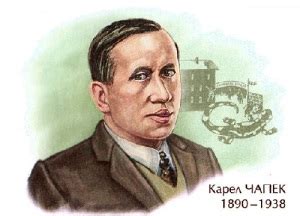
Karel Čapek was among the best-known Czech writers of the twentieth century, a prose writer and playwright. He was born on 9 January 1890 in Malé Svatoňovice, then Austria-Hungary (now the Czech Republic), the son of a factory doctor. In 1915 he took a doctorate in philosophy at Charles University, having also studied philosophy at the universities of Berlin and Paris. Exempted from military service on grounds of health, he worked for a time as a private tutor.
In the autumn of 1917 he became a journalist and critic on the newspaper Národní listy ("The National Gazette"), and from 1921 until his death he served as journalist and cultural and political editor at Lidové noviny ("The People's Gazette"). From 1921 to 1923 he was also a dramaturg at Prague's Vinohrady Theatre (Divadlo na Vinohradech). His literary career began in 1916, with the story collection The Luminous Depths, written with his brother Josef.
Recognition came in his own lifetime, both in Czechoslovakia and abroad: he was a nominee for the 1936 Nobel Prize in Literature, the founder and first chairman of the Czechoslovak PEN Club, and a member of the League of Nations Committee on Literature and the Arts. Beyond letters and journalism he earned a name as an amateur photographer. He was a convinced anti-fascist, and when he refused to leave the country after the resignation and emigration of President Edvard Beneš, he found himself in almost complete isolation. He died of double pneumonia on 25 December 1938.
His archive was hidden by his widow, Olga Scheinpflugová, in the garden of the Strž estate at Stará Huť, thirty-five kilometres south of Prague, where the writer had spent his last years; it came to light after the war. Čapek — a personal friend and longtime interlocutor of T. G. Masaryk, a promoter of many of his ideas, and no great sympathizer with socialism (witness his well-known article "Why I Am Not a Communist") — was at first banned in communist Czechoslovakia, but from the 1950s and 1960s his work was once again widely published and studied.