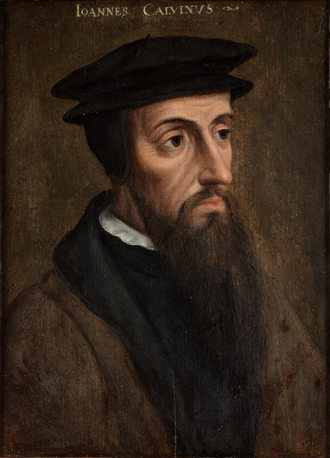
Jean Calvin was born in 1509 in the Picard town of Noyon, into the family of a church notary. His father intended his son for a clerical career and had already secured for him a church benefice, but later changed his mind and sent him to study law — first at Orléans, then at Bourges. Calvin received a legal education, became absorbed in humanist philology, and, it seems, somewhere in these years underwent a religious conversion of which he himself almost never spoke directly.
To remain in France had become dangerous: after anti-Catholic broadsheets appeared in 1534, repression fell upon the Protestants, and Calvin left. In Swiss Basel, sheltered from persecution, he published in 1536 the first edition of the book that would define the whole of his later life — the "Institutes of the Christian Religion." It was a systematic exposition of Protestant doctrine: on Scripture as the sole source of faith, on the sinfulness of man, and on salvation not by works but by faith. Calvin would go on revising and enlarging this book to the end of his life.
In that same year, 1536, passing through Geneva, he was almost forcibly detained there by the preacher Guillaume Farel, who persuaded him to stay and lead the reform of the city church. The first attempt failed: demands on the townspeople that were too severe provoked resistance, and in 1538 the city council expelled both reformers. Calvin went to Strasbourg, where for several years he served as pastor of the French Protestant community and married a widow named Idelette de Bure.
In 1541 Geneva, faced with political instability, called Calvin back — and this time on his own terms. He secured the adoption of church ordinances under which the spiritual and civil life of the city were interwoven almost indistinguishably. The consistory — a council of pastors and elders — watched not only over the purity of doctrine but also over the conduct of the citizens: attendance at sermons, gambling, taverns, dancing, and marital quarrels.
The theological core of Calvin's teaching became the doctrine of predestination: the fate of every person — salvation or damnation — is settled by God before the creation of the world, and no works can change it. The thought that the soul's lot is known in advance did not, paradoxically, breed fatalism among Calvin's followers but pushed them toward strict self-discipline and a work ethic that would later be tied to the very notion of Protestantism.
The darkest episode of Calvin's rule in Geneva was the execution of Michael Servetus — a Spanish physician and theologian who denied the dogma of the Trinity. In 1553 Servetus, fleeing the Inquisition, found himself in Geneva, was recognized, arrested, and by sentence of the city council burned at the stake. Calvin appeared as a witness for the prosecution at the trial and supported the death sentence for heresy, though he asked that burning be replaced by the swifter death of the sword — the council refused him. This episode remains to this day the chief stain on the reformer's reputation, a symbol of the degree to which religious intolerance was a common norm of the age rather than the personal trait of one man.
Calvin died in Geneva in 1564, leaving behind not merely a congregation but a system: a church order, a code of disciplinary rules, and the Geneva Academy he founded in 1559, which trained preachers for all of Europe. From Geneva Calvinism spread to Scotland, the Netherlands, part of France, and later to the New World, where its ethic of labor and personal responsibility entered firmly into the culture of the Protestant nations.