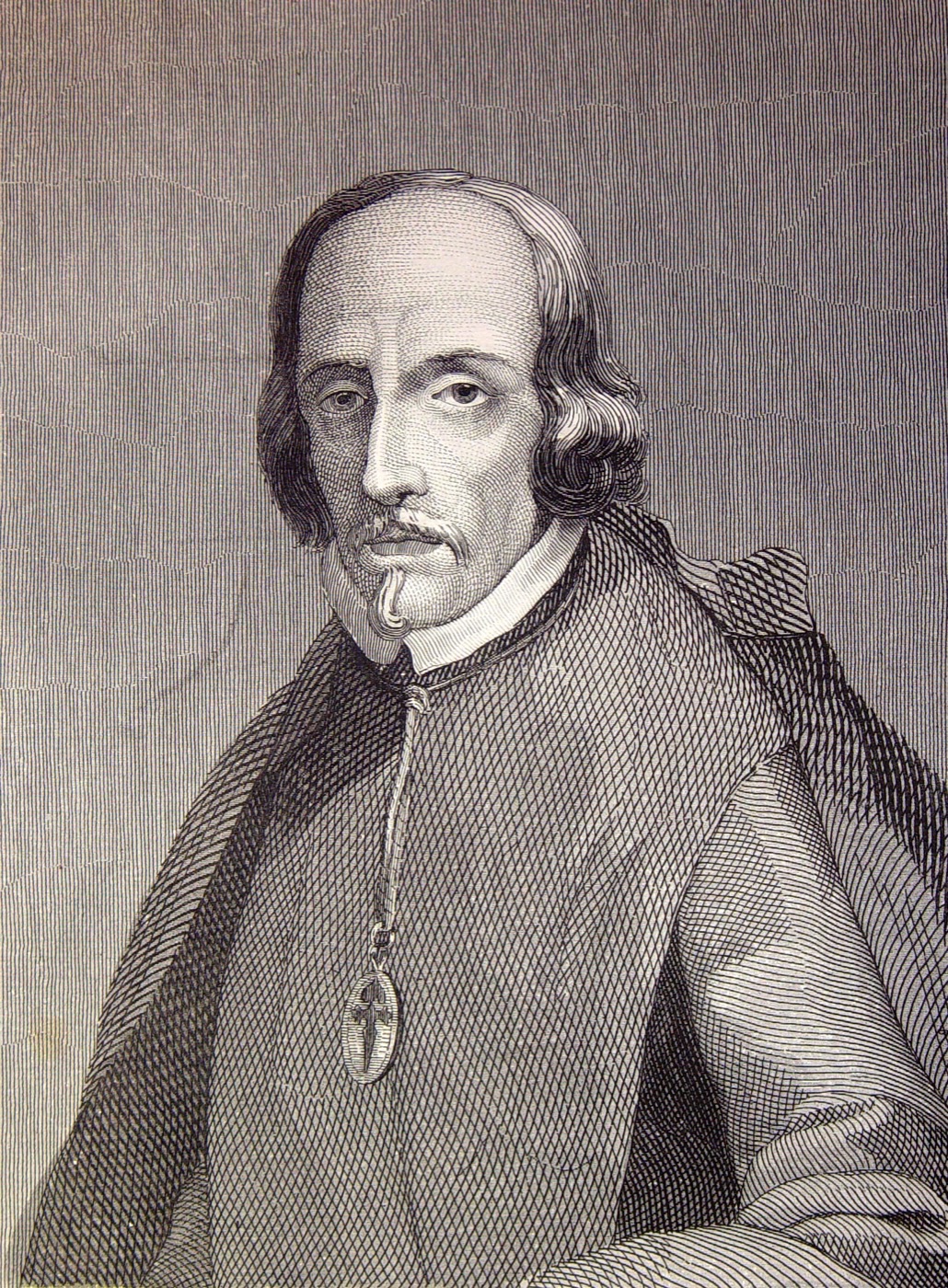
Pedro Calderón de la Barca — Calderón, for short — was a Spanish dramatist and poet whose work stands among the summits of the literature of Spain's Golden Age; with him, and his roughly two hundred dramatic works, the history of Spanish classical drama comes to its close. He was born in Madrid to Don Diego Calderón, a secretary of the treasury and a gentleman of middling rank; his mother, Ana María de Henao, was the daughter of an armourer of Flemish stock. His father intended him for the Church: he was schooled at the Jesuit college in Madrid and studied at the universities of Salamanca and Alcalá de Henares. In 1620, however, Calderón abandoned his studies for military service. By some accounts he served with the Spanish forces in Italy and Flanders between 1625 and 1635, though there is also evidence of his presence in Madrid during those years.
He made his debut as a playwright with “Love, Honour and Power” (Amor, honor y poder, 1623), and by the time his great predecessor and teacher Lope de Vega died in 1635 he was already reckoned the first dramatist of Spain. He had won favour at court as well. Philip IV made him a knight of the Order of Santiago and commissioned plays from him for the court theatre in the newly built palace of Buen Retiro, placing at his disposal the finest musicians and stage designers of the day. The plays of his years as court dramatist show a marked taste for elaborate stage effects: “The Beast, the Lightning and the Stone” (La fiera, el rayo y la piedra, 1652) was performed on an island in the middle of a lake in the palace park, the audience watching from boats.
In 1640–1642, back under arms in a company of cuirassiers raised by the count-duke of Olivares, Calderón took part in suppressing the Reapers' Revolt, the national-separatist rising in Catalonia. Ill health forced him from military service in 1642, and three years later he was granted a pension. He later became a tertiary of the Franciscan order, and in 1651 he was ordained priest — a step probably prompted by events in his private life (the death of a brother, the birth of an illegitimate son), about which little reliable is known, and by the persecution then gathering against the theatre. After ordination Calderón gave up writing secular plays and turned to the autos sacramentales — allegorical dramas on subjects drawn chiefly from the Bible and Sacred Tradition, dramatic illustrations of the mystery of the Eucharist. In 1663 he was appointed personal confessor to Philip IV, royal chaplain, an honour the king's successor, Charles II, preserved for him. Despite the popularity of his plays and the goodwill of the court, Calderón's last years were passed in conspicuous poverty. He died on 25 May 1681.
Calderón's drama is the baroque consummation of the theatrical model created in the late sixteenth and early seventeenth centuries by Lope de Vega. According to the list of works the author himself drew up shortly before his death, Calderón wrote some 120 comedies and dramas, 80 autos sacramentales, 20 interludes, and a good deal else besides, shorter and longer poems included. Though less prolific than his predecessor, he brought Lope de Vega's dramatic “formula” to perfection, purging it of lyrical and inessential elements and turning the play into a sumptuous baroque spectacle. Unlike Lope de Vega, he gave particular attention to the scenographic and musical side of performance.
Among his works: “Life Is a Dream”, “The Phantom Lady”, “The Constant Prince”.
By common consent, Calderón's baroque dramatic art shows most vividly in “Life Is a Dream” — the key drama not only of his own work but of baroque art as a whole. In reading it one should attend especially to the way religious, mythological, political and moral-philosophical strata of Calderón's thought overlap and refract one another in the unfolding of the conflict. This gives the play's opening thesis, lifted into its title, not the familiar medieval sense but a new, generalizing and metaphorical — and at the same time deeply ambiguous — character. “Life Is a Dream” is a drama of many problems at once, which is worth bearing in mind when one meets its interpretations in the critical literature. Some accounts press toward a historical-political concretizing of the plot — the claim, for instance, that this is a play about the education of an ideal ruler — which seems ill suited to Calderón's poetics. The allegorical-philosophical register of the drama can be felt with particular clarity if it is set beside “The Mayor of Zalamea”, Calderón's historical play, a reworking of a drama whose authorship is often linked with the name of Lope de Vega. There too Calderón concentrates on the problem of honour, but poses and resolves it on more concrete national-historical ground.