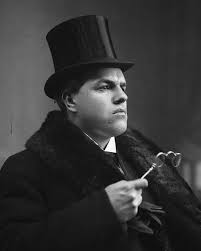
The “father of Russian Futurism,” scathing in his pronouncements and abrasive in his manifestos, David Burliuk was in life a calm, undemanding man with a sharpened paternal instinct toward those who “threw the classics overboard from the steamship of modernity.” More remarkable still, he managed never to quarrel with the Futurists who surrounded him in such numbers — and mildness of temper was hardly their distinguishing trait. His surname nonetheless became a byword, and Alexander Blok even complained: “The Burliuks, whom I have not yet seen, frighten me off. I fear there is more boorishness in this than anything else…”
David Burliuk was born into an agronomist’s family in Kharkov Governorate. He had two brothers and three sisters, none of whom shunned the brush; Nikolai, moreover, was a passable poet. It was Nikolai, incidentally, who “gave” David — if that is the word — his most distinctive outward feature. As a boy, in a fight, he knocked out his brother’s eye. The glass eye and the lorgnette became David Burliuk’s trademark. He flaunted them, even claiming that his singular artistic vision came of looking at the world with one eye.
David studied at the art schools of Kazan and Odessa and tried for the Academy of Arts, but failed the examination. He had to “make do” with Munich (the Royal Academy of Arts) and Paris (Cormon’s school of fine arts).
A born organizer and ringleader, he could rally every interested party around him; he mounted exhibitions, wrote manifestos, and personally nursed several luminaries into being. Mayakovsky said it was Burliuk who made him a poet — handing him fifty kopecks a day so that he would not have to write hungry. And that is no metaphor.
On returning to Russia after his studies, Burliuk landed in the thick of the literary and artistic avant-garde. In the 1910s the estate of Chernyanka in the Kherson country, where his father worked as steward, received the poets Mayakovsky, Kamensky, and Khlebnikov, the painters Larionov and Lentulov, and many others. It was there that Burliuk wrote the famous Futurist manifesto with the telling title A Slap in the Face of Public Taste, calling on his readers to “throw the classics overboard from the steamship of modernity.”
Burliuk was among the organizers of the Jack of Diamonds, an artists’ society that rejected academicism and realism while warming to Post-Impressionism, Fauvism, and Cubism. The group later split in two: some of its painters broke away and took the new French painting as their compass (Robert Falk, Pyotr Konchalovsky), while Burliuk, Malevich, Goncharova, and Larionov looked instead to national color, folk art, and the lubok print. Their movement they named, with characteristic effrontery, the Donkey’s Tail.
Burliuk seems to have left his mark on every one of the many artistic currents of that turbulent era. Scholars of the period like to observe, diplomatically, that his work is “highly eclectic.” In the 1910s he flirted with Primitivism. Echoes of Chagall, who repealed the law of gravity and sent his figures aloft, can be caught in The Headless Barber — though there the kinship is purely technical: Chagall’s magic never crossed onto Burliuk’s canvas. Understandably so — he painted The Barber while at work on A Slap in the Face of Public Taste, and built into it the three pillars of Futurism: disharmony, asymmetry, deconstruction. What has Chagall to do with disharmony? And yet something faintly Chagallian does seem to peer out of the little window at the right. One senses, too, an echo of Mikhail Larionov’s barbershop paintings.
In The Harvest and the Portrait of the Futurist Song-Fighter Vasily Kamensky, by contrast, Burliuk is more convincing: here the space of the picture lives by laws of its own rather than merely breaking the familiar ones.
He often turned to Post-Impressionist motifs as well, above all in his still lifes. Is it not plain that here “the spirit of Van Gogh, the very smell of Van Gogh” hangs in the air? Later, after emigrating to the United States, Burliuk would proclaim himself “the American Van Gogh.”
His landscapes are on the whole fairly realistic. What sets them apart is the paint itself, often laid on so thickly that whole encrustations rise from the canvas, as in Landscape with a Road.
How scathing and merciless Burliuk is in his accusing manifestos! How zealously he calls for everything that smacks of yesterday to be consigned to oblivion! He denounces and exposes; the glint of his lorgnette is always at the front line. Such a man, one assumes, must have been harsh, restless, and implacable in life as well. What do his contemporaries say?
Burliuk fussed endlessly over Khlebnikov; he looked after Mayakovsky, who to the end of his life called him his teacher; and he quite overwhelmed the twenty-five-year-old poet Benedikt Livshits by inviting him to Chernyanka with the words: “Come with me, child!”
The “father of Russian Futurism” really did feel fatherly toward his comrades. Here it is worth recalling a line of the Manifesto less famous than the jettisoning of Pushkin and Tolstoy, but one that perhaps cracks open the riddle of Burliuk’s personality: “He who does not forget his first love will not know his last.” Perhaps it was precisely his brazen want of reverence for the authorities of the past that left him so full of tenderness and care for the present ones — the disheveled, ungainly, prickly heroes of the future. Legend has it that Ilya Repin wished to paint Velimir Khlebnikov’s portrait and was refused: Khlebnikov declared that Burliuk had already painted him, and that nothing better was possible, since “only there do I look like a triangle.”
Aristarkh Lentulov would later come away from a meeting with Burliuk disappointed: he had expected a demon with a lorgnette, a toppler of values, and found instead “a middling businessman in retirement.” By nature, Lentulov recalled, “Burliuk was a family man and ordinary citizen with no craving for luxury.”
The Civil War carried Burliuk to Bashkiria, then on through Siberia and the Far East, preaching Futurism as he went. By then he was married. Maria Burliuk (née Yelenevskaya) emigrated with her husband to Japan in 1920 (by one account her father, a man of influence in Vladivostok, helped arrange the passage). In Japan Burliuk painted some ten landscapes, among them Mount Fuji, Japan and Temple Gate in Japan.
Some scholars hold that the Japanese period was for Burliuk merely a way of raising money for emigration to the United States, and that he painted to please the public. Japanese art historians reject the idea flatly — the more so since Burliuk did not forget Futurism even in Japan: witness On the Beach. The Land of the Rising Sun, indeed, counts David Burliuk the founding father of Japanese Futurism. A father here, too.
In 1922 Burliuk moved to the United States and opened a publishing house that issued prose, poetry, journalism, and memoirs. He assimilated successfully in America: he worked prolifically, won recognition, saw his pictures shown in the best museums and galleries, and traveled widely in Europe. In 1950 he even opened a gallery of his own on Long Island.
Burliuk compared a work of art to a storage battery whose task is to recharge. To judge by his life, he made a splendid “work of art” himself — and his charge sufficed for a great many painters and poets of the new art to come fully into their own. Nor should we forget that Burliuk managed to father both Russian and Japanese Futurism.