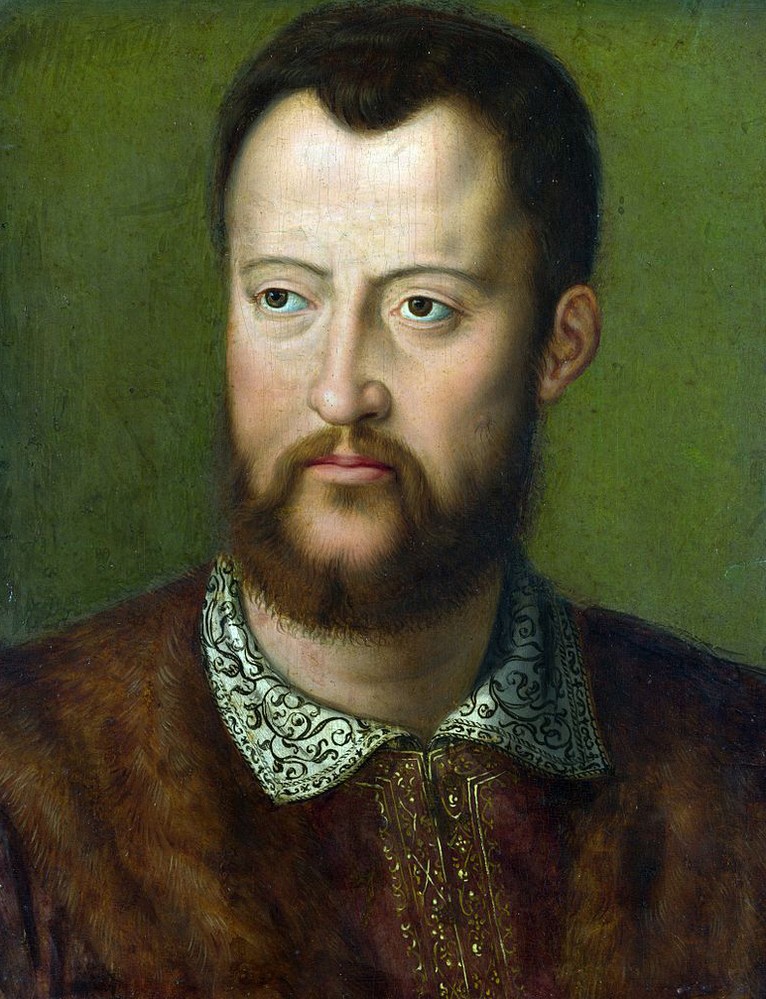
Agnolo Bronzino was born in 1503 in Monticelli, a suburb of Florence. He studied briefly under Raffaellino del Garbo, and then, from around 1515, became a pupil and assistant of Jacopo Pontormo — remaining close to him for decades. Giorgio Vasari, a contemporary of both men, wrote that they were bound by an almost father-and-son relationship; much later, Bronzino would show that same devotion to his own pupil, Alessandro Allori.
From the late 1530s Bronzino served as court painter to Cosimo I de' Medici, Duke and later Grand Duke of Tuscany. He designed the festivities for Cosimo's wedding to Eleonora of Toledo in 1539, and over the following decade decorated her private chapel in the Palazzo Vecchio.
The chief monument of this service is the portrait "Eleonora of Toledo with Her Son Giovanni" (c. 1545): a frozen, almost jewel-like precision in the rendering of the brocade gown and lapis-blue background — an image not so much of a mother as of the dynastic pillar of the Medici. Eleonora's face in the portrait is calm and almost impenetrable, with no trace of the warmth one might expect from a mother's portrait: Bronzino was painting not a woman but an institution of power embodied in a particular person. His court commissions were not limited to portraits: together with Pontormo he also produced cartoons for tapestries depicting the story of the biblical Joseph, which adorned the state hall of the Palazzo Vecchio — another great decorative undertaking of the Medici, in which painting served as a direct instrument of power.
No less famous is his intricate erotic-moralizing allegory "Venus, Cupid, Folly and Time" — probably a diplomatic gift from Cosimo I to King Francis I of France, though no documentary evidence survives to confirm that the painting actually entered the French royal collection.
Bronzino's style became the benchmark of Florentine Mannerist portraiture: a cold, detached, almost enamel-like smoothness of faces and fabrics, with a minimum of sentiment and a maximum of dignity in the sitter. Besides painting he wrote poetry, a common enough pastime at the Medici court, but not the most common combination of talents for a painter of his stature: his contemporaries prized his sonnets almost as highly as his painting, though today they are far less known.
In 1563 Bronzino became one of the founders of the Florentine Accademia delle Arti del Disegno — the first academy of art in Europe in the modern sense, established with the support of Cosimo I and on the initiative of that same Vasari.
Bronzino died in 1572 in Florence — outliving his mentor Pontormo by fifteen years. He never sought fame beyond the court he served, and spent almost his entire life in a single city, moving between a single workshop and a single palace — a stability rare for an artist of his era. His whole life was a story of continuity: he received his teacher's unconditional devotion and passed it on in turn to his own pupil, along with the ability to look at the world with that same finely honed, coolly precise gaze visible in every one of his portraits.