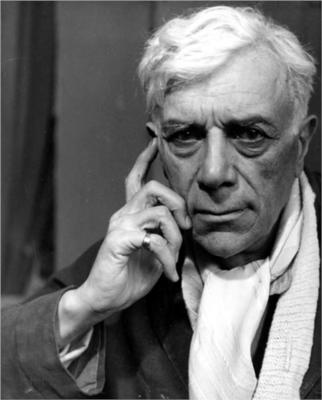
In 1908 he went to Picasso's studio to see Les Demoiselles d'Avignon. He came away shaken. Back in Normandy he painted a group of landscapes and showed them to the critic Louis Vauxcelles, who wrote of "little cubes." And so the word "Cubism" entered history.
Georges Braque was born in 1882 at Argenteuil, near Paris. His father was a house painter with a love of pictures, and from childhood Georges was handy with both his hands and a brush. He trained as a decorator, then studied at the Academy.
In 1907 he met Picasso. For the next five years the two worked so closely that afterwards neither could say for certain who had done what. They corresponded, exchanged canvases, and moved in a single direction: to break an object into planes, to see it from several sides at once.
Braque said: "We were like mountaineers roped together." When war came in 1914 he went to the front, was gravely wounded, and spent a year recovering. He returned to find that Picasso had already gone another way.
He carried on alone. His Cubism grew softer and warmer — textures appeared, earthy colours, still lifes with musical instruments. He came back to where he had begun: craft, material, surface.
Unlike Picasso, he had no taste for noise. He lived in Normandy and worked. He died in 1963, at eighty-one.
Picasso said of him: "Braque is the woman I loved most."