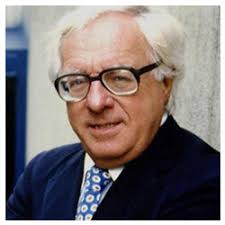
“I don't think about death, because I'll always be here. That box with my films and the shelves with my books assure me I have a hundred years or two in reserve. Death is a form of payment to the cosmos for the marvellous luxury of having been alive.” So Ray Bradbury, in his “rules of life.”
Raymond Douglas “Ray” Bradbury was an American writer of fantastic fiction; critics assign some of his work to magical realism. He was born on 22 August 1920 in Waukegan, Illinois. His middle name, Douglas, honoured the famous actor of the day, Douglas Fairbanks. His father, Leonard Spaulding Bradbury, was descended from English first settlers; his mother, Marie Esther Moberg, was Swedish by origin. In 1934 the family moved to Los Angeles, where Bradbury lived the rest of his life. His childhood and youth fell in the years of the Great Depression, and there was no money for a university education; yet having decided at barely twelve to become a writer, he pursued that resolve with enviable stubbornness and never once contemplated another profession. As a young man he sold newspapers, then lived for several years on his wife's earnings, until in 1950 his first major work, The Martian Chronicles, was at last published. With the novel Fahrenheit 451 in 1953, and its serialization in the earliest issues of Playboy, his fame became worldwide.
Bradbury is often called a grand master of science fiction, one of the finest writers in the genre and the founder of many of its traditions. In truth he is hardly a science-fiction writer at all: his work belongs to the “big,” extra-generic literature, and genuinely fantastic pieces make up only a small share of it. Most of his works are short stories of an unentertaining cast — brief sketches turning on moments of sharp drama and psychology, built chiefly on dialogue, monologue, the reflections of his characters. For all his evident gift for invention, for engaging and original plots, he often confines himself to plotless sketches, deeply metaphorical, full of hidden meaning or sometimes carrying no definite message at all. Even in his well-carpentered pieces he will readily break off the narrative, sidestep the particulars, abandon the action at the very peak of tension. Nor can he be caught moralizing or pressing his views: in ninety-nine per cent of his work the author stays out of the frame. A situation may develop with any degree of partiality, but Bradbury never leads the reader to a conclusion. He seems to see his task as stirring the reader, sharpening the situation, and withdrawing — leaving him to think on over the book.
And if Bradbury sometimes departed from his other principles, his language — his way of rendering images and thoughts — scarcely ever changed. Its hallmarks are a watercolour lightness: a minimum of detail, description, particulars, action. What is at work is not so much fantasy in the sense of unreality as a disdain for the claims of verisimilitude. This touches his plots — the fantastic cohabits easily with the fairy tale, the detective story with melodrama, sweeping genre boundaries aside — and his language alike: Bradbury neglects descriptions of places, of his characters' appearance, names, dates, figures. Naturally one finds in him no technical detail, no invention in the technical sphere. Holding no plot sacred, he shifts styles and genres freely: among stories written in a single year one may find science fiction, melodrama, detective story, fantasy, historical sketch and more.
To judge by his essays and interviews, Bradbury preached a literature of feelings rather than thoughts; of emotions rather than actions; of states rather than events. In his youth he once burned all his weak, failed stories in a grand bonfire on his plot of land. “I burned two million words,” he said sadly. That spectacle later fed his debut novel Fahrenheit 451, about the burning of books, and a story on the same theme. His work is the opposite of the classic plotted short story with its intrigue and knockout ending; the reader who comes for entertainment and suspense will likely go away disappointed. Curiously, these stories of mood, these felt sketches in which the author himself lives, speak most to the mature reader: most of Bradbury's admirers are middle-aged or older. Among his colleagues, the American science-fiction writers, the master had the reputation of a “good old storyteller,” held in great respect. Bradbury stood for spiritual values, and above all for imagination and creative work. The inner world of a human being — his outlook, his imagination — Bradbury declared all but the highest value, and the capacity to feel and to empathize he counted the chief human quality. His sympathies in his books go first of all to people of art, and even more to those who cherish it. And often enough, in his pages, he deals ruthlessly with the “enemies”: callous people without imagination, philistines, officials, politicians — those who obstruct the life of creative people, their self-expression and communion; who reduce culture to convention, mass production and standardization, and make life dry, dull, spiritually poor and stale.