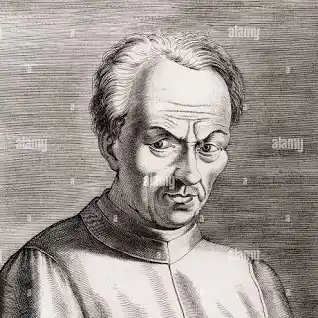
Poggio Bracciolini was born in 1380 in Terranuova, a small Tuscan town. He grew into a brilliant Latinist and in the early 1400s entered the service of the papal chancery in Rome. An apostolic secretary is a man who drafts the official documents of the Holy See. For fifty years Poggio served the popes — five or six of them, depending on whom one counts as legitimate, for this was precisely the time when the Great Western Schism was unfolding: three popes at once claimed legitimacy, and no one knew whom to believe.
In November 1414 the Council of Constance began — a church assembly meant to put an end to the schism. Poggio came with his pope. The council lasted four years, and throughout that time Poggio was in Constance and its surroundings. He was present at the trial of the Bohemian reformer Jan Hus, and on 6 July 1415 he watched him burned. In a letter to a friend Poggio described it coolly: Hus died steadfastly, almost cheerfully. And in the intervals between sessions Poggio rode out to the neighbouring monasteries — to hunt for old manuscripts.
The monastic libraries held texts the world had long forgotten: copied out by monks in the Middle Ages, they lay in chests, once read and then forgotten. In 1416, in the library of the monastery of Saint Gall, Poggio found a complete copy of the "Institutio Oratoria" of Quintilian — a manual of rhetoric known only in abridged copies. In early 1417, in a German monastery — presumably at Murbach — he discovered a manuscript of the poem by Lucretius, "De rerum natura" ("On the Nature of Things"). Poggio did not read it himself: he had it copied, sent the copy to a humanist friend in Florence, and moved on to his next find.
The poem set out the system of Epicurus: the universe is made of atoms moving in the void. The gods exist, but they take no interest in men. The soul is mortal and disintegrates with the body. There is no afterlife. The fear of death is irrational and harmful. The highest good is a calm pleasure attained without anxiety. For the Christian Europe of the fifteenth century this was explosive material. The manuscript passed quietly, but slowly and steadily it seeped into European thought. Montaigne quoted Lucretius more often than any other poet. Giordano Bruno drew on atomism. Newton knew Epicurean physics, in part through this channel. In the American "Declaration of Independence" the "pursuit of happiness" goes back, through a chain of transmission, to the Epicurean notion of hedone — though most of those who signed the document were not thinking of it.
Poggio went on finding manuscripts after Constance too: speeches of Cicero, the complete text of the "De architectura" of Vitruvius, of Silius Italicus, of Manilius. But he had another genre as well. The "Liber facetiarum" — the "Book of Jests" (1438–1452) — is a set of 273 short anecdotes, mostly bawdy. It was the first collection of its kind in the Renaissance: gluttonous monks, foolish husbands, cunning servants. The man who was rescuing ancient philosophy amused himself by collecting ribald tales. He found the two occupations perfectly compatible.
In 1453, at the age of seventy-three, Poggio became chancellor of Florence. He died in 1459. The humanist book script that he and his contemporaries developed to replace the Gothic hand became the basis of the first printed typefaces — and of those in which most books are set today. The first printed edition of Lucretius appeared in 1473 — fifty-six years after Poggio had made a copy of it in a German monastery and, by all appearances, had not read a single line.