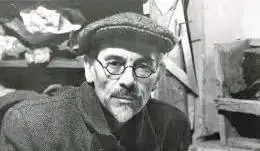
A devoted servant of his country's culture: the phrase might have been coined for Pyotr Dmitrievich Baranovsky. A remarkable man, a distinguished scholar and restorer, a superb connoisseur of the monuments of Russian art, he gave the cause of preserving and reviving his country's heritage — without exaggeration — his entire life.
He was born into a peasant family in the village of Shuyskoye, in the Vyazma district of Smolensk province. After the town school at Dorogobuzh he entered M. K. Priorov's Moscow school of construction and engineering, where he was counted among the best pupils (Architectural Archives Department, Shchusev State Museum of Architecture, fond R-XIV, P. D. Baranovsky; file 5316/10 — hereafter only the file number is given). In 1912 he completed “the full theoretical and practical course with excellent conduct” (D.5316/11), and then studied in the department of art history at the Moscow Archaeological Institute: he “attended the full course as an auditor and defended a dissertation, 'Monuments of Old Russian Architecture in the Boldino Monastery'” (D.5316/18, f.3). On finishing the Institute in 1918 he was “retained to prepare for a professorship” at the chair of the history of Russian architecture (D.5316/18, f.4).
His gifts, his knowledge, his industry and energy gave him every foundation for a scholarly career, and teaching might equally have become his path. From 1919 to 1922 Baranovsky lectured on the history of Russian architecture as a professor of the Yaroslavl branch of the Moscow Archaeological Institute; in 1922 he was invited to lecture at Moscow University on archaeological topography. He was closely tied to the celebrated Moscow Archaeological Society, which elected him a corresponding member in 1919 (D.5292/8), and from 1919 he was a senior researcher at the Academy of the History of Material Culture.
And Baranovsky did become both a scholar and a teacher — though he wrote no monographs, defended no further dissertations, gave no university lecture courses and supervised no graduate students. He was a profound scholar-practitioner, a connoisseur, a Master; he created a scientific school of restoration in the fullest sense, and saved, revived and defended dozens, if not hundreds, of architectural masterpieces. He was a teacher because he gathered the young around him, infecting them with his passion for Russian culture and for architecture, raising up restorers, allies and followers — the famous youth club Rodina at Krutitsy; the Movement of Volunteer Helpers of Restorers, which recently marked its thirtieth anniversary; those who found their calling in architecture and restoration thanks to him, and those who chose other professions yet remember their Teacher with gratitude to this day.
A particular facet of his talent was sheer activity of nature: he was a great practitioner, simply incapable of pursuing pure scholarship while monuments were perishing around him. In his autobiography he wrote that he abandoned teaching “because of the urgent necessity of protecting monuments, brought forward by the rebuilding of life. The broad possibilities opening up in restoration compelled me to give all my strength to that cause, so that there was no time even to think of anything else. From 1923, at my own wish, I gave up my teaching in higher education.” And further: “The favourable conditions in which one might calmly, fruitfully and in a scholarly way work up one's research materials have not arisen even now; the natural reproaches over my lack of publications continue, and I myself am conscious of the extreme need for them. A decisive turn in that direction would mean resolving to leave the work of protection and restoration and take up the thorough processing of materials. But the still insufficiently secured front of protecting and restoring existing monuments does not permit me to step back from caring for them.” That was written in January 1947; he never abandoned that care to the end of his life. He gave his chief cause seventy years — from 1911 to the early 1980s.
His love of ancient architecture had woken in earliest youth. At twelve he was struck, consciously and for good, by the wooden tent-roofed church in the Smolensk village of Rybki, and made the first measured drawings of his life; at fifteen came another marvel — the stone Church of the Presentation in the Boldino Trinity Monastery near Dorogobuzh. These two churches became his passport into life. The history of Baranovsky the restorer begins with a paper on them, read in December 1910 at a session of the Moscow Archaeological Society. On the Society's commission he travelled to the Boldino monastery in 1911 to survey its architecture, and brought back not only the survey materials but his first restoration project, for the Presentation church and the refectory. He himself recalled: “A few days later I was invited to the Archaeological Society. They showed me the paper on my award and handed me a prize of four hundred rubles in five-ruble gold coins. For me an unexpected, enormous sum, all of which I put in the bank, however hard my life was then. In the spring I bought a camera with its kit and set off across Russia” (quoted in Yu. A. Bychkov's life of Baranovsky). In 1912 and 1915 he would go on to study the monuments of Vyazma in the Smolensk region and Staritsa in the Tver region, drawing up projects for their reconstruction and restoration.
During the First World War Baranovsky was at the front, commanding a construction detachment. His interest in ancient monuments did not slacken in those years; it grew. In Polesye and in Volhynia he “contrived to carry out studies of monuments of wooden architecture, trying to preserve in drawings, sketches and photographs priceless examples of the folk art of the seventeenth and eighteenth centuries” (Bychkov).
After the war, in 1918, came the final choice of path. He wrote that 1918 was “decisive in my personal life, when, returning from the front after the October Revolution, I entered on the road of scholarly work, first proposing a project to free the Kitai-gorod wall in Moscow from the accretions that disfigured it, and then arguing before the Commissariat of Properties of the Republic the necessity of restoring the monuments of Yaroslavl after the White Guard mutiny” (D.5316/18, f.4). In 1918 began his long labour — lasting into the early 1930s — on the study and restoration of the monuments of Yaroslavl, gravely damaged by the barbarous shelling and bombardment of the city during the suppression of the uprising in the summer of 1918. Together with the architect N. N. Pomerantsev he saved masterpieces of the Yaroslavl architectural school, and at the same time uncovered, beneath later alterations and rebuildings, the original face of its medieval churches; in the same years he worked on architectural treasures elsewhere in the Yaroslavl land. Recalling that time, he said: “For me it was clear: Yaroslavl is a city-monument. All its churches are masterpieces, or at the least landmarks that must be preserved.” In 1932 his devotion to church antiquity and his feat of restoration in Yaroslavl (one of many) were remembered against him: “The Yaroslavl public... protests against Yaroslavl remaining a city of churches cluttering its squares, streets and thoroughfares, hindering the transformation of Yaroslavl from an episcopal-merchant cradle into a genuinely socialist city”; “Yaroslavl must become genuinely socialist, not a museum of antiquities... Clear the squares and streets of the 'Great Martyr Barbaras', the 'Simeon Stylites' and the other churches”; “The scholar-architects Baranovsky and Pomerantsev have not justified the hopes of the Yaroslavl public. Instead of an objective assessment they set about proving that the churches of Yaroslavl are historical monuments and must be preserved.” After such verdicts, in 1932, one could pay dearly — even with one's life. Baranovsky paid in 1933, with his freedom. And a whole series of Yaroslavl monuments he had saved and restored were destroyed in those grim, iconoclastic times.
But return to the beginning of his restorer's path, the early 1920s. Was that period any calmer for his work than the decade that followed? Was there ever a calm period in his life at all, when his work as a restorer was not bound up with a fight — not for the life of a monument (a restorer always fights for a monument's life, as a doctor fights for a patient's), but for a monument's right to live? Here is the terrible paradox of our not-so-distant past and, alas, of our present: the very notions of antiquity and beauty guarantee an architectural masterpiece no rights at all, and even official legal status as an object of artistic or historical value is still no guarantee of the right to exist. In cruel times and in mild ones, monuments — our history, our national inheritance, the historic face of historic cities, Moscow among them — somehow always have to be fought for (and in places the fight is already nearly hopeless). Once a monument's fate was decided by ideology; now by ordinary money; but then as now the monument stands in our streets like an undocumented migrant without rights: with luck it survives, without luck it does not — and luck has been rare. Baranovsky's whole life, one may say, passed in that fight. He knew what a monument was, and he fought, defended, argued — and worked. The architect-restorer A. A. Karnabed wrote that Baranovsky's credo was: “Better one saved monument than dozens of dissertations.” He possessed the unquenchable energy of a labourer; he threw himself into work, lived by it, carrying several investigations and restoration projects at once. Open the “List of Scholarly Investigations” he himself compiled, and you find that in 1919 — alongside the Yaroslavl work — he was occupied with wooden monuments in the Kaluga region, with monuments in the Kostroma region, was working at the Boldino monastery, and defending his dissertation at the Archaeological Institute besides. Under 1920 the list includes the cathedral of the Ivanovsky monastery in Vyazma; the Kitai-gorod wall in Moscow; the Divnaya church and refectory of the Alekseyevsky monastery in Uglich; the recording of Uglich's monuments after the fire (he worked there until 1924); the church of St Isidore and the cathedral of the Borisoglebsky monastery in Rostov the Great; the Dormition cathedral on the Gorodok at Zvenigorod; the tent-roofed church and fortress of Boris-Gorodok near Mozhaisk; the Northern Dvina expedition for the Commissariat of Enlightenment; the Gostiny Dvor in Arkhangelsk; tent-roofed churches of the Arkhangelsk and Yaroslavl regions; and, on top of all this, the design of an open-air Museum of Russian Wooden Architecture at Kolomenskoye — with the Yaroslavl monuments still in hand. Commentary is hardly needed. And so it went, all his life (the List, which he carried down to 1964, is eloquent enough). He said of himself: “I mean that inner charge which every great undertaking requires. I need extra years. I always wanted to split myself in two, in three, in ten, so as to get more done.”
From 1924 to 1933 his research and restoration work was tied to the Central State Restoration Workshops, where he held the post of architect-restorer. During the Great Patriotic War he served as an expert of the Extraordinary State Commission assessing the damage inflicted by the Nazis, and afterwards became head of the restoration department of the Committee on Architecture under the Council of People's Commissars of the RSFSR.
Baranovsky's name is bound up with numerous expeditions — to the Russian North, the Caucasus and Transcaucasia, Central Asia, the regions of central Russia, the Novgorod and Pskov lands, the Volga country, the Smolensk region, Belarus, western Ukraine and beyond.
In the 1920s he was haunted by the loss of the wooden architecture of the Russian North: survey it, save it, and what could not be saved in place, save by moving it to a museum of wooden architecture. In 1920 he took part, as noted, in the Workshops' Northern Dvina expedition. In 1921 he mounted a one-man expedition to the Vyya and Pinega. In 1922 he went with a Workshops expedition to Novgorod during the campaign of confiscation of church valuables, “for the selection and preservation of artistic and historical monuments” — inspecting fifty architectural monuments in the process. In 1922 and 1923 came the Commissariat of Enlightenment's expedition to Solovki, where an NKVD camp was then being installed in the monastery complex. In 1926 came the Obonezhye expedition to study wooden architecture in Karelia; the next two years went (among much else) on fieldwork in Moscow province. In 1929 there were two expeditions at once, to Georgia and to Belarus; in 1930 he surveyed the monuments of the Upper Volga; in 1931, the Russian North again, with the White Sea–Onega expedition. In 1938, 1939 and 1940 he studied the monuments of Azerbaijan from the age of Nizami; in parallel, in 1939–1941, the architecture of Caucasian Albania, and in 1940 the monuments of Derbent as well. In 1946, 1947 and 1949 he took part in three Caucasus expeditions united by a single theme, the links of Old Russian architecture with the Caucasus, Byzantium and the Balkan lands. In 1955 he studied the architecture of the towns of western Ukraine; in 1951 there was one more expedition to Azerbaijan, for the study and conservation of the round temple at Lekit. And these are only the formally organized expeditions — beyond them, how many journeys across Russia for the study and restoration of individual monuments and ensembles!
Speaking of Baranovsky, one must note his breadth of vision and his comprehensive approach to the monument as a bearer of historical information. He never shut himself within narrow professional bounds; he was at once researcher, practitioner and builder. Restoring an architectural masterpiece to its original form, he thought also of the potential stored in the inheritance left us by earlier generations — hence his concern for turning revived ensembles into museums. In the early 1920s he advanced the idea of creating, in what were then the villages of Kolomenskoye and Dyakovo outside Moscow, a museum of a new type (the first such museums had already appeared in Europe): an open-air museum of architecture and wooden building. To Kolomenskoye he gave ten years of unremitting labour (1923–1933), becoming the creator and first director of a museum that has since grown into Moscow's largest museum complex. To Kolomenskoye he brought monuments of wooden architecture from the Russian North that had been marked for destruction (they stand in the museum's displays today), created its first exhibitions, and restored, wholly or in part, the architectural monuments of Kolomenskoye and Dyakovo.
In 1929 and 1930, while studying and partly restoring the ensemble of the ancient Simonov monastery in Moscow — even as its destruction was already under way — he created there a museum display for the Museum of the Military-Fortress Defence of the Muscovite State.
From 1947 to 1950 he studied and drew up restoration projects for the monuments of the Spaso-Andronikov monastery in Moscow (he had first come to know its ensemble in the 1920s). It was largely thanks to him that the idea, conceived in 1947, of an Andrei Rublev museum-preserve in the Andronikov monastery — now the Central Museum of Old Russian Culture and Art named for Andrei Rublev — was brought to life.
Several more museum projects were his. In the 1920s and 1930s he repeatedly excavated, studied and restored the monuments of Alexandrova Sloboda in the Vladimir region, and raised the question of a museum there. In 1947 he drew up a project for a historical and architectural preserve at Yuriev-Polsky in the same region (he worked on the ensemble of the Michael Archangel monastery and the famous thirteenth-century St George cathedral from the 1920s into the 1950s). In 1946 he prepared the documents for a Chernigov historical and architectural preserve. In 1948 he proposed a Lekit historical-architectural preserve in Soviet Azerbaijan — an idea first conceived at the turn of the 1930s and 1940s, when he was studying the local monuments, among them the round sixth-century temple in the village of Lekit that he himself had discovered in 1933. In 1955 he raised the question of a preserve, “The City of Vladimir in Kiev,” and in 1962 worked out its plan.
In the 1950s and 1960s, working at the Boldino monastery and raising it from the destruction wrought by the Nazis, Baranovsky — in the words of his pupil and follower A. M. Ponomarev — “discovered for himself the extraordinarily dramatic and at the same time courageous history of the partisan movement in the Dorogobuzh country during the Great Patriotic War”: at the beginning of 1942 units caught in the Vyazma encirclement, together with local people, had organized a partisan movement there. He came to know participants of those events and, alongside the restoration work, threw himself into creating a museum of partisan glory, making search expeditions into the surrounding forests.
The Gerasimo-Boldinsky Trinity monastery had remained, since the distant 1910s, a special place on earth for him. As it turned out, he had to restore the ensemble twice: he first began restoration there in 1921, and in the 1920s created a museum with an open-air display (closed in 1929). Then, as already said, he rebuilt the monastery's monuments from post-war ruins — work continued by his pupil A. M. Ponomarev.
Special mention belongs to his restoration work of the late 1930s at the Trinity-Sergius Lavra, where he provided both the scholarly direction and the work itself. Baranovsky had the ability — the art, even — of being simultaneously scholar, organizer and executant. Ponomarev put it thus: “Pyotr Dmitrievich was alone in every role: author of the project, site foreman and master craftsman, and the personnel office and bookkeeping besides. Such was the organization of work on difficult monuments that he professed all his life.” In 1938, among much else, he discovered in the Lavra's fifteenth-century Dukhovskaya church the unique construction of its dome, resting upon columns.
Among the masterpieces Baranovsky brought back to life, a special place belongs to the twelfth-century church of Paraskeva Pyatnitsa in Chernigov (of the former Pyatnitsky monastery), whose ruins he saw almost on the very day the city was liberated by our troops in 1943. In the 1950s and 1960s he raised the Chernigov Pyatnitsa, in the literal sense of the words, from the ashes.
To list the full geography of his work is difficult; it is too vast. Beyond what has been mentioned, his labour and his restorer's art touched the monuments of the Moscow, Leningrad, Nizhny Novgorod and Kaluga regions, and of Kolomna, New Jerusalem, Serpukhov, Smolensk, Vologda, Vladimir, Suzdal, Gorokhovets, Pereslavl-Zalessky, Nizhny Novgorod, Pskov, Sudak, Kiev, Chernigov, Polotsk, Vitebsk, Novgorod-Seversky and more. And beyond the restoration work there were expert assessments of monuments and of replanning schemes for historic cities (to ensure monuments survived the replanning), the gathering and study of archival materials, the registration of monuments and their placement under protection, the defence of monastery-museums threatened with closure, and much else. It is hard to believe that all this was carried on for decades at once by a single man — with helpers and labourers on the restoration sites, of course, whom he himself most often found, gathered and trained on the job — but still by himself, by his own talent and his own hands.
Only once was he forcibly torn from his beloved work — and even then not entirely. He was arrested on 4 October 1933. After the investigation and the sentence of 2 April 1934 he was sent to the Siberian camps, to Mariinsk in the Kemerovo region. There he was made assistant to the head of the construction section, and, as he himself wrote, there “were at least life and labour, in whose intensity one could partly forget what had happened and even hope for some continuation of normal life and fruitful work in the future, in freedom. In the camp I was an exemplary worker; I built to my own design an agricultural museum, then a power station; I received commendations and was released early.” Release came in May 1936, but the “continuation of normal life” was not simple: he was forbidden to live in Moscow, and Aleksandrov — the so-called capital of the 101st kilometre — was assigned as his residence. All this told, of course, on his life and circumstances. His arrest and exile were evidently also the reason why, for all his immense experience and outstanding results, he held no academic titles — although petitions to award him the degree of Doctor of Architecture without a defence, and to elect him a corresponding member of the Academy of Architecture, had been submitted as early as 1947, among others by the academician Igor Grabar, with whom he had worked in the Restoration Workshops, and by I. V. Rylsky, full member of the Academy.
But what no hardship could touch was his need to work — to restore and to save. He took a post at the Aleksandrov museum and returned to the monuments of Alexandrova Sloboda; in the same years he restored at the Trinity-Sergius Lavra and served as scholarly consultant at Kolomenskoye. Most astonishing of all, he worked on a monument in Moscow itself — the city he was banned from entering, when breaking the ban threatened the gravest consequences. Yet he travelled to the capital daily, because of the demolition of the Kazan cathedral on Red Square. The history of the study and restoration of that unique monument, too, holds a special place in his life.
Indeed, Moscow and its architectural heritage played perhaps the leading role in Baranovsky's work. To list briefly his Moscow projects and undertakings: besides the museums at Kolomenskoye and the Andronikov monastery already described, he carried out scientific restoration work, varying in scope, on dozens of Moscow monuments. For years he returned to the problem of restoring the Kitai-gorod wall — in 1920, 1925 and 1927 (the wall was pulled down in 1934).
Among his achievements is the study (and in part the discovery) and restoration of the remarkable medieval ensemble in Okhotny Ryad (1923, 1926, 1928): the Golitsyn palace, the Troyekurov palace of the late seventeenth century, and the church of Paraskeva Pyatnitsa of the 1680s (with some rebuilding after the fire of 1737). Of this restoration Grabar wrote: “A most remarkable architectural perspective will emerge on completion of the work now begun on restoring the ancient seventeenth-century houses of Golitsyn and Troyekurov... Moscow will receive the rarest examples of seventeenth-century civil architecture, of which so few have come down to our time” (Architecture of Moscow, 1927). The remarkable perspective never came: in 1928 the demolition of the Paraskeva church, one of the masterpieces of Moscow architecture, began, and in 1934, despite Baranovsky's fight, the Golitsyn palace was demolished too.
In 1924 and 1937 he studied and measured the small but architecturally fascinating church of St Tryphon in Naprudnaya sloboda (turn of the fifteenth–sixteenth centuries) in view of its planned demolition — the church survived, a rather rare case.
A different fate awaited the Kazan cathedral on Red Square, the monument to the overcoming of the Time of Troubles, built in the 1630s. Thanks to Baranovsky, who studied it in 1925–1928, a genuine architectural marvel of the seventeenth century was uncovered, intact, beneath commonplace later classicist forms. He restored the cathedral, but the work was cut short by his arrest. And thanks to his risky, illegal journeys into Moscow from Aleksandrov in 1936, while the dismantling of the ancient building was already under way, he managed in time to record and measure it — which is why, in 1990–1993, one of his pupils, the architect O. I. Zhurin, was able to give the Kazan cathedral back to Moscow.
In the 1920s and 1930s he studied the Lion Gate of the almshouse at Preobrazhenskoye, later moved to the Kolomenskoye museum; the first hypotheses on the origin of that monument are his.
At the end of the 1920s and beginning of the 1930s he had several Moscow monuments in hand at once: he measured and studied the church of St Nicholas in Myasniki (structures of the early sixteenth and the eighteenth centuries) during its demolition in 1928; and immediately before his arrest in 1933 he was moving to Kolomenskoye pieces of the decoration of a doomed masterpiece, the Kitai-gorod church of St Nicholas Bolshoi Krest, built by the Filatyev merchants in the 1680s. It was straight after one such run with fragments of the monument from Kitai-gorod to Kolomenskoye that he was arrested.
In the 1950s he surveyed a whole group of Moscow's seventeenth-century churches: the Dormition in Putinki, St Sophia the Wisdom of God, St George in Endova, the Trinity in Listy, St John the Theologian in Bronnaya sloboda.
Over the years he drew up restoration projects, secured protected status, or carried out restoration itself for such monuments as the churches of the Trinity in Khoroshevo (sixteenth century), St Theodore Stratelates (sixteenth), St Nicholas Yavlenny on the Arbat (sixteenth), Sts Joachim and Anna (sixteenth), the Conception of St Anne in the Corner (sixteenth), St Nicholas Mokry (seventeenth), the Dormition on Pokrovka (seventeenth), Sts Frol and Lavr on Myasnitskaya (seventeenth), the Trinity in Listy (seventeenth), Sts Adrian and Natalia (seventeenth), St Nicholas in Stolpy (seventeenth), the Intercession cathedral — St Basil's — on Red Square (sixteenth); and civil monuments — the palaces of the Granatny Dvor (seventeenth century), the Nashchokin palaces (seventeenth), the palaces in Kozhevniki (seventeenth and eighteenth), the Dal house (eighteenth), the Sukharev tower (seventeenth), and others. Much on that list of masterpieces, alas, no longer exists.
In 1956, almost as with the Kazan cathedral in the 1920s, he discovered and studied the Old English Court in Zaryadye — palaces of the seventeenth century on older, sixteenth-century foundations, now well known to Muscovites as a branch of the Museum of Moscow. Thanks to Baranovsky the monument was not only studied but its exceptional value established, which allowed it to be preserved and taken under state protection. In 1962, in Kitai-gorod next to the English Court, two further monuments of the civil architecture of medieval Moscow were studied and saved with his participation: the palaces of Simon Ushakov in Ipatyevsky lane and the palaces of the Borovsk podvorye. Baranovsky treated them as a single complex with the magnificent seventeenth-century church of the Trinity in Nikitniki that stands beside them. Today the Ushakov palaces are on the whole restored, while the Borovsk podvorye palaces, shifted into a courtyard to make way for building in the lane, stand derelict.
One more crucial chapter of his life also belongs to Moscow: his scientific restoration of the Krutitsy podvorye, the medieval residence of the Metropolitans of Sarai and the Don, to which he gave nearly forty years. The restoration ran from the late 1940s into the 1980s, and a unique ensemble of medieval Moscow was returned to life. Baranovsky saw in Krutitsy a future museum, cultural and scientific-restoration centre. It was here, in 1964, that he founded one of the first youth and student associations, the Rodina club (under the Moscow city branch of the Society for the Protection of Historical and Cultural Monuments), whose members became volunteer helpers of restorers. The history of the Rodina club, which lasted until 1972 — closed by order of the authorities — is a fascinating page in its own right in the history of monument protection and in Baranovsky's biography. Here he created his experimental school-workshop. Of this undertaking the architect O. I. Zhurin wrote in the mid-1990s: “Baranovsky wanted to create a model workshop in which the traditions of genuine scientific restoration would be reborn. It was to train specialists of high qualification and form mobile flying detachments for the conservation of monuments. His workshop lived and worked; capable people gathered in it. Suffice it to say that the fifteen or so master craftsmen raised at Krutitsy are today the best in Moscow. Krutitsy is a school. Baranovsky's school.”
Such, in the barest outline, is the contribution made to his country's culture, and to the culture of Moscow, by this remarkable man — scholar, outstanding restorer, great guardian of our heritage.
And how is his memory honoured? His daughter, Olga Petrovna Baranovskaya (now herself deceased), who took upon herself the heavy labour of preserving her father's papers and his memory, initiated the memorial plaque at the Krutitsy podvorye, where for decades he saved and returned to the people unique monuments of medieval Moscow; there are plaques at Kolomenskoye and at the Hospital palaces of the Novodevichy convent, where he lived and worked for many years (strange as it may seem, installing these plaques was no simple matter). Thanks to her care his unique and extensive archive was preserved and given into the keeping of the Shchusev State Museum of Architecture — material beyond price for scholars of the most varied fields of Russian culture, above all for restorers, historians, architects and local historians.
Baranovsky is remembered in Yaroslavl, Dorogobuzh, Vyazma, Smolensk and Boldino; remembered by his pupils and friends, who in their time created a Baranovsky Fund, published a collection of his documents and the first (and so far only) biography, Yu. A. Bychkov's “Life of Pyotr Baranovsky”; there are short documentary film pieces about him. Since 2000 the Moscow Society of Local History has held the scholarly-practical “Baranovsky Readings” on the protection of monuments, studying and promoting the legacy of this extraordinary man.
But Olga Petrovna's efforts to establish a memorial museum-apartment in the Hospital palaces of the Novodevichy convent came to nothing. Nor does Moscow have a monument to Baranovsky, who by his selfless service earned the profound gratitude not only of the old capital but of all Russia — though a model for such a monument was made by Olga Petrovna, a sculptor by profession; the bureaucratic barriers proved impassable.