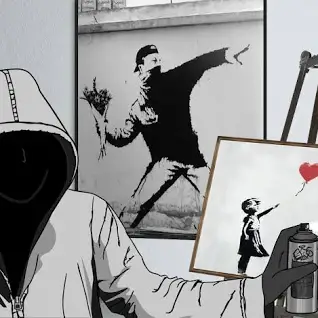
Banksy is the pseudonym of a street artist working in the United Kingdom since the 1990s who has never publicly revealed his true identity. According to the most widely accepted account, he was born around 1974 in Bristol; among the names most often proposed is Robin Gunningham, but none of these versions has been confirmed by the artist himself or established as definitive.
Banksy chose his recognizable technique — stencil graffiti — largely for practical reasons: a stencil cut in advance allows a complex, multi-layered image to be applied to a wall in a matter of minutes, which is critical for an artist working without permission and risking arrest. His subjects — rats, policemen, children, soldiers — almost always carry a sharp political or social subtext, delivered through a simple, instantly legible image.
One of his most recognizable images is "Girl with Balloon," which first appeared as a stencil in 2002 under Waterloo Bridge in London; the original stencil bore the caption "There is always hope." The image was repeated many times on walls in various cities and was released as a limited-edition print in 2004–2005.
In October 2018, a canvas bearing this image sold at Sotheby's in London for £1.04 million. The moment the hammer fell, a mechanism built into the frame unexpectedly activated, and the lower part of the canvas began to shred into narrow strips before the astonished audience — Banksy had hidden a shredder in the frame in advance, in case the painting was ever put up for auction. The half-destroyed work was renamed "Love Is in the Bin," and, against all logic, it did not lose value but became even more famous and expensive.
Three years later, in March 2021, a signed copy of the "Girl with Balloon" print with a gold balloon sold at the same Sotheby's for £1,104,000 — a new record price for a Banksy print edition.
Anonymity in his case is not merely a way to avoid responsibility for unlawful paintings on other people's walls. It has become part of the artistic statement: since the author's identity is unknown, the viewer is forced to deal only with the image itself and its meaning, without the biography, interviews, and media persona that usually accompany a famous artist. In this sense, the shredder at the auction and the concealed name are gestures of the same nature: both remove from play everything that distracts from the picture itself.
At the same time, Banksy has long outgrown the format of solitary street murals: he makes documentary films about his own art, stages large-scale temporary exhibition-provocations, and his works now appear not only on the walls of poor neighborhoods but also near zones of military conflict and natural disaster — as a statement, not merely as decoration. None of these undertakings is accompanied by a press conference featuring the author himself: announcements come only through his website and social media, without a single confirmed public appearance.
The paradox of Banksy is that the contemporary art market, built on an author's name, signature, and biography, has proven willing to pay enormous sums for the works of a man about whom, formally, nothing is known. The price in this case rests not on the reputation of a person but exclusively on the reputation of the gesture itself — and this, perhaps, best explains why a street artist who fundamentally evades the system of galleries and auctions has become one of the most expensive figures in that very market.