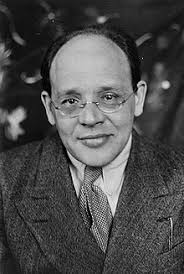
A Russian Soviet writer, journalist, and playwright, best known for his Odessa Stories and for Red Cavalry, the story cycle about Budyonny's First Cavalry Army. He was born in Odessa, the son of a Jewish tradesman.
The turn of the century was a time of civil unrest and of mass Jewish emigration from the Russian Empire. Babel himself lived through the pogrom of 1905 — a Christian family hid him — while his grandfather Shoyl was among the three hundred Jews killed.
To enter the preparatory class of the Nicholas I Commercial School in Odessa, Babel had to clear the quota on Jewish students (ten percent within the Pale of Settlement, five percent outside it, three percent in the two capitals); and though his marks entitled him to a place, it went to another boy whose parents had bribed the school's administration. In a single year of schooling at home Babel covered the curriculum of two grades; alongside the usual subjects he studied the Talmud and pursued music. After one more failed attempt to enter the University of Odessa — the quotas again — he landed at the Kiev Institute of Finance and Business. There he met his future wife, Yevgenia Gronfein.
Fluent in Yiddish, Russian, and French, Babel wrote his first pieces in French, but they have not survived. His first stories in Russian appeared in the journal Letopis. Then, on Gorky's advice, he "went out among the people" and passed through a string of trades. In 1920 he served as a soldier and political officer in the Cavalry Army, and in 1924 he published a series of stories that would later form the cycles Red Cavalry and Odessa Stories.
Babel had a masterly gift for carrying over into Russian the style of literature written in Yiddish — most visibly in the Odessa Stories, where the direct speech of his characters is at times a word-for-word translation from the Yiddish. Soviet critics of the day, while granting his talent and the significance of his work, pointed to his "antipathy to the cause of the working class" and reproached him for "naturalism, an apology for the elemental principle, and the romanticization of banditry."
In the Odessa Stories Babel paints, in a romantic key, the life of Jewish criminals in the early twentieth century, finding exotic color and strong characters in the daily round of thieves and raiders, and of artisans and petty traders too. In 1928 he published the play Sunset, staged at the Second Moscow Art Theatre, and in 1935 the play Maria. He also wrote several screenplays.
A master of the short story, Babel strove for concision and precision, joining in his characters, his plots, and his descriptions an enormous temperament to an outward impassivity. The florid, metaphor-laden language of his early stories later gave way to a spare and restrained narrative manner.
In May 1939 Babel was arrested on charges of "anti-Soviet conspiratorial terrorist activity," and on 27 January 1940 he was shot. In 1954 he was posthumously rehabilitated.
Babel's work exerted an enormous influence on the writers of the so-called South Russian school — Ilf, Petrov, Olesha, Kataev, Paustovsky, Svetlov, Bagritsky — and won wide recognition in the Soviet Union; his books have been translated into many languages.