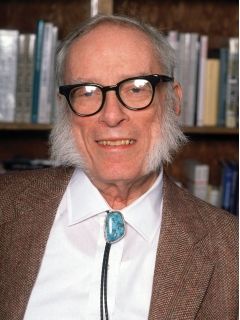
Isaac Asimov wrote more than five hundred books — on physics, chemistry, biology, history, biblical scholarship, humor, detective fiction, and, of course, science fiction. He never tired of it, because writing was his way of breathing.
He was born in 1920 in Petrovichi, in the Smolensk region, to a Jewish family that emigrated to New York when he was three. His father kept a candy store; Isaac read everything he could lay hands on. At nineteen he sold his first story to Astounding Science Fiction.
I, Robot, the story collection in which the Three Laws of Robotics were formulated, is more than science fiction: it is ethics cast in the form of a puzzle. Foundation is a cycle about scientists trying to shorten the dark age that follows the fall of a galactic civilization from thirty thousand years to a single thousand — science as an instrument of compassion.
Asimov almost never left the house; he was agoraphobic. He wrote eight hours a day, on a typewriter and later on a computer. He died in 1992 of HIV, contracted through a blood transfusion during heart surgery. To the end of his life he said his greatest fear was to die without having read all the books he still meant to read.