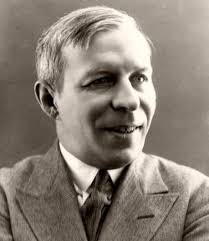
Nikolai Aseyev was born in 1889 in the town of Lgov in Kursk province. Before the First World War he had managed to become part of several literary associations — first "Lyrica" in Moscow, then the group "Centrifuge," where the young Boris Pasternak found himself alongside him. Both were then experimenting with sound, rhythm, word-creation. But his true alliance — with Mayakovsky — took shape a little later and determined the whole subsequent fate of Aseyev.
After the revolution and the Civil War, Aseyev found himself in Vladivostok: he spent several years in the Far East together with other Futurist poets before returning to Moscow. From the early 1920s he was at the center of the leftist literary movement: LEF — the Left Front of the Arts, founded by Mayakovsky — and its journals, in which Aseyev published regularly. ROSTA — the Russian Telegraph Agency, which put out agitational posters — became one of their common projects. This was poetry that understood itself as an instrument: direct, effective, without ornament.
In 1927 he wrote "The Blue Hussars" — a poem about the Decembrists, about men who went against the authorities out of conviction and lost. It is one of the few of his works that holds up not as a document of its era but as a living text. In it there is what most Soviet poetry of the 1920s lacked: a sense of cost. The Decembrists in Aseyev are neither victors nor victims, but people who knew what they were risking and made their choice all the same. After the Party, at the end of the 1920s, demanded of poets "clarity" and "popular accessibility," this tone was already harder to sustain.
On 14 April 1930 Mayakovsky shot himself. Aseyev was among the first to come to him. That day changed his position in the Soviet literary hierarchy: from a comrade-in-arms he turned into a keeper of memory. The role was not an easy one. Official culture quickly adapted Mayakovsky to its own needs: it made a monument of him, out of his rebellion an official rhetoric, out of his stanzas obligatory quotations. Aseyev lived beside this, at times took part in it, at times — from within, not openly — resisted it.
The result was the poem "Mayakovsky Begins" (1940) — a large biographical text attempting to show the living Mayakovsky, and not his bronze version. In 1941 the poem received the Stalin Prize, First Class. This is at once a recognition and a trap: the state rewarded a book about a rebel, thereby inscribing it once and for all into the pantheon. Mayakovsky remained in it a state poet — even in the attempt to bring him back from that condition. Aseyev himself understood this contradiction — or at the least lived inside it.
The rest of his life he spent as a recognized Soviet poet — with awards, posts, official commissions. His early poetry — rhythmically inventive, with a genuine Futurist energy — remained in the past; the later was simpler and more cautious. He outlived Mayakovsky by thirty-three years and died in 1963 in Moscow. The question of what it means to be honest toward the memory of one whom the system has digested — this question his poem did not resolve. But it posed it more precisely than all the official Mayakovsky scholarship put together.
His fate is a question about the price of loyalty. Aseyev was not a conformist in the simple sense: he sincerely believed in the revolution and in poetry's capacity to be its instrument. But the system he served gradually substituted form for content, the revolution for its image. A man who knows how to fit himself in risks discovering, at some moment, that he has fitted himself into a void. "Mayakovsky Begins" is a book about a beginning that with each decade receded ever further. Aseyev wrote it when he himself stood in the middle.