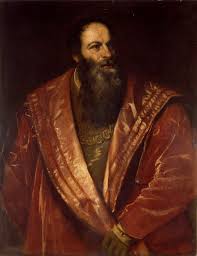
Pietro Aretino (1492-1556), the Italian writer, was born in the Tuscan town of Arezzo, the son of a poor shoemaker. He spent his youth in Perugia, where he tried his hand at painting, and then made his way to Rome. There his turbulent career began in the household of Agostino Chigi, the richest of the Roman bankers. Shortly before the death of Leo X he gained entry to the Vatican and caught the pope's eye; by then he was already famous as the author of a stream of witty and malicious pasquinades that mocked one papal courtier after another. When Chigi and Leo X were both dead, Aretino had to flee Rome: the new pope, Adrian VI, badly stung by his verses during the conclave, meant to deal with him in earnest. A year later, when Adrian gave way to Clement VII (1523), Aretino returned, counting on the new pope's protection. He miscalculated. Having imprudently entangled himself in court intrigues, he took several dagger wounds, and finding the pope in no hurry to stand up for him, left Rome once more. In 1527 he settled in Venice, and there a life began quite unlike anything he had known. His fame grew, and with fame came wealth; to the end of his days he lived among friends — Titian, Jacopo Sansovino — surrounded by pupils, admirers, hangers-on and mistresses, like a true grandee. In Venice he died.
Aretino was the first major European writer to make his position entirely by literary talent and literary adroitness. His fortune was built on his literary earnings, though those earnings were sometimes of a rather peculiar kind. Before him, a writer could subsist only at the court of some petty prince or magnate, and his work had to be the glorification of his protector. Aretino renounced protectors, quit the courts, scorned the patrons, and became a free publicist — and it is in his journalism that his chief literary significance lies. He was enormously prolific, writing in verse and in prose: heroic poems, comedies, a single tragedy, lyric poetry of every kind, lives of saints, dialogues of every kind — including frankly pornographic ones — giudizii, or satirical prognostications, and above all letters. The letters and the giudizii alike are concentrated, brilliant pamphlets, brief but forceful: journalism in the true sense. In the power of their influence on society, they amount to a major public force not only in Italian but in European life, and they mark a distinct stage in the evolution of social relations. Aretino's Venetian period coincided with the Catholic and feudal reaction in Italy. Free thought had been crushed; trade and industry were in decline, and the bourgeoisie was steadily losing its footing. Venice remained a solitary island where everything survived that was left of the recent flowering of science, letters and art, and only from Venice could the Italian bourgeoisie defend its positions and attempt to win new ones. Aretino was, in the fullest sense, the leader of the Italian bourgeois intelligentsia. He fought in the name of freedom of thought and human dignity, and he was not afraid to take on monarchs great and small, loosing his savage satires at Francis I of France, at the Emperor Charles V, and at such Italian tyrants as had not yet been rooted out. True, his immediate aim was baldly mercenary; in that respect he was without principles of any kind. But even as he extorted and blackmailed, he was asserting the power of journalism — by means his age did not yet count impermissible.
Of his other works, the tragedy Orazia and his five comedies — Marescalco, Cortigiana, Ipocrito, Filosofo, Talanta — enjoyed the greatest popularity in his lifetime, the comedies above all. In them, as in the dialogues Raggionamenti, notorious for their indecency, Aretino displays a rich plastic gift: a knack for moulding figures, for vivid pictures of daily life, for genre scenes. Another side of his talent, less visible to his contemporaries than to posterity, was his capacity to appreciate works of art, and with it the ability to render in words the language of line, colour and chiaroscuro. He had a painter's eye and the genuine gift of an art critic. He cultivated neither, and so his writings preserve only occasional — though extraordinarily vivid — traces of these qualities.