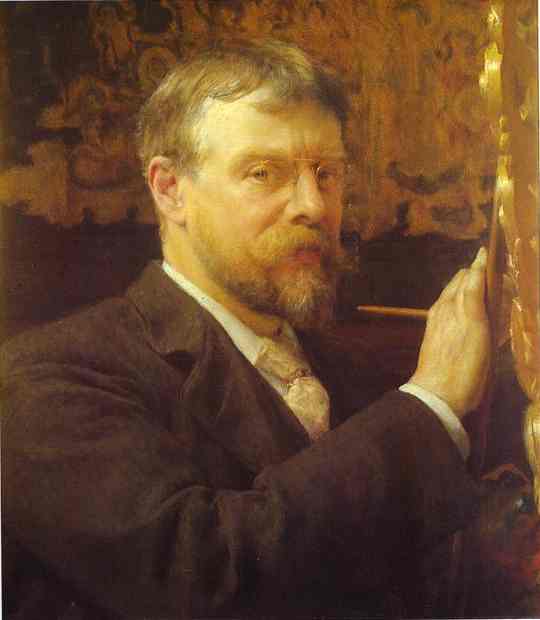
Sir Lawrence Alma-Tadema (8 January 1836, Dronrijp, the Netherlands – 25 June 1912, Wiesbaden, Germany) was a British painter of Dutch origin who devoted himself to historical subjects — one of the most popular and best-paid masters of the Victorian age.
He always presented himself as a history painter. While still a student he began drawing his subjects from the age of the Merovingians — the first dynasty of Frankish kings in the history of France — and from ancient Egypt. Of his 408 canvases at least 300 depict antiquity, yet the people in them were his contemporaries: Victorians set down amid classical scenery. This, perhaps — along with his famously exact rendering of antique detail — accounts for his popularity with critics and public alike. Honors were plentiful too. In 1899 he was knighted, an exceptional distinction for a foreign-born artist: before him it had fallen to Rubens and Van Dyck, among others. In 1904 he received the Order of Merit.
Alma-Tadema is often set, rather aggressively, against the "poor and starving" artists who passed into eternity — first, because he never starved; and second, as if in compensation for a comfortable life, because after his death he was forgotten with remarkable speed, almost immediately after the posthumous memorial exhibition.
Two things may be said in his defense. As a child he nearly died, and for a long while lived in the shadow of an expected early death. And his popularity, his "salon" polish, owed much to the fact that no one knew the periods he painted better than he did. He was devoted to history, architecture, and archaeology — he even took part in excavations — and, unlike many of his contemporaries, he never got his facts wrong.
Gossip of varying degrees of malice followed him. It was whispered that he copied his figures from photographs, adding a few touches "of his own" to put the viewer off the scent. He also numbered his paintings — what pettiness! And what a gift to today's researchers.
Among his best-known paintings: The Roses of Heliogabalus, The Baths of Caracalla, The Finding of Moses, Antony and Cleopatra, A Coign of Vantage, the Self-Portrait, Welcome Footsteps, The Harvest Festival, The Honeymoon, A Summer Offering, Courtship, The Voice of Spring, An Egyptian Juggler.
A Notary's Son
By the standards of his time the painter lived long: seventy-six years. Born in the Netherlands and trained in Belgium, he moved to Britain in 1870, and three years later received British citizenship by personal order of Queen Victoria.
He came into the world in the village of Dronrijp, in Friesland in the north of the Netherlands, the sixth child of a village notary. Lourens and Alma were the names his godfather gave him; after the move to England, Alma became part of the surname. Contemporaries murmured that he had done it so as to appear at the head of exhibition catalogues.
It was his mother who proposed painting lessons for the children — his father died when the boy was four. At first Lawrence studied with a local artist alongside his brothers, then taught himself from Leonardo da Vinci's treatise written expressly for young painters. His mother, meanwhile, had decided to make a lawyer of him, and he went without much resistance to the gymnasium at Leeuwarden, where he fell in love with history, and then with the archaeology and architecture of the ancient world. An artist, they say, chooses his own genre — but not in Tadema's case: here the historical genre appointed its own executor.
A Diagnosis, and the Making of a Perfectionist
At fifteen he was given what was then a death sentence: consumption. Believing he would soon die, Tadema redoubled his efforts to master his material, historical and painterly alike. The first school where he showed real class was the Antwerp Academy: there he tasted success, collected numerous awards, and was counted among the most gifted and diligent students. He then attended Professor Louis Jan de Taeye's courses on history and historical costume — and there the future painter's perfectionism first declared itself. Every failed sketch and study he ruthlessly destroyed, which is why so few preparatory works could be found after his death.
A year later, at sixteen, Tadema entered the Academy of Fine Arts in Antwerp, where his mentor was the Belgian Romantic painter Baron Hendrik Leys.
Belgium claimed him at twenty-six, through marriage to the daughter of a French man of letters who lived there. The honeymoon in Rome and Pompeii proved a turning point in his art: from then on, antiquity was the principal theme of his canvases.
Marie-Pauline Gressin-Dumoulin de Boisgirard often posed for her husband; anyone who studies Tadema's work learns to recognize her recurring features. The couple had three children, but this gave the master no line of descent: the only son died in childhood, and the daughters never married.
Tadema's Great Britain
His acquaintance with Ernest Gambart, the celebrated art dealer of the day, brought still more awards, orders, prizes and, of course, money. By twenty-seven he was an artist who exhibited and sold with success. Yet historians and critics date his real arrival from the move to England.
He went there, once again, not on a whim but because of illness. By then a widower — his wife had died of smallpox at thirty-two — Tadema came to England in search of a diagnosis the Belgian doctors had been unable to provide. From that point on, every landmark in his life bears a British address. There he met Laura Theresa Epps and married again. There, partly through his second wife, he entered the circle of the Pre-Raphaelites. There he became a Royal Academician; there his flowering and his years of maturity ran their course. There he was elected an honorary member of the Oxford University Dramatic Society and a full member of the Royal Society of Painters in Water Colours, though he painted comparatively little in watercolor. There his palette grew lighter and brighter. And there he bought the house that would become one of London's landmarks.
His second wife deserves a word of her own. Laura Epps — far better known under his name, as Laura Alma-Tadema — was a painter herself, and at first his pupil. She also served as his model: we see her in The Women of Amphissa, and there is a portrait of her, the painting called Interrupted. Seventeen years separated them, and her father at first opposed the match; Tadema won him over with a portrait of the Epps family.
Caught in the Blast
Around Tadema there reigned a phenomenon inexplicable by atheism or by the laws of physics: explosions pursued him. The first incident came in 1866, caused by a gas leak in the house of his eminent patron Gambart; the result was a nervous shock from which the artist's first wife never recovered for the rest of her life. In 1874 the explosion of a gunpowder barge on the Regent's Canal in London destroyed Tadema's own house — he and his family had the good fortune to be out visiting at the time. His daughters from the first marriage were less lucky: the blast threw them from the windows, though without serious injury. Miraculously, not a single painting was harmed.
Travels, in Life and After
Tadema was no homebody. He crossed and recrossed Europe almost without pause: excavations at Pompeii (a favorite and frequent occupation), exhibitions in Paris and Brussels, and, of course, Rome. Wiesbaden came only at the end, when his daughter took him there so that German doctors could treat his stomach ulcer — the second fateful episode in his life to turn on illness, for it was ill health, as we recall, that had first brought him to England, the country of his zenith. Germany became the third and final entry on his list of migrations, the country of his departure. He outlived his second wife by only three years, never recovering from the wound of her death. On 28 June 1912 Tadema died in Wiesbaden. He was buried in England, the country of his fame; his remains rest in St Paul's Cathedral in London, beside the grave of Anthony van Dyck.
Why He Was Loved
The popularity of his paintings had its own logic. Victorian mores prescribed not only the one correct way to behave but the one — or almost the one — correct genre. Alma-Tadema's genre and his light-filled palette quickly found admirers among the devotees of classicism and neoclassicism, since in the England of those days to love anything else was simply not done. Even as the Victorian age waned, he changed nothing. New movements arose and flourished — Impressionism, Fauvism, Cubism, Futurism, Post-Impressionism — and the artist, understanding and respecting them, held rigidly to his own calling. The public liked him for it.
Another guarantee of his popularity was work in the "applied" branch of a neighboring art: Tadema was in steady demand as a theatrical designer. London's Lyceum Theatre entrusted him chiefly with Shakespeare, with exceptions such as the 1901 production of Coriolanus for Henry Irving.
Why He Was Rich
Tadema was a craftsman in the best sense of the word. He not only commanded the technique of classical painting to perfection; he made sure that no practical discovery of his went to waste. Whatever succeeded in his stage designs or illustrations he transferred to canvas, and he painted variant versions of his subjects. So arose The Baths of Caracalla (formerly a stage set) and Ask Me No More (formerly an illustration to a poem by Alfred Tennyson).
An artist's fortunes, moreover, are made by his buyers, and Tadema's included the American millionaire William Vanderbilt. His work sold well on the American continent generally, not only in Europe.
A Legacy That Bypassed the Heiresses
At his death Tadema left, in today's English money, some five million pounds. Everything else — the unsold paintings, his library of 4,000 books, his collection of 5,000 photographs — passed to humanity at large. The museum in Leeuwarden, the town of his childhood, received only a small share of his small-format works. His daughters inherited a hundred pounds each, along with their father's furniture and personal effects. A peculiar man, all the same.
Most of his paintings now hang in the Rijksmuseum in Amsterdam and the Musée du Luxembourg in Paris; the books and photographs went to the Victoria and Albert Museum in London.
His house, a genuine London landmark, was put up for sale, but for a long time no buyer could be found for so extraordinary a property. The mansion suffered the ignominious fate of a block of rental flats, in which not one of the interiors its former owner had decorated with such love and at such expense survived. The house still stands at 44 Grove End Road, St John's Wood, with a memorial plaque on its wall.
Forgotten?
In the 1960s a joke went around about a thief who stole some Tademas and shot himself in despair of ever selling them. The joke lasted a decade: by the 1970s his paintings were rising in price again. Fashion!
In 2017, more than a century after the artist's death, a major retrospective toured Europe with success: "Alma-Tadema: Classical Charm." And The Finding of Moses, sold at Sotheby's in New York in 2010 for 36 million dollars, holds the record for a painting of the Victorian era.